BuildPhysics

AP Physics 1 · Unit 3 · Work, Energy, and Power

Work and Kinetic Energy

Change a force and its direction, measure the resulting motion, and connect net work with the change in kinetic energy.

Start lesson
  • Free
  • No account required
  • Self-paced
Work and Kinetic Energy guided lesson preview Start guided lesson
Explore the model. Make predictions. Check your thinking.

Learn by doing

Three ideas you’ll put into motion

Identify work

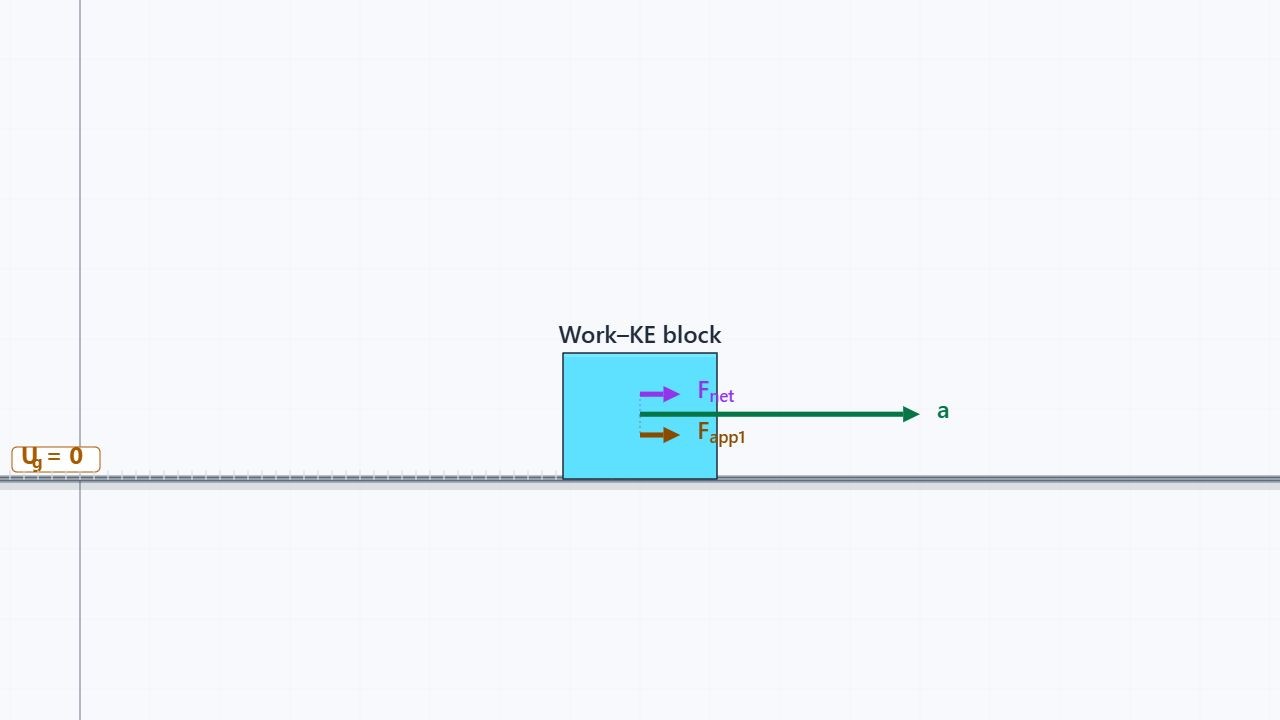
Compare forces parallel, opposite, and perpendicular to a displacement.

Connect work and speed

Use the net work to predict a change in kinetic energy.

Test the relationship

Compare simulation measurements with an energy-based prediction.

The big idea

The key ideas, at a glance.

Work depends on direction

For a constant force, W = Fd cos θ. Only its component along the displacement contributes to work.

Net work changes kinetic energy

The work–kinetic energy theorem gives Wnet = ΔK. Translational kinetic energy is K = ½mv2.

A quick comparison

Double an object’s speed while keeping its mass fixed.

Its translational kinetic energy becomes four times as large.

speed vspeed 2vSame mass → four times the kinetic energy
Teaching this topic?Classroom fit, AP connections, and support
Classroom fit
Use for a concept introduction, guided independent practice, or a projected class discussion.
Before students begin
Force vectors, displacement, basic trigonometry, and squared quantities.
Built-in support
Prepared scenes, guided prompts, and feedback on lesson questions.
AP Physics 1 connections
Unit 3: work, kinetic energy, and energy-based predictions.
Check for understanding
Ask why a force perpendicular to displacement does zero work on that displacement.
Meet the educator behind Build Physics

Ready to test your thinking?

The first scene is set up. Start the lesson and explore.

Start lesson