
Plan the investigation
What students will do
Start with a guided comparison, then plan an investigation, analyze a graph, and check a prediction.
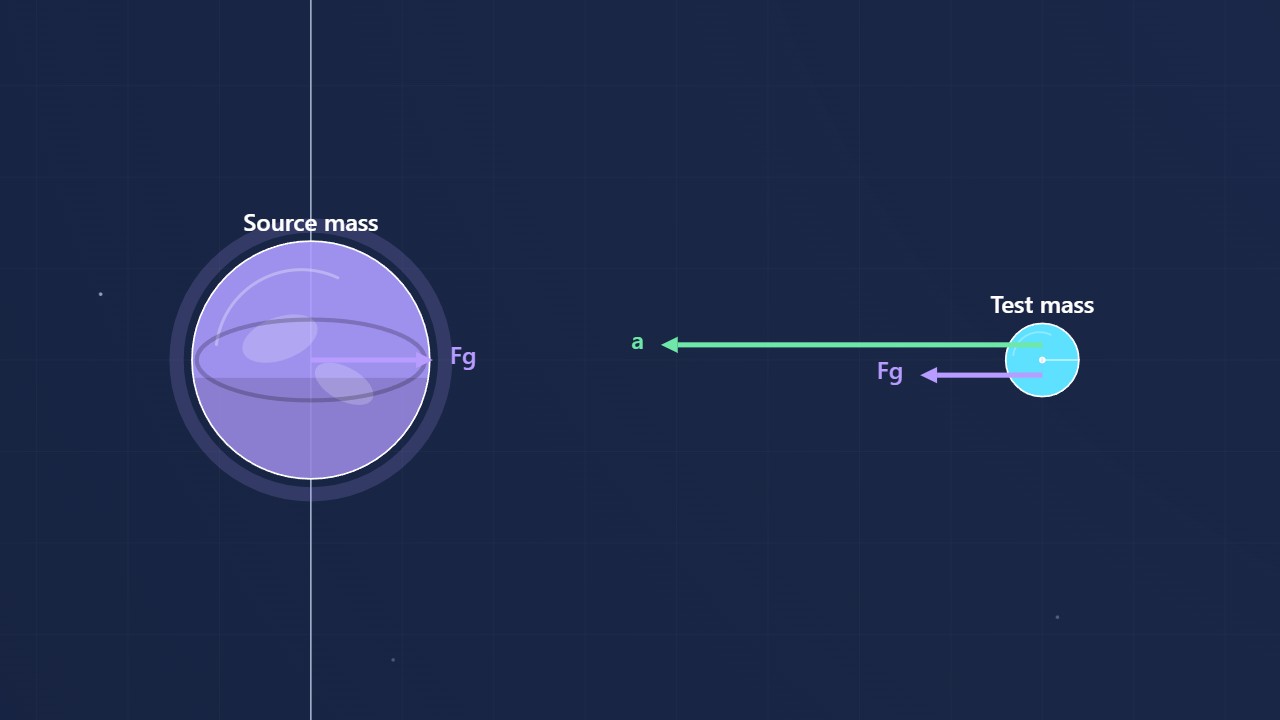
- Compare test masses. Keep separation and central mass fixed. Read gravitational force and acceleration for different test masses without running.
- Design and collect. Choose at least five center-to-center separations with both masses fixed. Measure the force at each starting position.
- Linearize the data. Transform force and separation to form a straight line. Use the best-fit slope to estimate the gravitational constant.
- Explain and predict. Evaluate the inverse-square relationship, then predict and check the force at an unused separation.
What students will learn
- Distinguish gravitational force from gravitational acceleration.
- Use center-to-center separation in an inverse-square model.
- Infer a physical constant from transformed graph data.
Common misconception
Does doubling separation halve gravitational force?
Students test an inverse-square dependence using controlled distance measurements.