
Plan the investigation
What speed makes gravity turn without pulling inward?
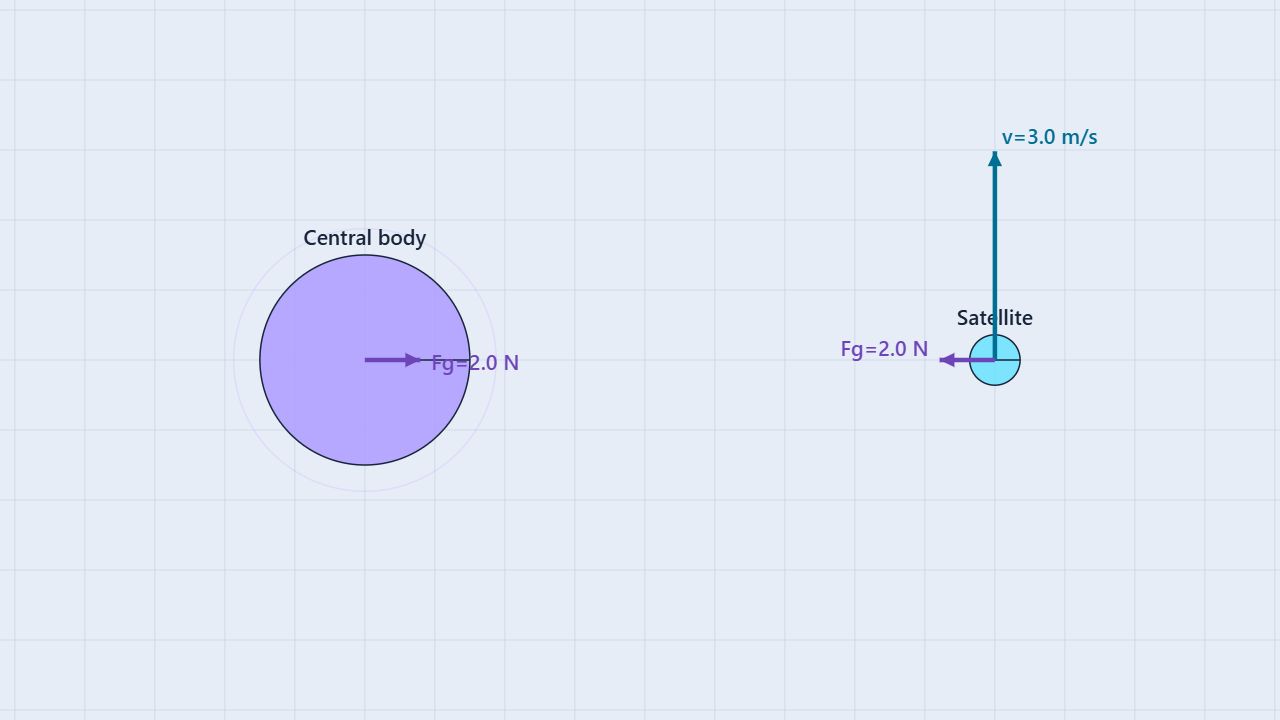
A circular orbit requires gravity to provide exactly the inward net force needed to turn the satellite’s velocity. The satellite starts 4.5 m to the right of the central body with a tangential velocity upward on screen. World gravity and drag are zero; only the central body’s inverse-square attraction acts.
Fg = GMm/r²
Fg = mac = mv²/r
vcirc = √(GM/r)
Change
Change orbital radius, tangential launch speed, or central-body mass one at a time. Restore a tangential direction after each reset.
Measure and compare
Record center-to-center radius, speed, gravitational-force magnitude, and period. A circular trial keeps radius and speed nearly constant.
The compact simulation uses GM = G M = 40 m³/s² rather than Earth’s physical scale. That makes the relationships easy to measure while preserving the inverse-square model.
Build the model
Set gravity equal to the required inward force
For a satellite of mass m at radius r, gravity points toward the central body. In a circular orbit, speed stays constant but velocity changes direction, so acceleration is nonzero and points inward.
GMm/r² = mv²/r
v² = GM/r
T = 2πr/v = 2π√(r³/GM)
The satellite mass cancels from the circular-speed equation. Changing satellite mass changes both the gravitational force and the required net force by the same factor, so the ideal circular speed stays the same at a fixed radius and central mass.
Use center-to-center distance for r. The visible radius of the central body is not the orbital radius, and the orbital speed is tangent to the path rather than directed toward the center.
Procedure
Find and test the circular speed
- Load and inspect. Launch the Circular Orbit simulation and keep the prepared central body and satellite. Confirm World gravity and drag are zero and the satellite begins 4.5 m from the center.
- Calculate the prediction. Use GM = 40 m³/s² and r = 4.5 m to calculate vcirc, ac, Fg, and the period before running.
- Set tangent velocity. Select the satellite in Properties. At the rightmost starting point, set vx = 0 and vy = +2.981 m/s. A radial launch component would change the orbit immediately.
- Choose measurements. Show the trail and vector values. In Data, record central radius, speed, and central gravitational-force magnitude at several times after the satellite begins moving.
- Run several periods. Use a run long enough for at least two returns to the starting direction. A circular trial should keep r and speed nearly constant while the velocity and acceleration directions rotate.
- Test a lower speed. Reset and use 80% of the circular speed. Predict an inward-curving, noncircular path and compare the minimum radius with the baseline.
- Test a higher speed. Reset and use 120% of the circular speed. Predict an outward-curving path. Keep the speed below escape speed when you want a bound ellipse rather than an unbound trajectory.
- Change one parameter. Repeat at a different radius or central mass. Recalculate the required speed instead of reusing the old value.
| Quantity | Prediction | Meaning |
|---|---|---|
| Circular speed | 2.981 m/s | Tangential speed required to hold r constant |
| Inward acceleration | 1.975 m/s² | Velocity direction changes continuously |
| Gravitational force | 1.975 N | Only inward net force in this model |
| Orbital period | 9.483 s | Time for one 2π revolution |
Change the radius
At a larger radius, circular speed falls
Keep GM = 40 m³/s² and m = 1 kg, move the satellite to a new radius, and set the corresponding tangential speed. The force falls with 1/r² while the required circular speed falls with 1/√r.
| Radius (m) | vcirc (m/s) | Fg (N) | Period (s) |
|---|---|---|---|
| 3.00 | 3.651 | 4.444 | 5.153 |
| 4.50 | 2.981 | 1.975 | 9.483 |
| 6.00 | 2.582 | 1.111 | 14.590 |
Do not compare force values without recording the radius. A satellite farther out needs less inward force, but it also travels a longer circumference and has a longer period.
Worked example
Check the prepared 4.5 m orbit
For GM = 40 m³/s², r = 4.5 m, and m = 1 kg:
vcirc = √(40/4.5) = 2.981 m/s
ac = v²/r = 8.8889/4.5 = 1.975 m/s² inward
Fg = GMm/r² = 40/20.25 = 1.975 N inward
T = 2π(4.5)/2.981 = 9.483 s
The equal numerical values of force and acceleration here are a consequence of m = 1 kg. Their units and meanings remain different. If the satellite mass changes to 2 kg, the force becomes 3.951 N, but the circular speed and acceleration at the same radius stay 2.981 m/s and 1.975 m/s².
Classify the path
One radius has one circular speed
At r = 4.5 m, the circular speed is about 2.981 m/s and the escape speed is √2 times larger, about 4.216 m/s. A tangential launch below circular speed curves inward first; a launch above circular speed but below escape speed produces a bound ellipse; a launch at escape speed is the ideal boundary between bound and unbound motion.
Too slow
Gravity bends the path inward more sharply than a circular path. The satellite moves toward a smaller radius and speeds up.
Too fast
The satellite moves outward first. Gravity still acts inward, but it is not enough to maintain the original radius.
The circular case is the special orbit in which the radial distance and speed remain constant. It is also the limiting case where the ellipse’s two apsides have the same radius.
Energy connection
Check circular motion with orbital energy
With gravitational potential energy zero at infinite separation:
Ug = −GMm/r
K = ½mv²
E = K + Ug = −GMm/(2r) for a circular orbit
For the prepared orbit, Ug = −8.889 J, K = 4.444 J, and total energy E = −4.444 J. Negative total energy indicates a bound orbit; it does not mean speed or kinetic energy is negative.
Common misconceptions
Check the reasoning
Is centripetal force an extra force?
No. “Centripetal” describes the inward net-force role. In this experiment, the real gravitational force supplies it.
Does constant speed mean zero acceleration?
No. Acceleration also measures a change in velocity direction. Circular motion has inward acceleration even when speed is constant.
Does gravity turn off at the side of the orbit?
No. Gravity always points toward the central body and continuously turns the velocity.
Does the satellite’s mass determine the circular speed?
No. Satellite mass cancels from vcirc = √(GM/r). It changes force and momentum, not ideal circular speed at fixed radius.
Is the visible central-body radius the orbital radius?
No. Use the center-to-center distance between the central body and satellite.
For teachers
Make the squared and inverse-square relationships visible
Have students calculate the baseline before running. Then compare radius trials by plotting v² against 1/r and gravitational force against 1/r². The first plot should be linear with slope GM; the second should be linear with slope GMm.
Change satellite mass at fixed radius as a deliberate cancellation test. Students should see force double while circular speed and acceleration remain unchanged. Follow with 80%, 100%, and 120% of circular speed to classify inward-curving, circular, and outward-curving starts.
Continue with Elliptical Orbit to track changing speed and energy, or Uniform Circular Motion to isolate tension as the inward force. Review Conservation of Energy for the bound-orbit energy check.
Physics reference: OpenStax, University Physics Volume 1, §13.4. Learn about the educator behind these simulations on the BuildPhysics About page.