
Plan the investigation
How does launch speed reshape an orbit?
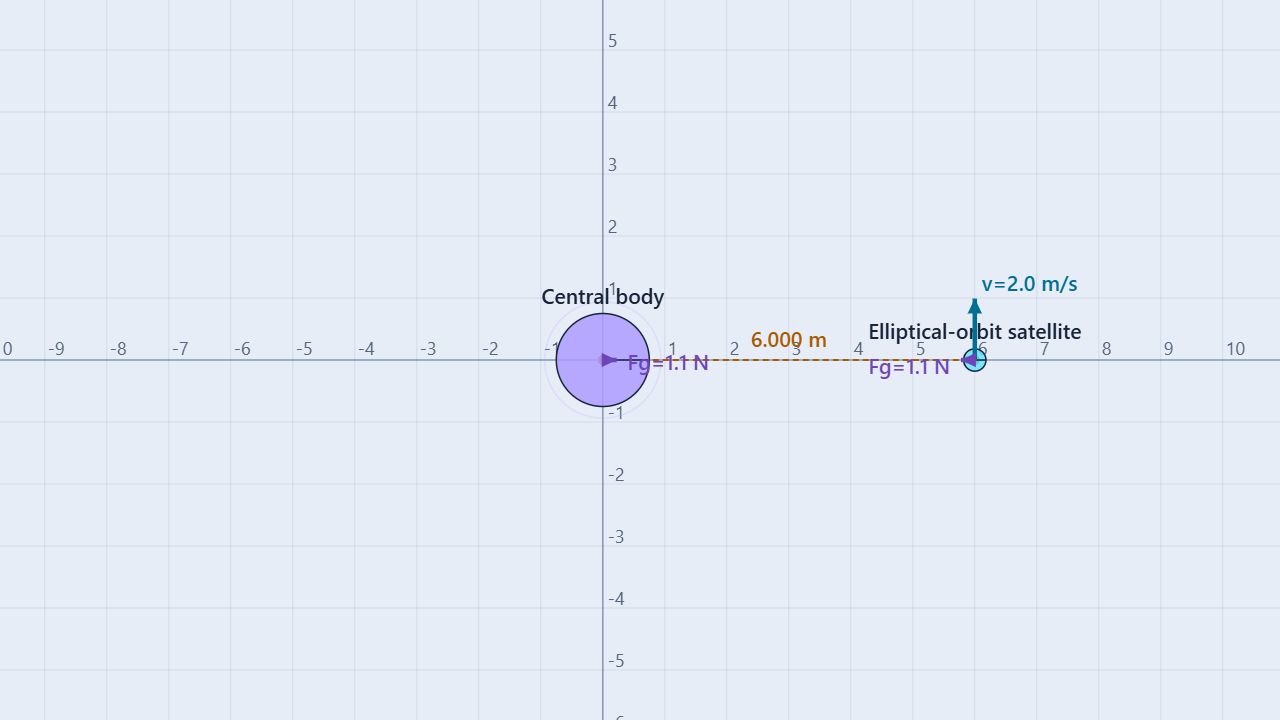
The preset starts a 1 kg satellite at (6, 0) m around a central body at the origin. Its initial velocity points upward, perpendicular to the starting radius. The intended orbit has apoapsis 6 m and periapsis 2.5 m.
Change
Initial tangential speed: 1.8, 2.0, 2.2, 2.4, and 2.5 m/s.
Keep fixed
Starting radius 6 m, satellite mass 1 kg, central-body mass, zero radial velocity, and no drag or applied forces.
The model uses G = 6.67430 × 10⁻¹¹ and central mass about 5.99314 × 10¹¹ kg, giving GM ≈ 40 m³/s². These compact simulation dimensions are not Earth’s physical parameters. Keep uniform World gravity at zero; attraction to the central body supplies gravity here.
Build the model
Use inverse-square gravity
F = GMm/r²
U = −GMm/r
E = ½mv² − GMm/r
Here r is center-to-center distance, and gravitational potential energy is zero at infinite separation. Do not use mgh across an orbit where gravitational acceleration changes substantially.
For a bound ellipse, define the semimajor axis a = (rₐ + rₚ)/2. Then:
E = −GMm/(2a)
v² = GM(2/r − 1/a)
At the two apsides: rₐvₐ = rₚvₚ
The last equality uses the fact that velocity is perpendicular to the radius at closest and farthest approach. At other points, angular momentum depends on the perpendicular velocity component, not the full speed alone.
Procedure
A useful five-trial workflow
- Load and inspect. Launch the simulation and choose Elliptical orbit if a saved scene appears. Confirm uniform World gravity and drag are zero. Preserve the central body and its gravitational attraction.
- Set tangential velocity. Open Properties and select Elliptical-orbit satellite. At the original position (6, 0), set initial x velocity to zero and y velocity to +1.8 m/s.
- Predict and run. Calculate the expected periapsis radius. Set a 15-second run duration beside Play to include a complete orbit for these trial speeds.
- Read the closest approach. With the satellite selected, open the Data panel. The preset graphs central radius, speed, and central gravitational force. Find the first minimum radius and record its time, radius, speed, and force. Compare with the starting apoapsis.
- Reset and repeat. Reset before entering +2.0, +2.2, +2.4, and +2.5 m/s for initial y velocity. Restore the same position and zero x velocity. Export CSV to compare the first orbit of each trial.
| Launch speed (m/s) | Periapsis radius (m) | Periapsis speed (m/s) |
|---|---|---|
| 1.80 | 1.926 | 5.607 |
| 2.00 | 2.571 | 4.667 |
| 2.20 | 3.419 | 3.861 |
| 2.40 | 4.563 | 3.156 |
| 2.50 | 5.294 | 2.833 |
All five speeds are below the circular speed at 6 m, √(40/6) ≈ 2.582 m/s. The starting point is therefore apoapsis, and increasing launch speed makes these orbits closer to circular. A sampled minimum may miss the exact apsis slightly; record the actual row rather than assuming an exact theoretical position.
Worked example
Check the prepared 6 m by 2.5 m orbit
The semimajor axis is (6 + 2.5)/2 = 4.25 m.
vₐ = √[40(2/6 − 1/4.25)] ≈ 1.980 m/s
vₚ = (6/2.5)vₐ ≈ 4.753 m/s
E = −40/(2 × 4.25) ≈ −4.706 J
At apoapsis, U ≈ −6.667 J and K ≈ 1.961 J. At periapsis, U = −16.000 J and K ≈ 11.294 J. Their sum is the same: the increased kinetic energy comes from a decrease in gravitational potential energy.
The force rises from 40/6² ≈ 1.111 N to 40/2.5² = 6.400 N. The force ratio is (6/2.5)² = 5.76, while the speed ratio is 6/2.5 = 2.4.
Common misconception
Is the central body at the ellipse’s center?
No. In the fixed-central-body approximation, it is at one focus. A circular orbit is the special case where the foci coincide.
Does conserved energy imply constant speed?
No. Kinetic and potential energy exchange continuously. The sum can stay constant while speed changes.
Does gravity turn off when the satellite moves away?
No. Attraction continues toward the central body, slowing the outward motion. The force becomes weaker with increasing radius.
Does a negative orbital energy mean negative speed?
No. Negative total energy means a bound orbit under the zero-at-infinity convention. Kinetic energy remains nonnegative.
Predict before running
What happens above circular speed?
At the same radius, compare circular speed 2.582 m/s with escape speed √(80/6) ≈ 3.651 m/s.
Reveal the ideal classification
A purely tangential launch between these speeds gives a bound ellipse with the starting point at periapsis. At escape speed the ideal path is parabolic; above it, hyperbolic. These predictions assume no collision or additional forces.
For teachers
Test two conservation laws
Compare E = ½mv² − GMm/r at several samples. At the two apsides, compare rv; elsewhere use the magnitude of r × v. A central force has zero torque about the center, explaining angular-momentum conservation and equal areas swept in equal times.
Compare only uncollided trajectories. Lower launch speeds can drive the satellite into the central body; a collision ends the assumptions behind the orbit prediction. Use measured center distances rather than surface clearance.
Continue with the Circular Orbit experiment and review Conservation of Energy. Physics reference: OpenStax, University Physics Volume 1, §13.5. Learn about the educator behind the simulations on the BuildPhysics About page.