Set the system boundary
Identify what belongs to the system and which interactions transfer energy across its boundary.
 BuildPhysics
AP Physics 1 · Unit 3 · Work, Energy, and Power
Add external work and friction to an energy model. Track where energy enters, leaves, or changes form during motion.
Start lesson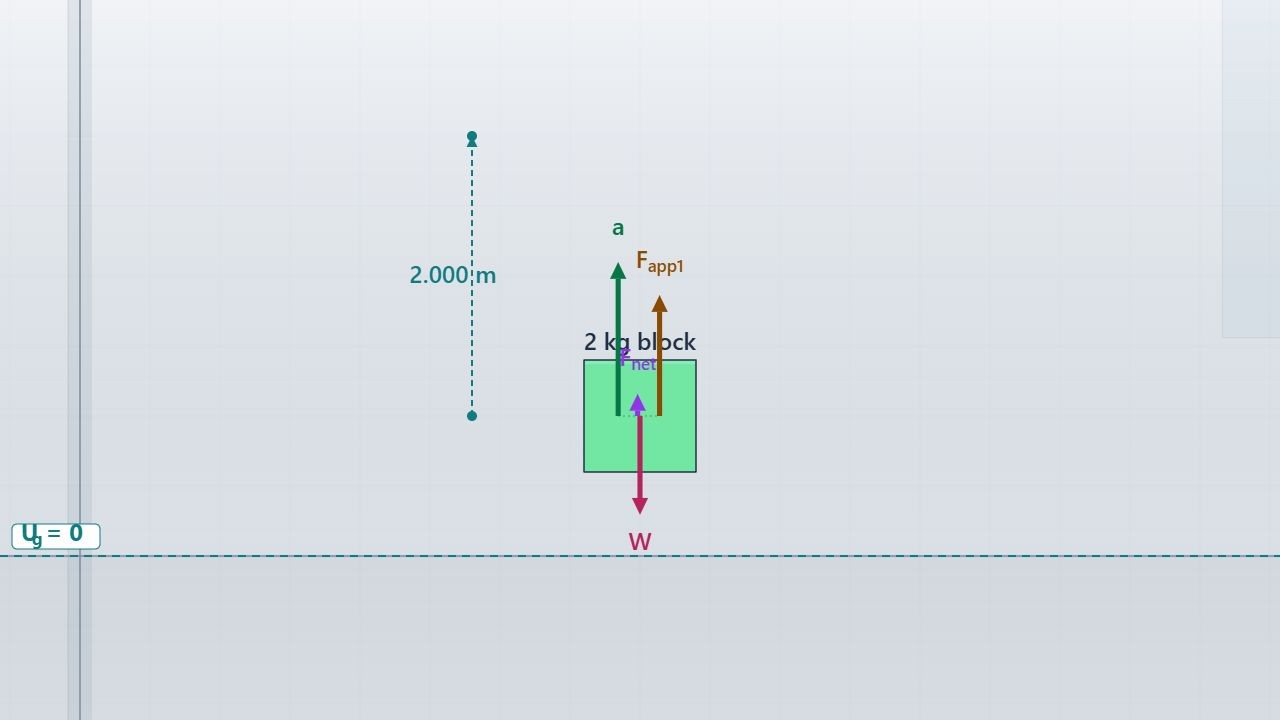 Start guided lesson
Learn by doing
Identify what belongs to the system and which interactions transfer energy across its boundary.
Compare positive and negative work with changes in the system’s energy.
Explain why mechanical energy can decrease while total energy is still accounted for.
The big idea
An external force can transfer energy into or out of a system. Its work sign depends on the force and displacement directions.
Friction can transfer mechanical energy into thermal energy. Choose the system before deciding whether to describe that transfer as external work or an internal change.
A quick comparison
An external force opposes an object’s displacement.
Its work on the object is negative.
The first scene is set up. Start the lesson and explore.