Choose an energy system
Decide which objects and energy stores to include. Account for gravity, a spring, and work by forces outside the chosen system without counting an interaction twice.
 BuildPhysics
AP Physics 1 · Unit 3 · Energy
Extend energy calculations to motors, resistance, and springs. Compare smooth and rough routes, then solve stopping tracks, connected ramps, and powered uphill motion.
12 questions6 conceptual · 6 calculation
Start practiceFree · No account required · Self-paced
 Open interactive practice
What you’ll practice
Decide which objects and energy stores to include. Account for gravity, a spring, and work by forces outside the chosen system without counting an interaction twice.
Use motor or resistance work with kinetic, gravitational, and elastic-energy changes. Find stopping distance, final speed, or required motor work.
Analyze slides with the same drop but different friction transfers. Extend the accounting to a spring guide and a connected incline system.
A question from this set
A motor pulls a cart at constant speed along a level rough track. The motor does positive work. Must the cart–Earth system’s mechanical energy increase?
Try it in the practice setKey ideas
For a system whose mechanical stores are K, Ug, and Us, work by the other included external forces equals the change in their sum. A motor can add mechanical energy while resistance removes it.
Include the gravitational potential-energy change when Earth is part of the system. Avoid also treating the same gravitational interaction as an additional work input in that equation.
See the physics
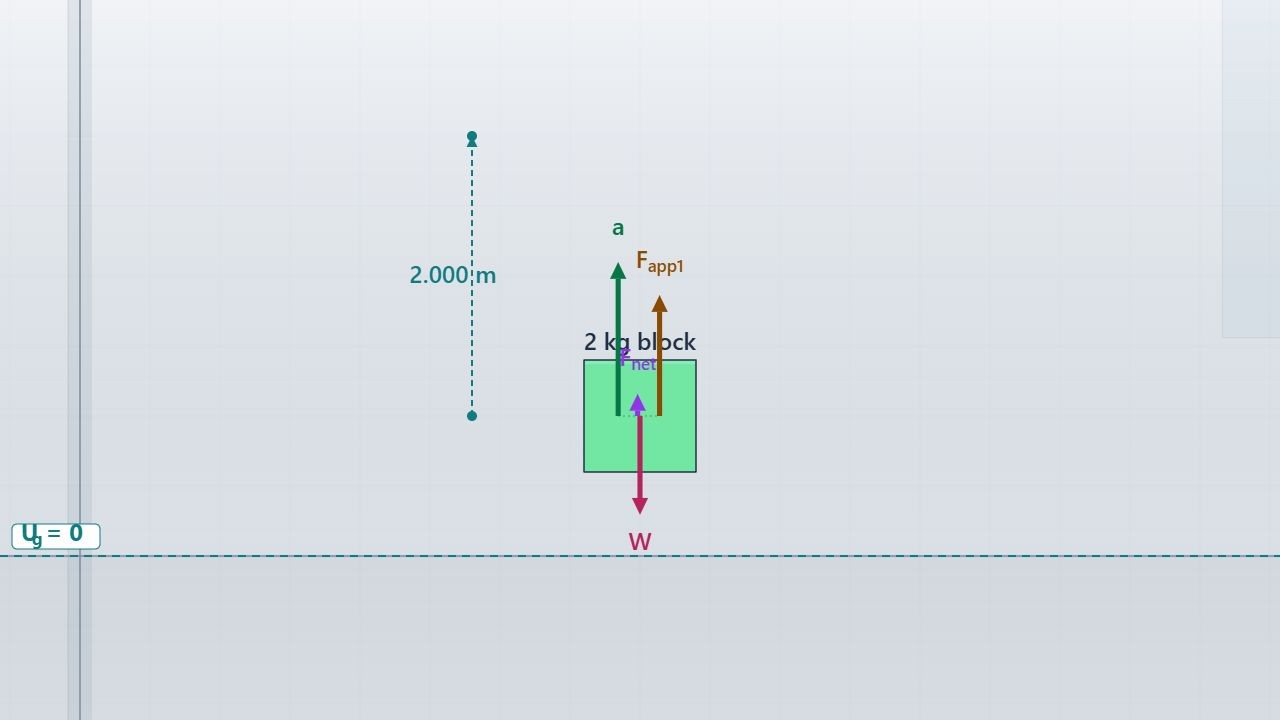
After checking each answer part, run a smooth or rough slide, a spring launch, or a motor-driven cart. Compare motor and resistance work with kinetic and potential-energy records.
Use a hint for a starting point or open a worked solution to follow the reasoning. Your progress saves in this browser, so you can return to unfinished questions.
Begin with a conceptual question, then work through the calculations.