BuildPhysics

AP Physics 1 · Unit 3 · Work, Energy, and Power

Conservation of Mechanical Energy

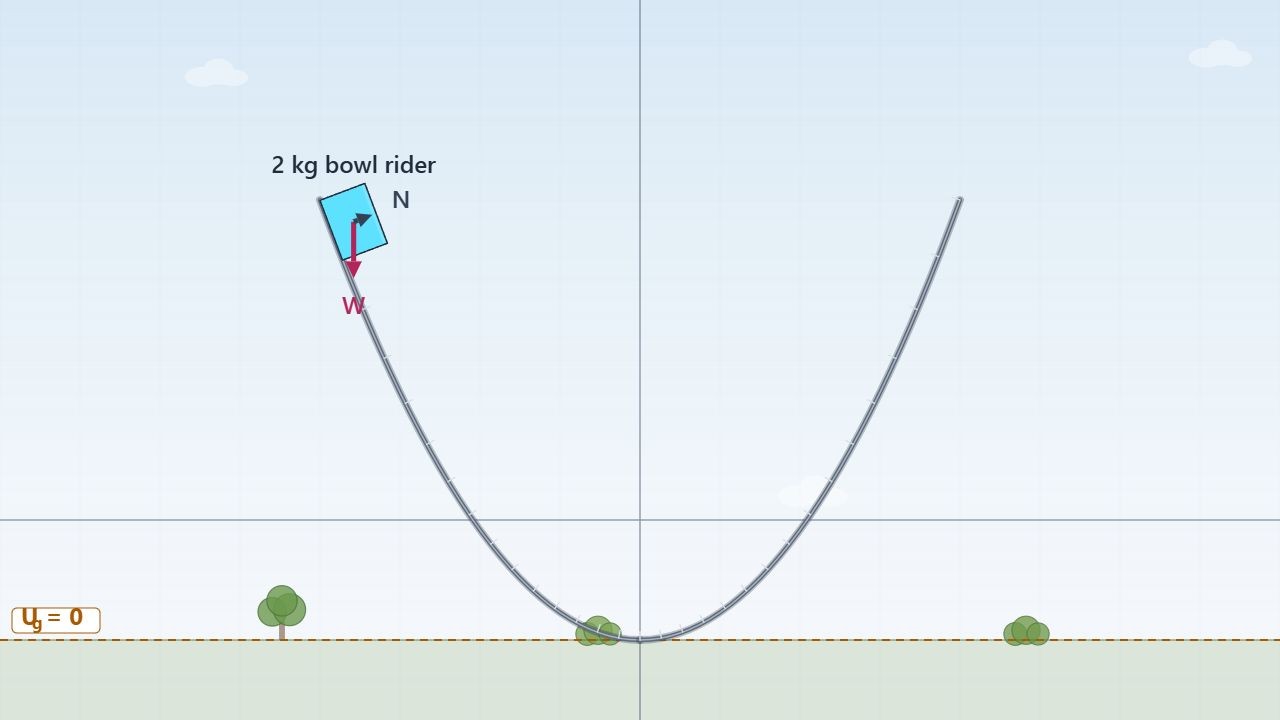
Track kinetic and potential energy as an object moves. Choose a system and test when mechanical energy stays constant.

Start lesson
  • Free
  • No account required
  • Self-paced
Conservation of Mechanical Energy guided lesson preview Start guided lesson
Explore the model. Make predictions. Check your thinking.

Learn by doing

Three ideas you’ll put into motion

Follow the transformation

Observe energy shifting between motion and position in a prepared scene.

Choose the energy model

Identify the system and decide which interactions belong in the accounting.

Predict another point

Use initial and final energy to predict a speed or height, then check the result.

The big idea

The key ideas, at a glance.

Mechanical energy combines stores

Mechanical energy is Emech = K + U. Changes in one store can be balanced by changes in another.

Conservation has conditions

Mechanical energy remains constant when no external transfer or dissipative process changes it in the chosen model.

A quick comparison

Release an object from rest on a frictionless track in constant gravity.

Same vertical drop → same speed, regardless of route.

higher positionlower positionPotential energy decreases as kinetic energy increases
Teaching this topic?Classroom fit, AP connections, and support
Classroom fit
Use for a concept introduction, guided independent practice, or a projected class discussion.
Before students begin
Kinetic energy, gravitational potential energy, and basic algebra.
Built-in support
Prepared scenes, guided prompts, and feedback on lesson questions.
AP Physics 1 connections
Unit 3: system boundaries and conservation of mechanical energy.
Check for understanding
Ask which change to the system or interactions would invalidate a mechanical-energy-only prediction.
Optional extension
Try the Skater Bowl lab.
Meet the educator behind Build Physics

Ready to test your thinking?

The first scene is set up. Start the lesson and explore.

Start lesson