BuildPhysics

AP Physics 1 · Unit 3 · Work, Energy, and Power

Work Done by Varying Forces

Read force–position graphs and use their signed areas to calculate work when the force changes during a motion.

Start lesson
  • Free
  • No account required
  • Self-paced
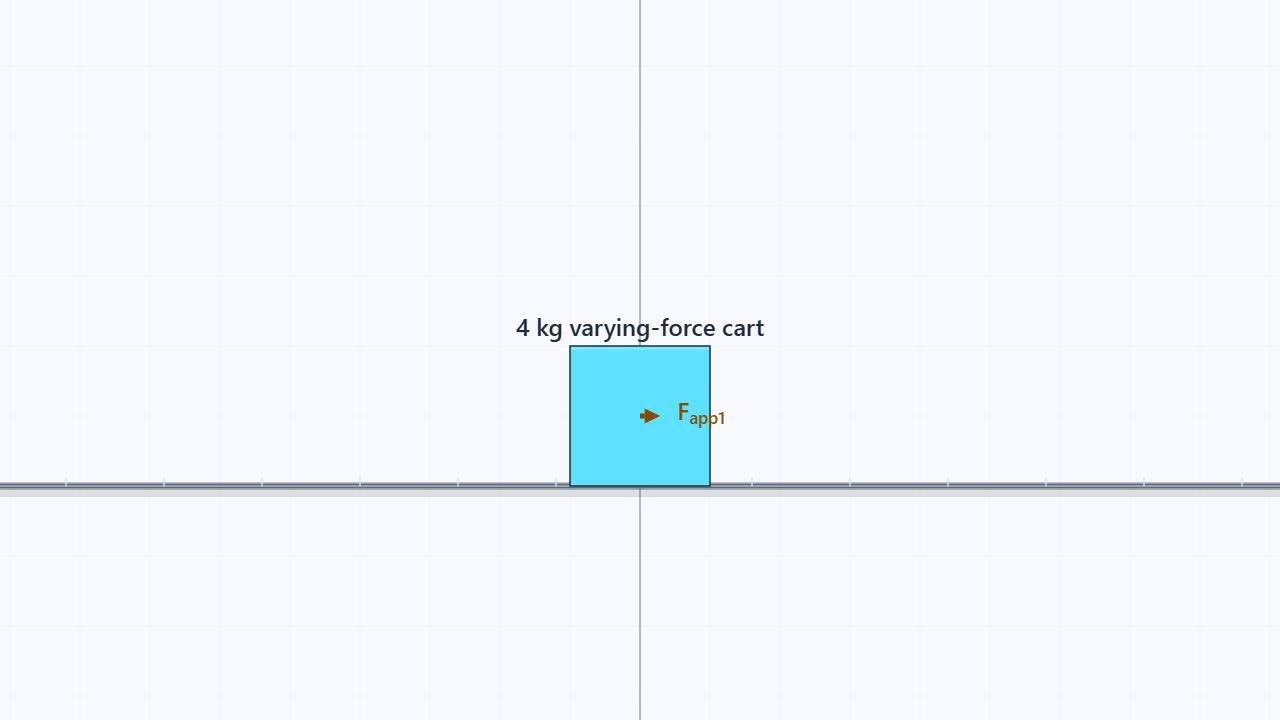
Work Done by Varying Forces guided lesson preview Start guided lesson
Explore the model. Make predictions. Check your thinking.

Learn by doing

Three ideas you’ll put into motion

Read the force graph

Connect force values with positions rather than elapsed times.

Add signed areas

Use simple geometric regions to find positive, negative, and net work.

Predict the energy change

Connect the total work from a changing force with the object’s kinetic energy.

The big idea

The key ideas, at a glance.

Area represents work

The signed area under a force-component-versus-position graph gives work along that coordinate. A force–time graph instead gives impulse.

Opposing regions can cancel

Areas below the position axis contribute negative work. Add all signed regions to find the net work and corresponding ΔK.

A quick comparison

A constant +3 N force acts through a +2 m displacement.

Rectangular area → +6 J of work.

forcepositionSchematic relationship
Teaching this topic?Classroom fit, AP connections, and support
Classroom fit
Use for a concept introduction, guided independent practice, or a projected class discussion.
Before students begin
Work, kinetic energy, and the areas of rectangles and triangles. Calculus is not needed.
Built-in support
Prepared scenes, guided prompts, and feedback on lesson questions.
AP Physics 1 connections
Unit 3: graphical work calculations and the work–kinetic energy theorem.
Check for understanding
Ask how the area interpretation differs between a force–position graph and a force–time graph.
Meet the educator behind Build Physics

Ready to test your thinking?

The first scene is set up. Start the lesson and explore.

Start lesson