BuildPhysics

AP Physics 1 · Unit 8 · Fluids

Density

Measure mass and occupied volume, compare specimens, and discover what density means from real measurements and graphs.

Start lesson
  • Free
  • No account required
  • Self-paced
Density guided lesson preview Start guided lesson
Inspect specimens, collect measurements and connect graph slopes with density.

Learn by doing

Three ideas you’ll put into motion

Compare specimens

Change mass or volume separately and explain how their ratio changes.

Measure three-dimensional volume

Use dimensions, cylinder and sphere formulas, and liquid displacement with compatible units.

Read the relationship

Find density from a mass–volume slope, reverse the axes, and set a mass for a target density.

The big idea

The key ideas, at a glance.

Density means mass per volume

Density is ρ = m/V. At fixed volume, greater mass means greater density; at fixed mass, greater volume means lower density.

The graph axes matter

For one uniform material, a mass-versus-volume slope is density. With the axes reversed, a volume-versus-mass slope is 1/ρ.

A quick comparison

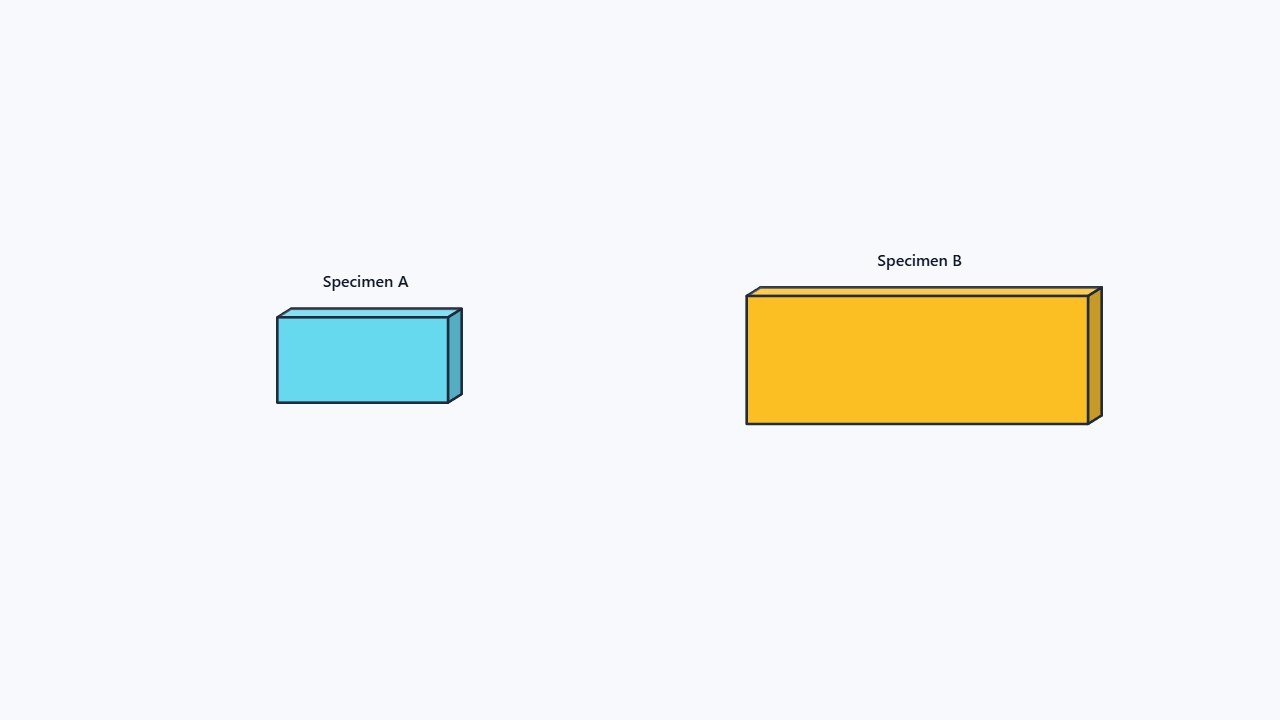
Keep a specimen’s mass fixed while doubling its occupied volume.

Its density becomes half as large.

same masstwice the volumeDensity is mass per occupied volume
Teaching this topic?Classroom fit, AP connections, and support
Classroom fit
Use for a concept introduction, guided independent practice, or a projected class discussion.
Before students begin
Mass, length, area, volume, basic algebra, and graph slope. No prior fluids knowledge is needed.
Built-in support
Prepared scenes, guided prompts, and feedback on lesson questions.
AP Physics 1 connections
Unit 8, Topic 8.1: internal structure and density. Connect fluid properties with mass per volume, quantitative representations and experimental measurements.
Check for understanding
Ask why a larger piece of the same uniform material has the same density, and why a liquid’s shape can change without a change in its volume.
Meet the educator behind Build Physics

Ready to test your thinking?

The first scene is set up. Start the lesson and explore.

Start lesson