BuildPhysics

AP Physics 1 · Unit 2, Part 1 · Forces

Newton’s Second Law

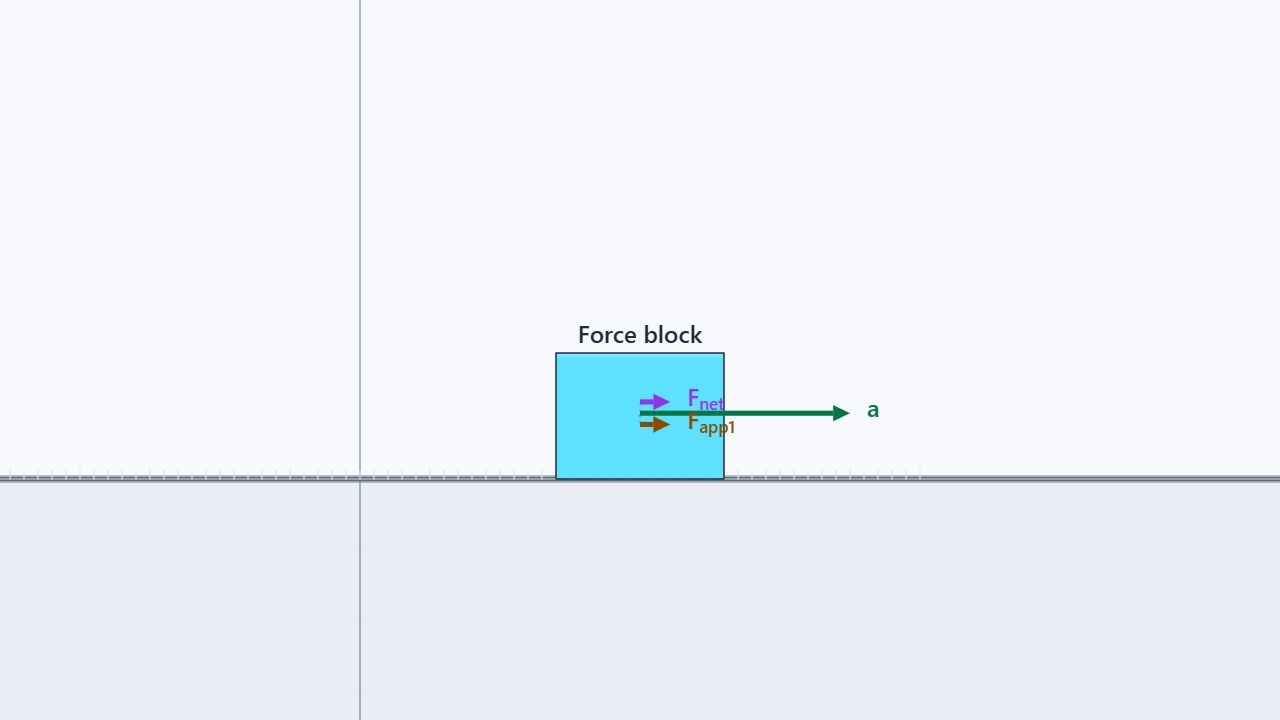
Change net force and mass, compare acceleration, and use controlled trials to test Newton’s second law.

Start lesson
  • Free
  • No account required
  • Self-paced
Newton’s Second Law guided lesson preview Start guided lesson
Explore the model. Make predictions. Check your thinking.

Learn by doing

Three ideas you’ll put into motion

Change the net force

Hold mass fixed and observe how acceleration responds to different forces.

Change the mass

Keep the force fixed and compare the response of different masses.

Use the whole force model

Add opposing forces before predicting acceleration, then test your result.

The big idea

The key ideas, at a glance.

Acceleration follows net force

Use ΣF = ma. The direction of acceleration follows the net external force, which can differ from the direction of velocity.

Mass changes the response

At fixed net force, greater mass means smaller acceleration. Compare one changed variable at a time.

A quick comparison

Double the net force while keeping the mass the same.

The acceleration doubles.

net force Fnet force 2FSame mass → twice the acceleration
Teaching this topic?Classroom fit, AP connections, and support
Classroom fit
Use for a concept introduction, guided independent practice, or a projected class discussion.
Before students begin
Free-body diagrams, signed force sums, and basic algebra.
Built-in support
Prepared scenes, guided prompts, and feedback on lesson questions.
AP Physics 1 connections
Unit 2: Newton’s second law, system mass, and force–acceleration relationships.
Check for understanding
Ask why the largest individual force does not always determine the acceleration.
Optional extension
Collect more data in the Newton’s Second Law lab.
Meet the educator behind Build Physics

Ready to test your thinking?

The first scene is set up. Start the lesson and explore.

Start lesson