BuildPhysics

AP Physics 1 · Unit 2, Part 1 · Forces

Elevator Forces and Apparent Weight

Ride through elevator motion and use force diagrams to explain when a scale reads heavier, lighter, or the usual weight.

Start lesson
  • Free
  • No account required
  • Self-paced
Elevator Forces and Apparent Weight guided lesson preview Start guided lesson
Explore the model. Make predictions. Check your thinking.

Learn by doing

Three ideas you’ll put into motion

Compare scale readings

Observe apparent weight during different elevator accelerations.

Separate direction and change

Distinguish moving upward from accelerating upward, including slowing during a trip.

Explain the forces

Compare the normal force with gravitational force and connect the difference to acceleration.

The big idea

The key ideas, at a glance.

The scale measures normal force

Apparent weight is the support force exerted on the rider. Gravitational force remains mg near Earth.

Acceleration sets the difference

With upward positive, N − mg = ma. An upward acceleration raises the scale reading; downward acceleration lowers it.

A quick comparison

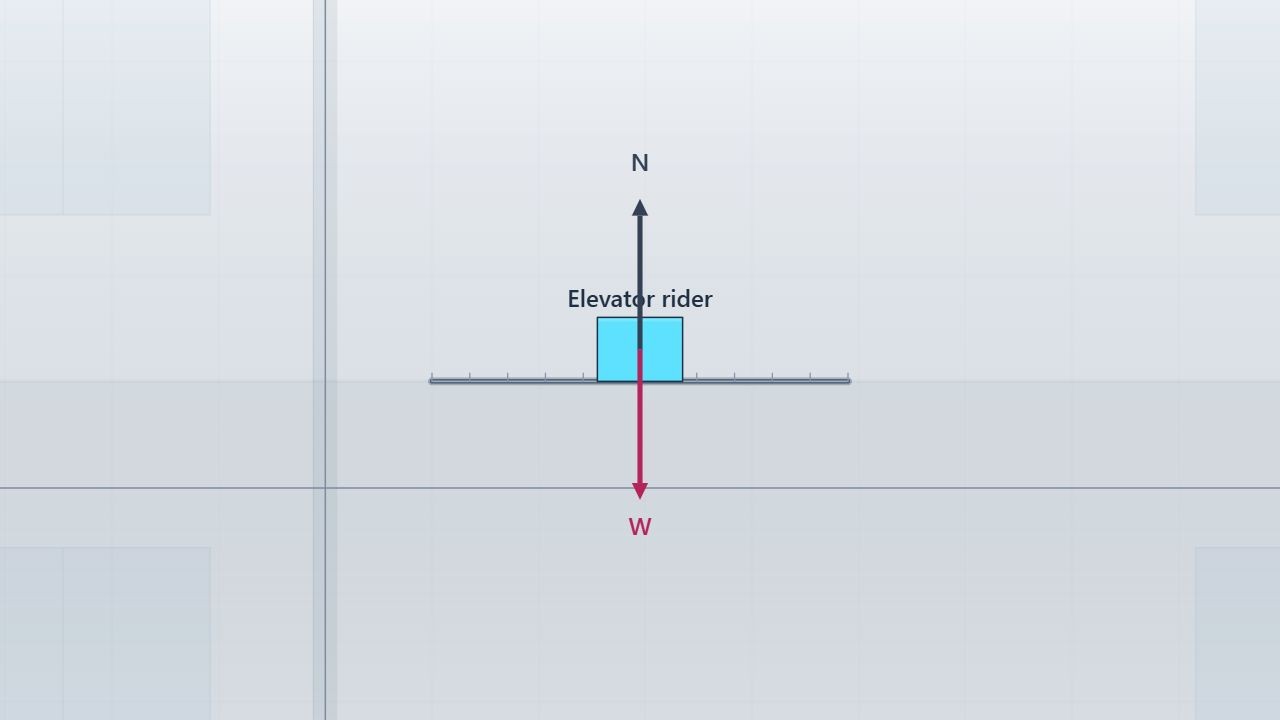
The elevator moves upward at constant velocity.

Acceleration zeroScale reading N = mg

Nmg
Teaching this topic?Classroom fit, AP connections, and support
Classroom fit
Use for a concept introduction, guided independent practice, or a projected class discussion.
Before students begin
Free-body diagrams and Newton’s second law. Keep upward and downward signs consistent.
Built-in support
Prepared scenes, guided prompts, and feedback on lesson questions.
AP Physics 1 connections
Unit 2: applying Newton’s laws to apparent weight and equilibrium.
Check for understanding
Ask whether an elevator moving downward must always make its rider feel lighter.
Optional extension
Try the Elevator Forces lab.
Meet the educator behind Build Physics

Ready to test your thinking?

The first scene is set up. Start the lesson and explore.

Start lesson