
Plan the investigation
When does a rider feel heavier?
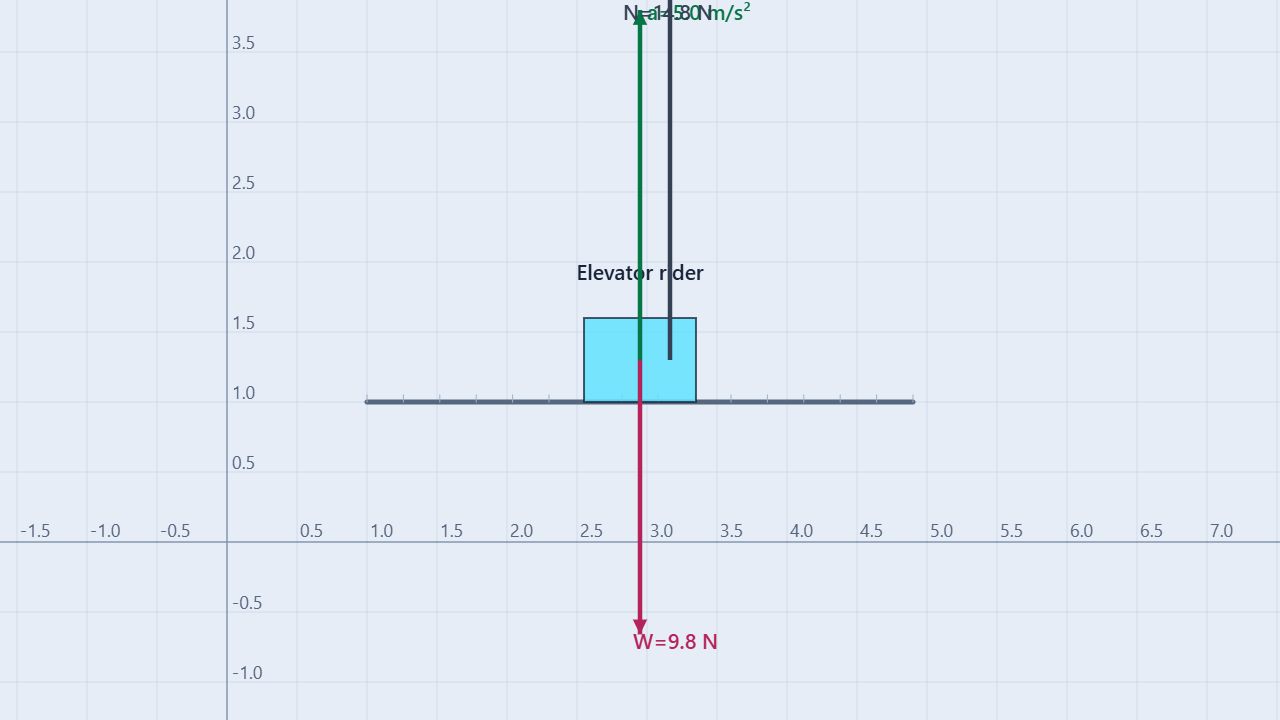
The prepared scene uses a 1 kg Elevator rider resting on an Elevator floor. The floor starts from rest with upward acceleration +5 m/s². The block represents a rider; its small mass makes the force calculations easy to compare.
Change
Floor y acceleration: −5, −2, 0, +2, and +5 m/s².
Keep fixed
Rider mass at 1 kg, gravity downward at 9.80 m/s², original positions, and zero initial velocity for both rider and floor.
Use short runs while the rider remains on the floor. These trials change acceleration rather than combining different starting velocities with different accelerations.
Build the model
Two forces act on the rider
Draw weight mg downward and the floor’s normal force N upward. The motor or cable acts on the elevator, not directly on the rider. With upward positive, Newton’s second law gives:
N − mg = may
N = m(g + ay)
Use a signed acceleration: upward is positive and downward is negative. Here g is the positive magnitude 9.80 m/s². The rider shares the floor’s acceleration only while they maintain contact.
Procedure
A useful five-trial workflow
- Load the scene. Launch the simulation and choose Elevator forces if a saved scene appears. Confirm gravity is downward at 9.80 m/s².
- Set acceleration. Open Properties and select Elevator floor. Set its y acceleration to −5 m/s² and leave x acceleration zero. Keep its initial velocity zero. Select Elevator rider to confirm a 1 kg mass and zero initial velocity.
- Predict and run. Calculate N before pressing Play. Set a 0.5-second run duration beside Play. Watch that the rider remains supported by the floor.
- Read the rider’s data. Select Elevator rider and open the Data panel. Choose normal-force magnitude and vertical acceleration as graph measurements. Record a sample after motion begins, including time, N, and ay. Compare N − mg with may.
- Reset and repeat. Reset before entering −2, 0, +2, and +5 m/s² for the floor. Restore the same starting conditions. Export CSV and compare samples at the same time across trials.
| aᵧ (m/s²) | Weight mg (N) | Normal force (N) | Apparent weight |
|---|---|---|---|
| −5.00 | 9.80 | 4.80 | Lighter |
| −2.00 | 9.80 | 7.80 | Lighter |
| 0.00 | 9.80 | 9.80 | Usual |
| +2.00 | 9.80 | 11.80 | Heavier |
| +5.00 | 9.80 | 14.80 | Heavier |
If a contact transient appears, compare a later supported sample rather than an impact spike. Check the selected object is the rider, not the floor or world totals.
Worked example
Check the prepared upward acceleration
For the original 1 kg rider with ay = +5 m/s²:
N = 1.00(9.80 + 5.00) = 14.80 N
ΣFy = 14.80 − 9.80 = +5.00 N
The rider’s weight is still 9.80 N. The extra 5 N of upward force produces upward acceleration; it does not represent an increase in gravitational force.
Scale up to a 60 kg person
For downward acceleration −2 m/s², a 60 kg person’s gravitational weight is 588 N and normal force is 60(9.80 − 2.00) = 468 N. A scale calibrated to display kilograms would indicate approximately 468/9.80 = 47.8 kg, although the person’s mass remains 60 kg. This is an illustrative calculation, not a simulation reading.
Separate velocity from acceleration
Going down can make you feel heavier
| Motion | Acceleration | Scale reading |
|---|---|---|
| Up, speeding up | Up | Above mg |
| Up, slowing down | Down | Below mg |
| Down, speeding up | Down | Below mg |
| Down, slowing down | Up | Above mg |
| Constant velocity | Zero | Equal to mg |
Prediction check: descending and braking
A rider descending while slowing has upward acceleration. The upward normal force exceeds weight. The elevator does not need to be moving upward for the rider to feel heavier.
Common misconception
Does the normal force always equal weight?
Only when vertical acceleration is zero and these are the rider’s only vertical forces. Being momentarily at rest does not guarantee zero acceleration.
Are normal force and weight a third-law pair?
No. Both act on the rider. The reaction to the floor pushing the rider upward is the rider pushing the floor downward; those forces act on different objects.
Does apparent weightlessness mean no gravity?
No. In ideal free fall, ay = −g and N = 0, while gravity still acts. If the floor accelerates downward faster than g, it moves away from an unsupported rider. A negative value from N = m(g + afloor) would mean the shared-acceleration assumption has failed, not that the floor pulls the rider downward.
For teachers
Infer mass from the graph
Plot normal force vertically against signed vertical acceleration horizontally. The model predicts a straight line with slope m and intercept mg. For the 1 kg rider, expect slope 1 kg and intercept 9.80 N.
Extend one trial by doubling rider mass: both normal force and gravitational weight double at fixed acceleration. For a direction comparison, give rider and floor the same initial vertical velocity before running so they begin together without a collision.
Review the Elevator Forces and Apparent Weight guide, then compare with the Newton’s Second Law experiment. Physics reference: OpenStax, University Physics Volume 1, §6.1. Learn about the educator behind these simulations on the BuildPhysics About page.