Compare rotational responses
Hold the mass distribution fixed while changing net torque, then compare masses at different distances.
 BuildPhysics
AP Physics 1 · Unit 5 · Torque and Rotational Dynamics
Change torque, mass and distance from an axis, then use the rotation you observe to explain moment of inertia and angular acceleration.
Start lesson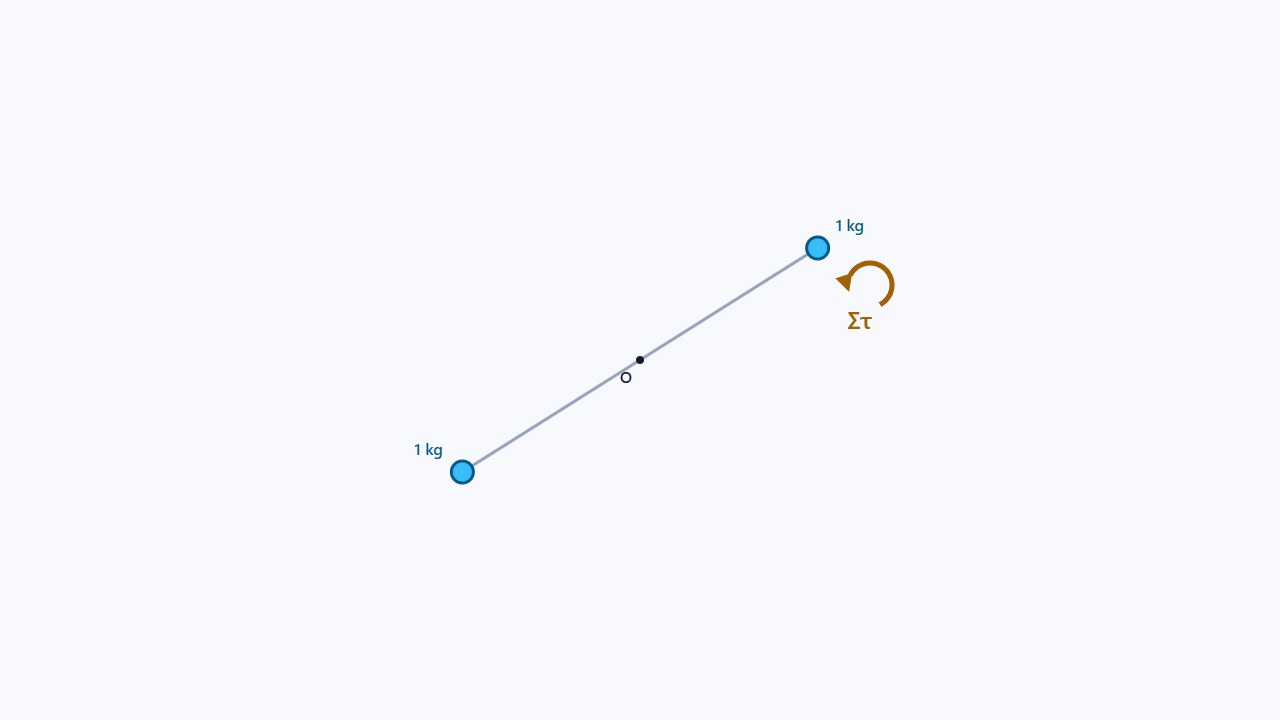 Start guided lesson
Learn by doing
Hold the mass distribution fixed while changing net torque, then compare masses at different distances.
Add point-mass contributions and use the parallel-axis theorem for a uniform rod.
Analyze a combined rigid system and an annular pulley with axle friction, then set and test a target angular acceleration.
The big idea
For a rigid system about a fixed axis, Στ = Iα. At fixed inertia, angular acceleration is proportional to net torque; at fixed torque, larger inertia gives smaller angular acceleration.
A point mass contributes mr2 to rotational inertia. Add contributions about the same axis. For parallel axes separated by d, I = ICM + Md2. Extended-object formulas are supplied for the stated axes.
A quick comparison
Move two point masses twice as far from the axis while keeping their masses and net torque fixed.
Rotational inertia becomes four times as large; angular acceleration becomes one quarter as large.
The first scene is set up. Start the lesson and explore.