BuildPhysics

AP Physics 1 · Unit 1 · Kinematics

2D Vectors and Relative Motion

Build vectors from components, add them tip to tail, and steer a boat across a moving river using relative velocity.

Start lesson
  • Free
  • No account required
  • Self-paced
2D Vectors and Relative Motion guided lesson preview Start guided lesson
Explore the model. Make predictions. Check your thinking.

Learn by doing

Three ideas you’ll put into motion

Build a vector

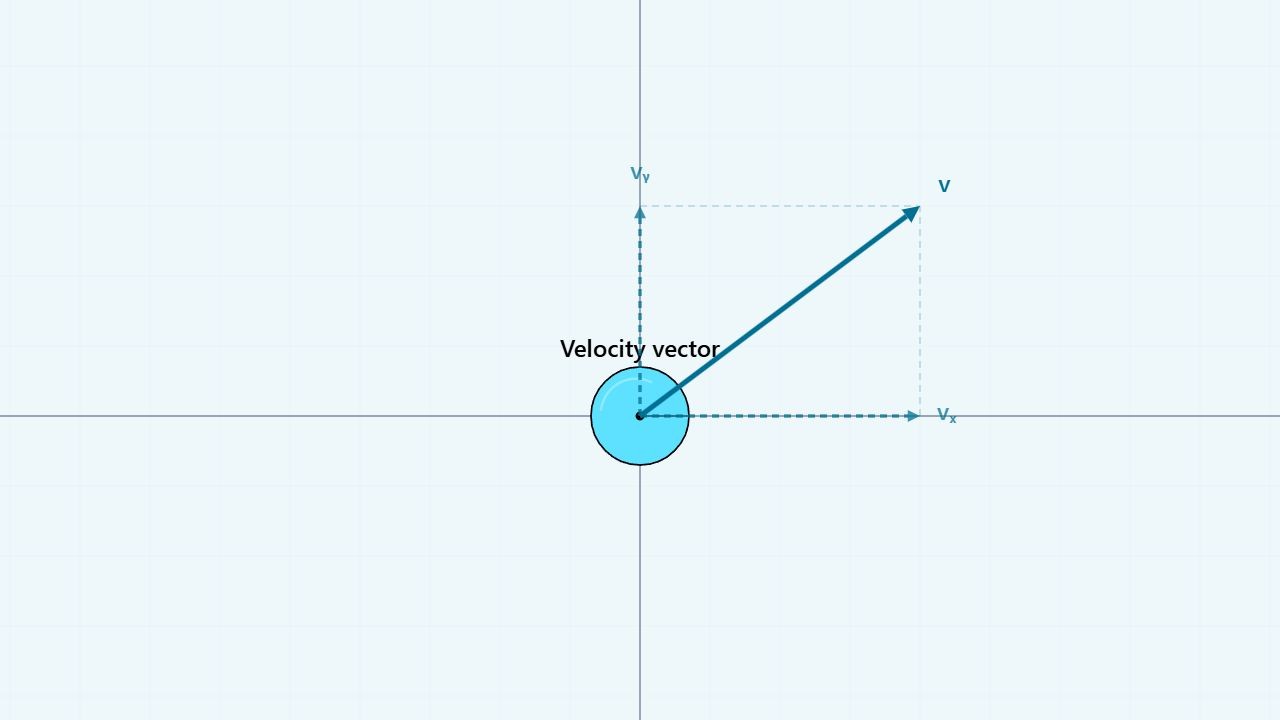
Set horizontal and vertical components, then connect them to magnitude and direction.

Add two motions

Draw vectors tip to tail and compare their sum with component addition.

Choose a reference frame

Combine boat-through-water velocity with the current to predict the ground-relative trip.

The big idea

The key ideas, at a glance.

Components describe one vector

Perpendicular components combine as |v| = √(vx2 + vy2). Keep direction signs when adding.

Relative velocity adds vectors

The boat’s velocity relative to shore is its velocity through water plus the water’s velocity relative to shore.

A quick comparison

A boat heads across a river while the current flows downstream.

Shore motion = boat motion + current

horizontal componentverticalresultant
Teaching this topic?Classroom fit, AP connections, and support
Classroom fit
Use for a concept introduction, guided independent practice, or a projected class discussion.
Before students begin
Signed coordinates, the Pythagorean theorem, and basic sine, cosine, and tangent.
Built-in support
Prepared scenes, guided prompts, and feedback on lesson questions.
AP Physics 1 connections
Unit 1: vector components, two-dimensional motion, and reference frames.
Check for understanding
Ask which velocity sets crossing time when the river current is parallel to the banks.
Optional extension
Practice vector addition with the Vector Displacement Scavenger Hunt.
Meet the educator behind Build Physics

Ready to test your thinking?

The first scene is set up. Start the lesson and explore.

Start lesson