
Plan the investigation
Where do ten connected displacements lead?
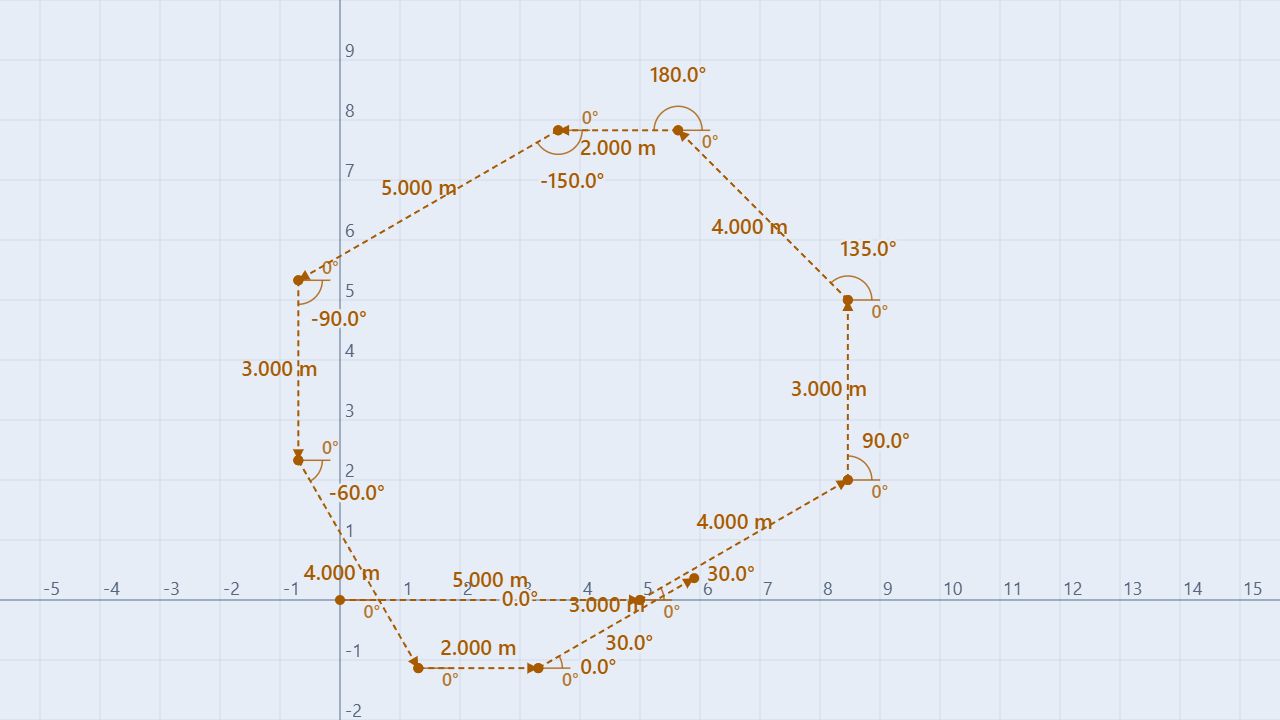
The prepared scavenger hunt starts at (0.00, 0.00) m with gravity disabled. The Measure Displacement tool is used to draw ten vectors tip to tail. East is +x, north is +y, and each clue gives a magnitude and a direction measured counterclockwise from +x.
Change or control
Control the clue order, starting point, magnitude, and direction for the required hunt. After completing it, change one vector or reorder the same vectors to test which parts of the path change.
Measure and compare
Record each vector’s x and y components, its starting and ending coordinates, the total path length, and the resultant from the origin to the treasure point.
A displacement measurement is an arrow from one position to another. It is not a force or a velocity vector. Every new clue must begin at the exact tip of the preceding clue; the tutorial checks the start point within 0.20 m, the length within 0.20 m, and the direction within 1°.
Procedure
A useful five-trial workflow
- Start the hunt. Launch the simulation and choose 2D Vector Displacement Scavenger Hunt. Leave the grid and degree angle display on. Measure the first vector from the origin, (0.00, 0.00).
- Follow the clues. Draw each vector from the previous tip. Read the displayed magnitude and angle after placing it, then adjust the endpoint if needed. Complete all ten clues in order.
- Record components. For a vector of length r at angle θ, calculate Δx = r cos θ and Δy = r sin θ. Keep the signs: west gives negative Δx and south gives negative Δy.
- Check the resultant. Add all x components and all y components. The final coordinate should equal (ΣΔx, ΣΔy). Compare the direct origin-to-treasure arrow with the ten-vector path.
- Run comparison trials. Recreate the same vectors in a different order, then change one magnitude or direction. Decide whether the final resultant, intermediate tips, and total path length change in the same way.
| Clue | Displacement | Δx (m) | Δy (m) | Predicted tip (m) |
|---|---|---|---|---|
| 1 | 5 m East | +5.000 | 0.000 | (5.000, 0.000) |
| 2 | 4 m, 30° North of East | +3.464 | +2.000 | (8.464, 2.000) |
| 3 | 3 m North | 0.000 | +3.000 | (8.464, 5.000) |
| 4 | 4 m, 45° North of West | −2.828 | +2.828 | (5.636, 7.828) |
| 5 | 2 m West | −2.000 | 0.000 | (3.636, 7.828) |
| 6 | 5 m, 30° South of West | −4.330 | −2.500 | (−0.694, 5.328) |
| 7 | 3 m South | 0.000 | −3.000 | (−0.694, 2.328) |
| 8 | 4 m, 60° South of East | +2.000 | −3.464 | (1.306, −1.136) |
| 9 | 2 m East | +2.000 | 0.000 | (3.306, −1.136) |
| 10 | 3 m, 30° North of East | +2.598 | +1.500 | (5.904, 0.364) |
The tutorial’s final treasure marker should appear near (5.904, 0.364) m. The construction uses 35.00 m of total path length, but the net displacement is much shorter because several vectors cancel.
Worked example
Resolve one clue into components
Clue 2 is a 4.00 m displacement at 30° north of east. The vector begins at the tip of clue 1, (5.000, 0.000) m:
Δx2 = r cos θ = 4.00 cos 30° = +3.464 m
Δy2 = r sin θ = 4.00 sin 30° = +2.000 m
Adding those components to the previous tip gives (5.000 + 3.464, 0.000 + 2.000) = (8.464, 2.000) m. The next vector must begin there, even though its direction is measured from the same global +x axis.
Resultant check
Compare the path with the direct displacement
Summing the ten clues gives the final displacement components:
ΣΔx = 5.904 m ΣΔy = 0.364 m
|Δr⃗| = √((5.904)² + (0.364)²) = 5.915 m
θresultant = tan⁻¹(0.364/5.904) = 3.53° north of east
| Quantity | Prediction | What to verify |
|---|---|---|
| Total path length | 35.000 m | Add the ten magnitudes; direction does not cancel path length. |
| Resultant x-component | +5.904 m | Final x-coordinate from the origin. |
| Resultant y-component | +0.364 m | Final y-coordinate from the origin. |
| Resultant magnitude | 5.915 m | Direct start-to-finish arrow length. |
| Resultant direction | 3.53° north of east | Angle of the direct arrow from +x. |
If you reorder the same ten vectors, the intermediate tips and drawn route change, but the final resultant remains the same because vector addition is commutative. If you change a magnitude or direction, both the final point and the resultant generally change.
Common misconception
What does the resultant represent?
The resultant is the single displacement from the starting point directly to the final point. It is not the sum of path lengths and it does not trace the route taken by the ten individual vectors.
Does the order of vectors matter?
It matters for the intermediate coordinates and the visible route, but not for the final sum when the same vectors are added exactly.
Is 30° North of East measured from north?
No. It starts at the +x east direction and turns 30° toward north. Its components are positive x and positive y.
Can a vector start anywhere if its length and angle are right?
No. In this hunt, each vector is a displacement between positions, so the starting point must be the previous vector’s tip.
For teachers
Make vector addition visible
Ask students to calculate the next tip before they draw it. Require a sign table for east, west, north, and south components, then have them compare the direct resultant with the full tip-to-tail construction.
After the required sequence is complete, have groups reorder the clues and predict which observations will change. A second extension changes only clue 6 or clue 8 so students can identify which component causes the largest shift in the treasure location.
The 2D Vectors and Relative Motion guide develops component notation, while the Displacement and Velocity guide distinguishes path length from net change in position. The Projectile Target Challenge applies the same component reasoning to a landing prediction.