
Plan the investigation
How much speed keeps the string taut?
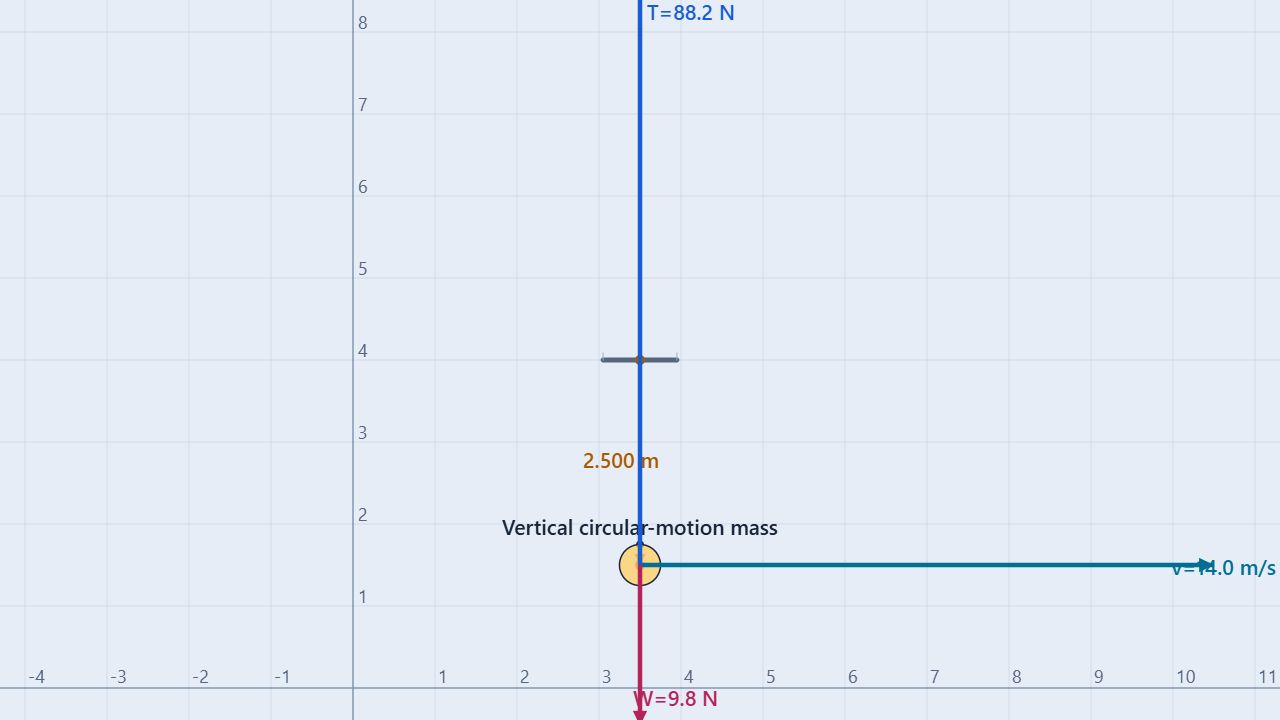
The prepared scene starts with a 1 kg mass at the bottom of a 2.5 m string, moving horizontally right at 14 m/s. The pivot is at height 4 m, so the mass center starts at y = 1.5 m and reaches y = 6.5 m at the top of a complete circle.
Change
Bottom speed: 12, 13, 14, 15, and 16 m/s.
Keep fixed
Mass at 1 kg, radius at 2.5 m, gravity downward at 9.80 m/s², friction disabled, and the original bottom starting position.
Begin with speeds safely above the ideal loop threshold. After comparing complete loops, investigate what happens at a lower launch speed. The equations below assume a massless, inextensible string, a fixed pivot, no energy losses, and a taut string.
Build the model
Choose inward as positive at each position
At the bottom, inward is upward: tension opposes weight. At the top, inward is downward: tension and weight point together toward the pivot.
Bottom: Ftension,b − mg = mvb²/r
Top: Ftension,t + mg = mvt²/r
The mass rises by 2r from bottom to top. Energy conservation gives:
½mvb² = ½mvt² + mg(2r)
vt² = vb² − 4gr
Find top speed from energy first, then use that speed in the top force equation. Using bottom speed at the top would overestimate the tension.
Procedure
A useful five-trial workflow
- Load the scene. Launch the simulation and choose Vertical circular motion if a saved scene appears. Check World gravity is downward at 9.80 m/s² and friction is disabled.
- Set the launch. Open Properties and select Vertical circular-motion mass. At the original bottom position, keep Mass at 1 kg and set initial x velocity to +12 m/s and y velocity to 0.
- Predict and run. Calculate top speed and tension at both ends of the circle. Set a 3-second run duration beside Play and observe the first loop.
- Read the evidence. With the mass selected, open the Data panel. The preset graphs tension, speed, and y position. Use position to locate the first top passage near y = 6.5 m and bottom passage near y = 1.5 m. Record the actual sample times, heights, speeds, and tensions.
- Reset and compare. Reset before setting initial x velocity to +13, +14, +15, and +16 m/s. Keep all other starting conditions fixed. Export CSV to compare the five trials.
| Bottom speed (m/s) | Top speed (m/s) | Bottom tension (N) | Top tension (N) |
|---|---|---|---|
| 12.00 | 6.782 | 67.40 | 8.60 |
| 13.00 | 8.426 | 77.40 | 18.60 |
| 14.00 | 9.899 | 88.20 | 29.40 |
| 15.00 | 11.269 | 99.80 | 41.00 |
| 16.00 | 12.570 | 112.20 | 53.40 |
A sampled row may fall just before or after the exact top or bottom. Record its height instead of assuming it is precisely at an endpoint. Numerical integration can also produce drift; compare the first loop across trials.
Worked example
The prepared 14 m/s launch
The rise to the top is 5 m. The predicted top speed is:
vt = √(14² − 4 × 9.80 × 2.5) = √98 ≈ 9.899 m/s
Ftension,b = 1(14²/2.5 + 9.80) = 88.20 N
Ftension,t = 1(98/2.5 − 9.80) = 29.40 N
Tension differs by 58.80 N, or 6mg. In this ideal model that difference is the same for every complete taut-string loop in the table, even though both individual tensions increase with launch speed.
Extend the investigation
Find the minimum launch speed
A string can pull but cannot push. At the limiting top speed, tension is zero, so gravity alone supplies the inward force:
vt,min = √(gr) ≈ 4.950 m/s
vb,min = √(5gr) ≈ 11.068 m/s
After the five main trials, compare 10 m/s and 12 m/s launches. Predict which will lose a taut circular path. Once the string becomes slack, stop applying the fixed-radius equations: the mass follows a different path until tension acts again. Treat the exact limiting speed as an ideal boundary, not a robust numerical test.
Common misconception
Is tension always mv²/r?
No. mv²/r is the required inward net force. Weight also contributes in a vertical circle, so tension alone is not generally equal to it.
Is enough energy to reach the top sufficient?
No. Reaching the top at zero speed would not maintain a taut string. The mass also needs enough top speed for gravity and a nonnegative tension to supply the required inward acceleration.
Is acceleration always directed inward?
The radial component is inward. Away from the top and bottom, gravity also has a tangential component that changes speed, so the total acceleration need not point directly toward the pivot.
For teachers
Connect force diagrams with energy
Ask students to draw separate top and bottom force diagrams before calculating. Compare vb² − vt² with 4gr = 98 m²/s² and the tension difference with 6mg = 58.8 N. Both comparisons combine information from two positions.
Repeat one launch with twice the mass: ideal speeds remain unchanged while tensions double. Contrast the results with Uniform Circular Motion, where gravity is disabled and speed stays approximately constant.
Physics reference: UMass Lowell circular-motion lecture notes. Learn about the educator behind the simulations on the BuildPhysics About page.