Calculate floating fractions and volumes
Find the displaced water beneath a timber beam, use density ratios to separate the submerged and exposed portions of an ice block, and calculate the volume left above water on an unloaded raft.
 BuildPhysics
AP Physics 1 · Unit 8 · Fluids
Connect displaced liquid with floating fractions, supported loads, string tensions, and apparent weight.
12 questions6 conceptual · 6 calculation
Start practiceFree · No account required · Self-paced
 Open interactive practice
What you’ll practice
Find the displaced water beneath a timber beam, use density ratios to separate the submerged and exposed portions of an ice block, and calculate the volume left above water on an unloaded raft.
Compare a dry load above the water with dense ballast hung underwater. Include the ballast’s own buoyancy when finding the mass that just submerges the wood, and distinguish force on the wood from force on the entire system.
Compare equal-volume cubes at different depths and masses, calculate their string tensions and bottom pressures, and use a suspension-scale force change to infer liquid and specimen densities.
A question from this set
Two cubes of equal volume are held fully underwater by separate strings from above. Cube A has greater mass and is shallower than cube B. Neither touches the tank. Compare the buoyant forces.
Try it in the practice setKey ideas
For a fully immersed object in an incompressible liquid, buoyancy depends on displaced volume and fluid density. Moving the object deeper increases both top and bottom pressures while leaving their difference unchanged.
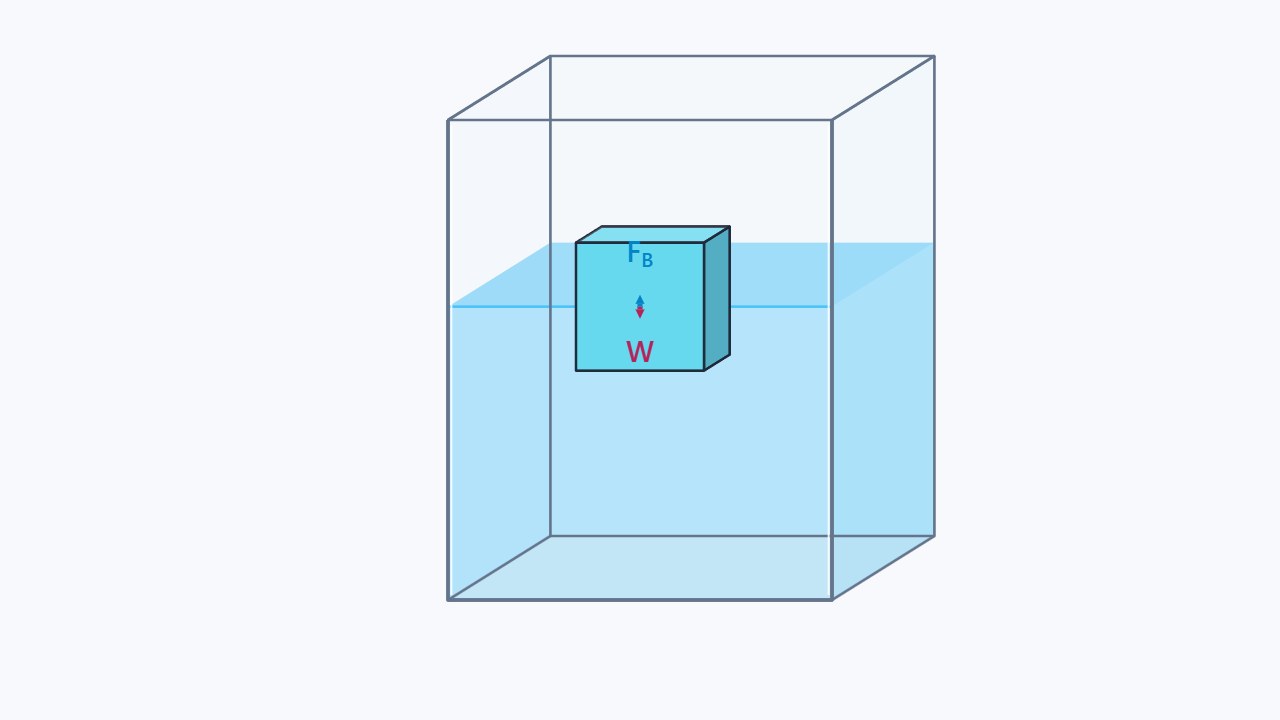
At rest, a floating assembly’s buoyancy balances its total supported weight. A larger object can have greater capacity without experiencing greater buoyancy when it carries a smaller load.
See the physics
After attempting a question, watch floating bodies settle under gravity and buoyancy, compare loaded rafts, or inspect suspended cubes held by actual strings. Recorded graphs show fluid forces, submerged fractions, and apparent-weight support forces.
Use a hint for a starting point or open a worked solution to follow the reasoning. Your progress saves in this browser, so you can return to unfinished questions.
Begin with a conceptual question, then work through the calculations.