BuildPhysics

AP Physics 1 · Unit 8 · Fluids

Buoyancy

Measure displaced fluid and connect buoyant force with floating, sinking, a loaded brass tube and a helium balloon.

Start lesson
  • Free
  • No account required
  • Self-paced
Buoyancy guided lesson preview Start guided lesson
Compare buoyancy and weight for a real cylindrical-displacement model of the floating brass tube.

Learn by doing

Three ideas you’ll put into motion

Develop the buoyant-force model

Use pressure differences and submerged volume to explain Archimedes’ principle.

Separate force and floating conditions

Change volume, density, mass and depth, then use force balance for floating and tethered objects.

Predict and test a new case

Calculate balloon tension and release acceleration, investigate a boat-and-ball puzzle, and design a target floating fraction.

The big idea

The key ideas, at a glance.

Buoyancy comes from displaced fluid

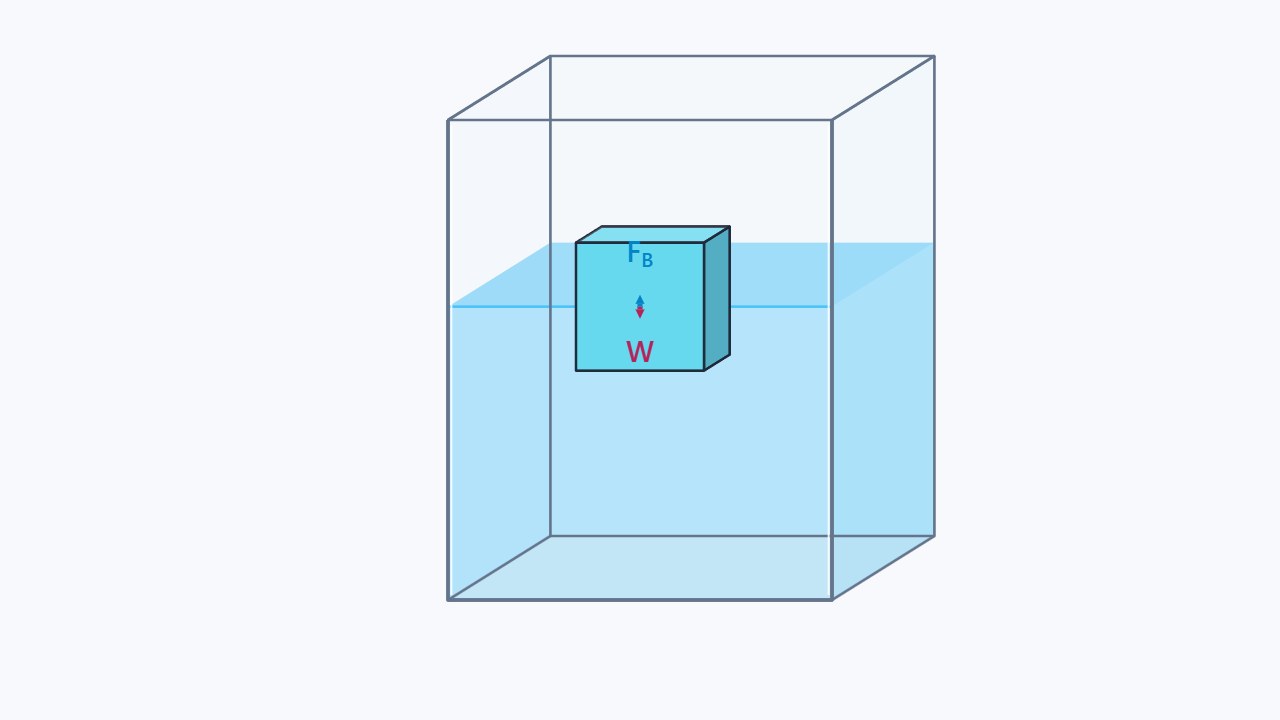
The pressure difference across an object produces a net upward force. FB = ρfluidVdisplacedg equals the weight of the displaced fluid.

Compare buoyancy with all other forces

A freely floating object at rest has FB = mg. A tethered balloon also has a downward rope force; a sinking object still experiences upward buoyancy.

A quick comparison

Keep a specimen fully submerged in the same liquid while increasing only its mass.

Its buoyant force stays the same, while its weight increases.

same displaced volumegreater object massDisplaced fluid determines buoyancy; force balance determines motion
Teaching this topic?Classroom fit, AP connections, and support
Classroom fit
Use for a concept introduction, guided independent practice, or a projected class discussion.
Before students begin
Density, hydrostatic pressure, Newton’s second law, equilibrium, and basic area and volume formulas. The Density, Pressure and Hydrostatics lessons prepare these ideas.
Built-in support
Prepared scenes, guided prompts, and feedback on lesson questions.
AP Physics 1 connections
Unit 8, Topic 8.3: fluids and Newton’s laws. Connect buoyancy with displaced-fluid weight and apply force models, mathematical reasoning and evidence from measurements.
Check for understanding
Ask students to distinguish total object volume from displaced volume, compare buoyancy with weight, and explain why the pool level falls when a ball moves from a floating boat into the water and sinks.
Meet the educator behind Build Physics

Ready to test your thinking?

The first scene is set up. Start the lesson and explore.

Start lesson