Identify deformation and force direction
Measure extension or compression from natural length. Explain why a restoring force can oppose a cart’s current motion.
 BuildPhysics
AP Physics 1 · Unit 3 · Energy
Connect spring deformation, restoring force, and elastic potential energy. Practice stretching, compression, spring launches, vertical equilibrium, and a spring bumper on a rough track.
12 questions6 conceptual · 6 calculation
Start practiceFree · No account required · Self-paced
 Open interactive practice
What you’ll practice
Measure extension or compression from natural length. Explain why a restoring force can oppose a cart’s current motion.
Use spring stiffness and deformation to find stored energy. Compare equal stretching and compression and calculate work between two extensions.
Combine elastic, gravitational, and kinetic energy in horizontal or vertical launches. Include resistance when a spring-driven cart enters a rough track.
A question from this set
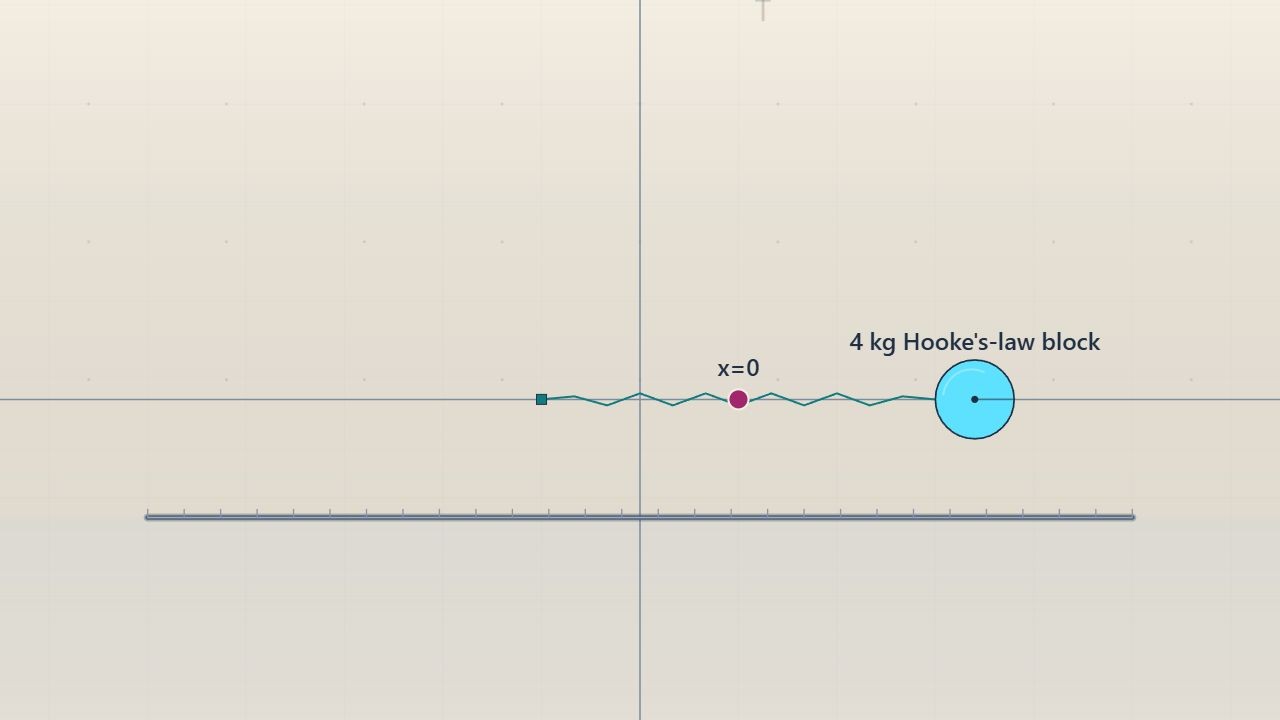
A cart attached to a horizontal spring is to the right of the spring’s relaxed position and is moving farther right. Ignore friction. In which direction does the spring exert a force on the cart?
Try it in the practice setKey ideas
Along the spring axis, Fspring = −kx when x is deformation from natural length. The minus sign describes the restoring direction.
Us = ½kx² is positive for either stretching or compression of an ideal spring. Doubling deformation multiplies stored energy by four.
See the physics
Check your answer, then run the cart or switch stretching and compression trials. Watch the restoring force reverse as deformation changes, and compare stored energy with launch motion.
Use a hint for a starting point or open a worked solution to follow the reasoning. Your progress saves in this browser, so you can return to unfinished questions.
Begin with a conceptual question, then work through the calculations.