BuildPhysics

AP Physics 1 · Unit 8 · Fluids

Continuity

Watch water move through changing pipe openings, develop the continuity equation, and connect volume flow with mass flow.

Start lesson
  • Free
  • No account required
  • Self-paced
Continuity guided lesson preview Start guided lesson
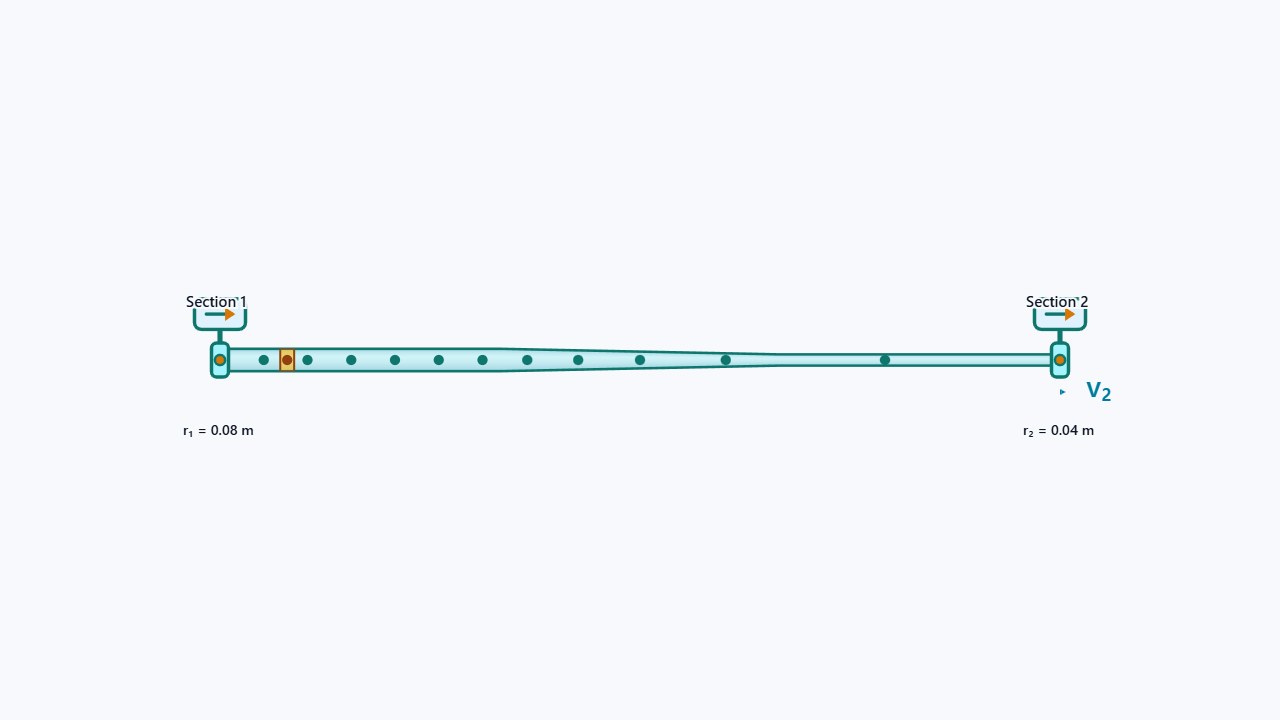
Compare the inlet and outlet speeds and follow a fixed-volume water parcel through the source example.

Learn by doing

Three ideas you’ll put into motion

Build the flow model

Connect transported volume with cross-sectional area, speed and time, then develop Q = Av.

Compare area and speed

Change an outlet and the source flow, distinguish radius from area factors, and interpret a speed–speed graph.

Apply and test continuity

Calculate outlet speed, delivered volume and mass flow, then design an outlet for a target speed.

The big idea

The key ideas, at a glance.

Conserve what passes each section

In steady, incompressible flow through a full pipe without leaks or branches, equal volumes pass each section in equal times: A1v1 = A2v2.

Distinguish flow rate from speed

Q = Av measures volume per second. At fixed Q, a smaller area requires a larger average speed. Circular area depends on radius squared; mass flow is ρQ.

A quick comparison

Halve an outlet diameter while keeping the volume flow rate fixed.

The opening area falls to one quarter, so outlet speed becomes four times as large.

same volume per secondhalf the diameterArea and speed compensate to conserve flow
Teaching this topic?Classroom fit, AP connections, and support
Classroom fit
Use for a concept introduction, guided independent practice, or a projected class discussion.
Before students begin
Density, speed, volume, circular area and algebraic ratios. Brief reminders distinguish radius, diameter, area, volume and flow rate.
Built-in support
Prepared scenes, guided prompts, and feedback on lesson questions.
AP Physics 1 connections
Unit 8, Topic 8.4.A: describe incompressible fluid flow using conservation of mass. Develop mathematical relationships, compare measured cases and interpret quantitative graphs.
Check for understanding
Ask students to justify why faster flow in a narrower section does not imply more volume per second, and to design a new outlet using a fixed source flow rate.
Meet the educator behind Build Physics

Ready to test your thinking?

The first scene is set up. Start the lesson and explore.

Start lesson