Compare force and mass trials
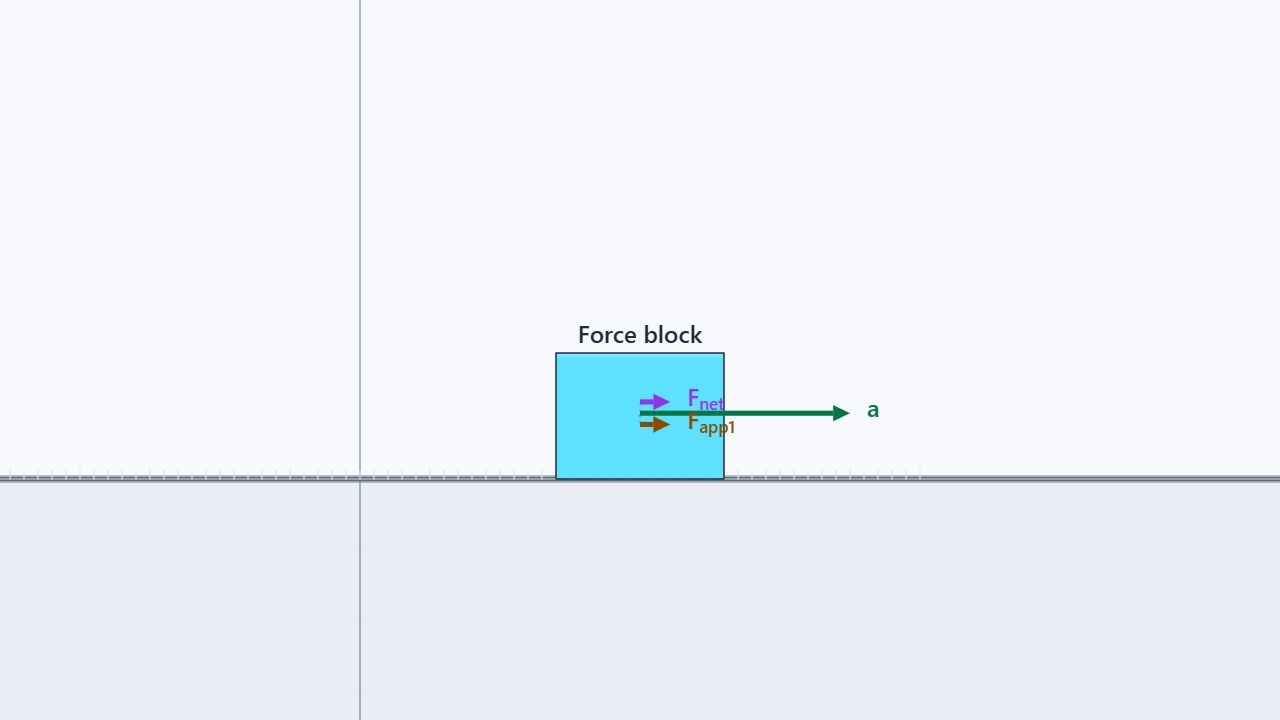
Predict how acceleration changes when net force doubles or when the same force acts on a larger mass. Keep the controlled quantity fixed.
 BuildPhysics
AP Physics 1 · Unit 2, Part 1 · Forces
Use net force and mass to explain acceleration. Compare controlled force and mass changes, then solve problems involving opposing forces, braking, different gravitational fields, and an angled force.
12 questions6 conceptual · 6 calculation
Start practiceFree · No account required · Self-paced
 Open interactive practice
What you’ll practice
Predict how acceleration changes when net force doubles or when the same force acts on a larger mass. Keep the controlled quantity fixed.
Combine opposing and angled forces before applying Newton’s second law. Solve for an unknown force, mass, or acceleration.
Analyze a tug slowing down and a raft moving through acceleration and steady-speed stages. Distinguish velocity direction from acceleration direction.
A question from this set
A 3.0 kg cart starts from rest on a level track with negligible friction. In a second trial, the horizontal net force is doubled while the cart’s mass stays the same. How does its acceleration compare?
Try it in the practice setKey ideas
The acceleration belongs to the selected object or system and follows its net external force. A large individual force can be partly canceled by another force.
At fixed mass, acceleration is proportional to net force. At fixed net force, increasing mass reduces acceleration. Compare otherwise identical trials to isolate the relationship.
See the physics
Check your prediction, then run paired force or mass trials from rest. Inspect velocity changes and force arrows, or compare the braking interval with the direction of acceleration.
Use a hint for a starting point or open a worked solution to follow the reasoning. Your progress saves in this browser, so you can return to unfinished questions.
Begin with a conceptual question, then work through the calculations.