Identify free fall
Decide when gravity is the only force. Compare different masses released together and distinguish rising motion from upward acceleration.
 BuildPhysics
AP Physics 1 · Unit 1 · Kinematics
Analyze drops, upward throws, and objects released from moving carriers. Practice the motion at a highest point, repeated crossings of one height, and a rocket’s transition from powered ascent to free flight.
12 questions6 conceptual · 6 calculation
Start practiceFree · No account required · Self-paced
 Open interactive practice
What you’ll practice
Decide when gravity is the only force. Compare different masses released together and distinguish rising motion from upward acceleration.
Apply constant-acceleration relationships to drops and throws. Track the positive direction and recognize when one height can be reached twice.
Use the velocity of a rising drone or powered rocket at the instant its payload enters free flight. Separate the stages before combining their heights and times.
A question from this set
Two same-size balls of mass 1.00 kg and 3.00 kg are released from rest at the same height. Ignore air resistance. How do their motions compare?
Try it in the practice setKey ideas
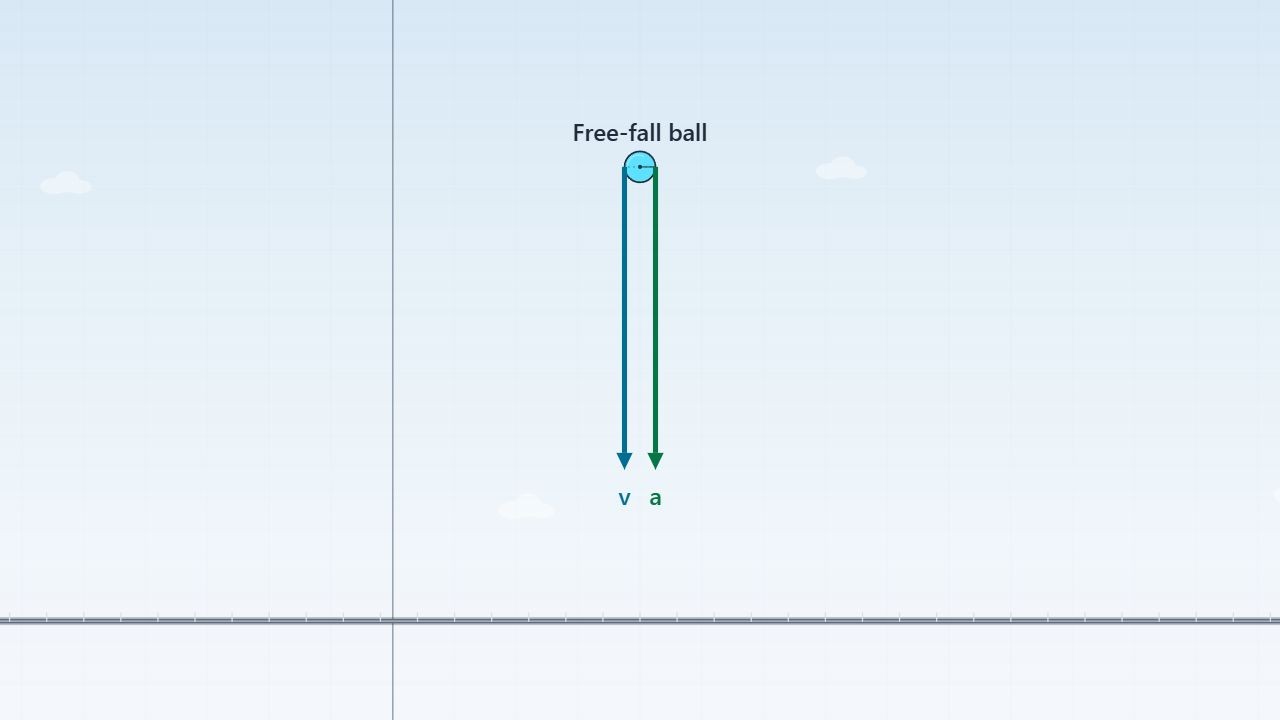
An object is in free fall after release when gravity is its only force. Its velocity can point up while its acceleration points down. Air resistance is neglected in these ideal comparisons.
A payload released by a moving carrier keeps that carrier’s velocity at release. Treat this as the initial velocity for the following free-flight interval.
See the physics
Check a response, then watch balls fall side by side or follow a single upward launch. Compare recorded turning points and height crossings with your calculated times and velocities.
Use a hint for a starting point or open a worked solution to follow the reasoning. Your progress saves in this browser, so you can return to unfinished questions.
Begin with a conceptual question, then work through the calculations.