BuildPhysics

AP Physics 1 · Unit 1 · Kinematics

Free Fall Motion

Drop and launch objects, compare masses, and use vertical-motion graphs to predict free fall, the highest point, and landing.

Start lesson
  • Free
  • No account required
  • Self-paced
Free Fall Motion guided lesson preview Start guided lesson
Explore the model. Make predictions. Check your thinking.

Learn by doing

Three ideas you’ll put into motion

Test the model

Compare falling objects while changing mass, shape, or release height.

Track an upward launch

Observe slowing, the highest point, and the return to the launch height.

Check vertical predictions

Use signed velocity, acceleration, and elapsed time to interpret graphs and calculate motion.

The big idea

The key ideas, at a glance.

Gravity sets acceleration

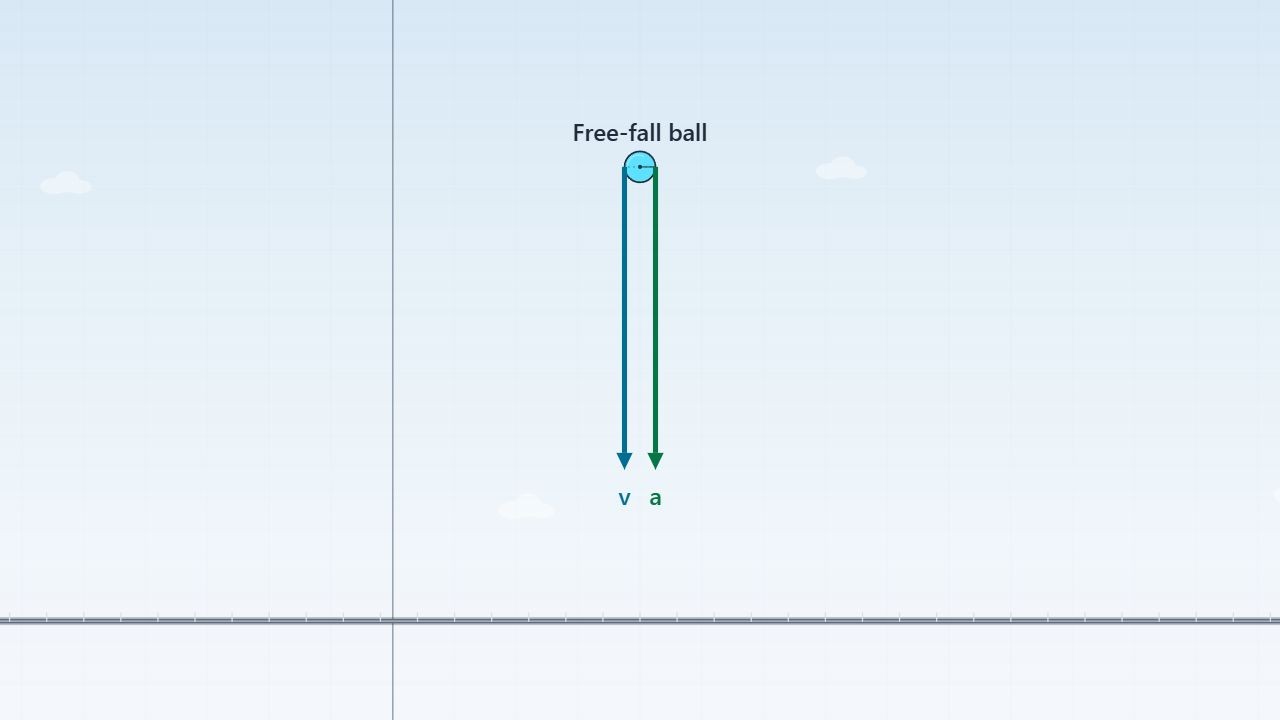
With air resistance ignored and upward positive, ay = −g. Mass does not change the free-fall acceleration.

The apex is an instant

Vertical velocity is zero at the highest point. Acceleration remains downward throughout the flight.

A quick comparison

Compare the highest point with a moment just before it.

At the apex: vy = 0Still: ay = −g

vertical velocitytimeSchematic relationship
Teaching this topic?Classroom fit, AP connections, and support
Classroom fit
Use for a concept introduction, guided independent practice, or a projected class discussion.
Before students begin
Constant acceleration, a consistent positive direction, and basic kinematics algebra.
Built-in support
Prepared scenes, guided prompts, and feedback on lesson questions.
AP Physics 1 connections
Unit 1: vertical motion under near-Earth gravity and motion graphs.
Check for understanding
Ask students to explain why zero velocity at the apex does not mean zero acceleration.
Optional extension
Collect additional evidence in the Free Fall lab.
Meet the educator behind Build Physics

Ready to test your thinking?

The first scene is set up. Start the lesson and explore.

Start lesson