BuildPhysics

AP Physics 1 · Unit 2, Part 1 · Forces

Static and Kinetic Friction

Increase a push, cross the slipping threshold, and compare how static and kinetic friction affect motion on surfaces and ramps.

Start lesson
  • Free
  • No account required
  • Self-paced
Static and Kinetic Friction guided lesson preview Start guided lesson
Explore the model. Make predictions. Check your thinking.

Learn by doing

Three ideas you’ll put into motion

Test static friction

Observe how friction adjusts while an object remains at rest.

Start sliding

Identify the threshold for slipping and compare the force during sliding.

Apply the model

Use the normal force and friction coefficients to explain motion on level surfaces and inclines.

The big idea

The key ideas, at a glance.

Static friction can adjust

Static friction satisfies fs ≤ μsN. The value μsN is its maximum, not its value in every situation.

Kinetic friction acts during sliding

In the simple model, fk = μkN. Its direction opposes relative sliding at the contact.

A quick comparison

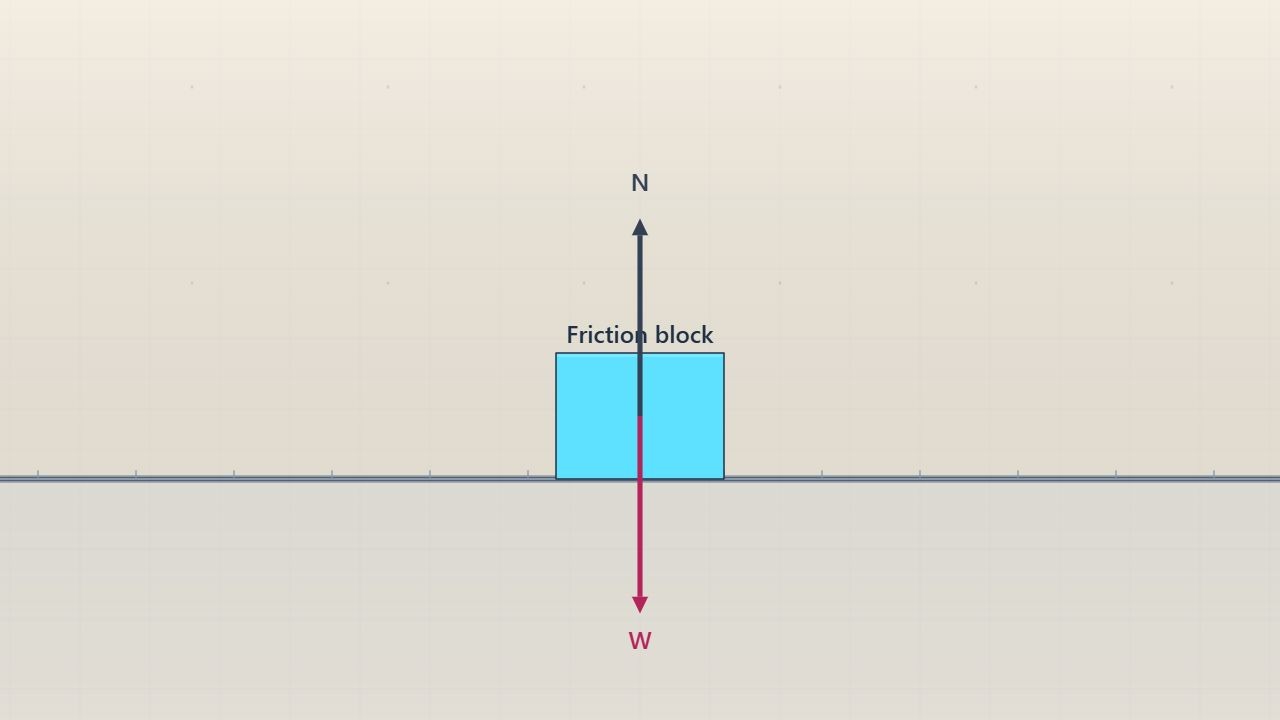
A small push acts on a block that stays at rest on a level surface.

Static friction matches the push until its limit is reached.

normalweightfrictionpush
Teaching this topic?Classroom fit, AP connections, and support
Classroom fit
Use for a concept introduction, guided independent practice, or a projected class discussion.
Before students begin
Normal force, force diagrams, and the distinction between rest and acceleration.
Built-in support
Prepared scenes, guided prompts, and feedback on lesson questions.
AP Physics 1 connections
Unit 2: static and kinetic friction and the normal force.
Check for understanding
Ask why using f = μN for every stationary object can give an incorrect force.
Optional extension
Compare trials in the Static Versus Kinetic Friction lab.
Meet the educator behind Build Physics

Ready to test your thinking?

The first scene is set up. Start the lesson and explore.

Start lesson