BuildPhysics

AP Physics 1 · Unit 8 · Fluids

Hydrostatics

Compare connected liquid columns and use their measured levels to find an unknown gas pressure or liquid density.

Start lesson
  • Free
  • No account required
  • Self-paced
Hydrostatics guided lesson preview Start guided lesson
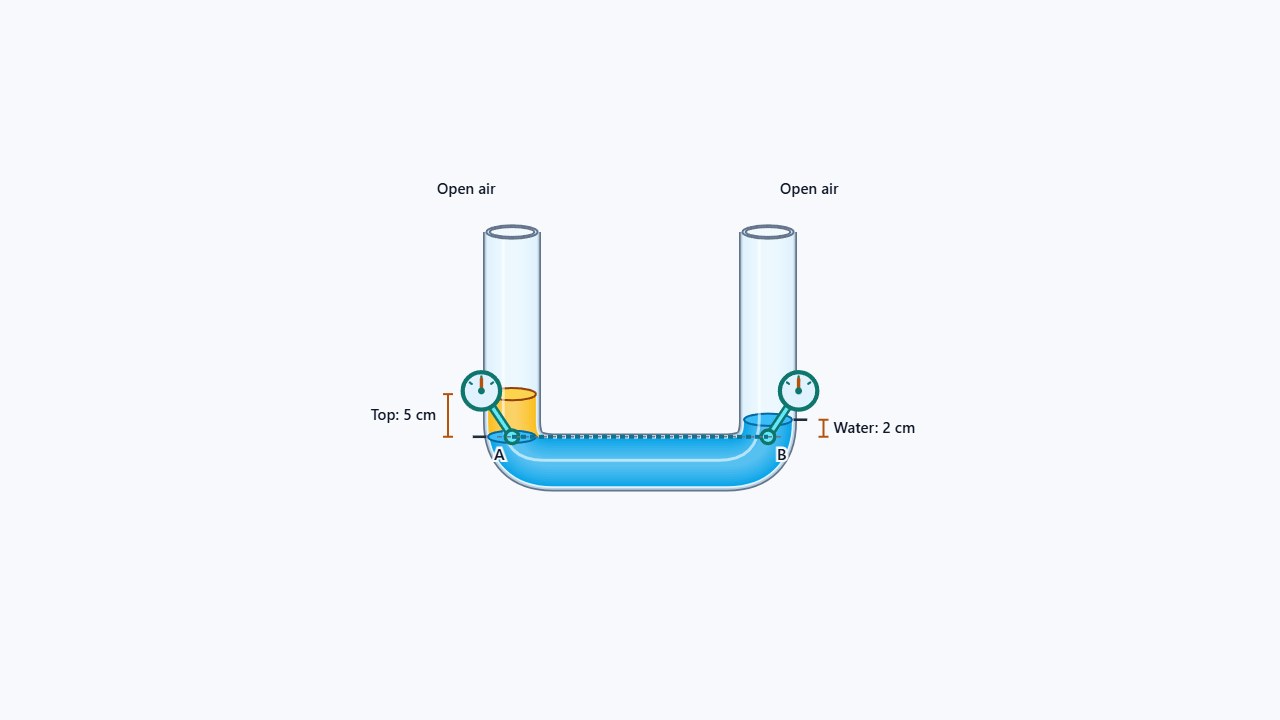
Compare the two connected water columns and determine the density of the separate top liquid.

Learn by doing

Three ideas you’ll put into motion

Choose a comparison level

Measure pressures at equal heights in connected stationary liquid and test the limits of this rule.

Read a manometer

Connect surface-level differences with gas-pressure differences, then calculate and check an unknown pressure.

Balance different liquids

Develop a two-liquid pressure balance, determine an unknown density and design a target pressure setting.

The big idea

The key ideas, at a glance.

Match points in connected liquid

At the same height in the same connected stationary liquid, pressures are equal. Moving downward adds ρgh; moving upward subtracts it.

Include each column above the line

For two liquids open to the same atmosphere, the pressure balance gives ρfhf = ρwhw. The heights belong to the columns above the chosen comparison level.

A quick comparison

Double a gas-pressure difference while keeping the measuring-liquid density and gravity fixed.

The equilibrium surface-level difference becomes twice as large.

pressure differencetwice the differenceThe liquid levels reveal the pressure balance
Teaching this topic?Classroom fit, AP connections, and support
Classroom fit
Use for a concept introduction, guided independent practice, or a projected class discussion.
Before students begin
Density, pressure, atmospheric and gauge pressure, and P = P₀ + ρgh. The Pressure lesson prepares these ideas.
Built-in support
Prepared scenes, guided prompts, and feedback on lesson questions.
AP Physics 1 connections
Unit 8, Topic 8.2: hydrostatic pressure. Use a reference pressure and liquid columns to construct mathematical representations and justify claims from measurements.
Check for understanding
Ask students to choose a valid equal-pressure line, distinguish a level difference from a whole column height, and explain why equal height alone is insufficient when the points are in different liquids.
Meet the educator behind Build Physics

Ready to test your thinking?

The first scene is set up. Start the lesson and explore.

Start lesson