Separate horizontal and vertical motion
Resolve launch velocity into components. Use constant horizontal velocity and downward vertical acceleration when air resistance is negligible.
 BuildPhysics
AP Physics 1 · Unit 1 · Kinematics
Combine horizontal motion with vertical free fall. Practice horizontal and angled launches, targets at different heights, barrier clearance, and two launch angles that give the same range.
12 questions6 conceptual · 6 calculation
Start practiceFree · No account required · Self-paced
 Open interactive practice
What you’ll practice
Resolve launch velocity into components. Use constant horizontal velocity and downward vertical acceleration when air resistance is negligible.
Calculate flight time, range, maximum height, and velocity at selected points. Include the difference between launch and landing heights.
Find a projectile’s height at a given horizontal position. Compare complementary launch angles for a level-ground landing.
A question from this set
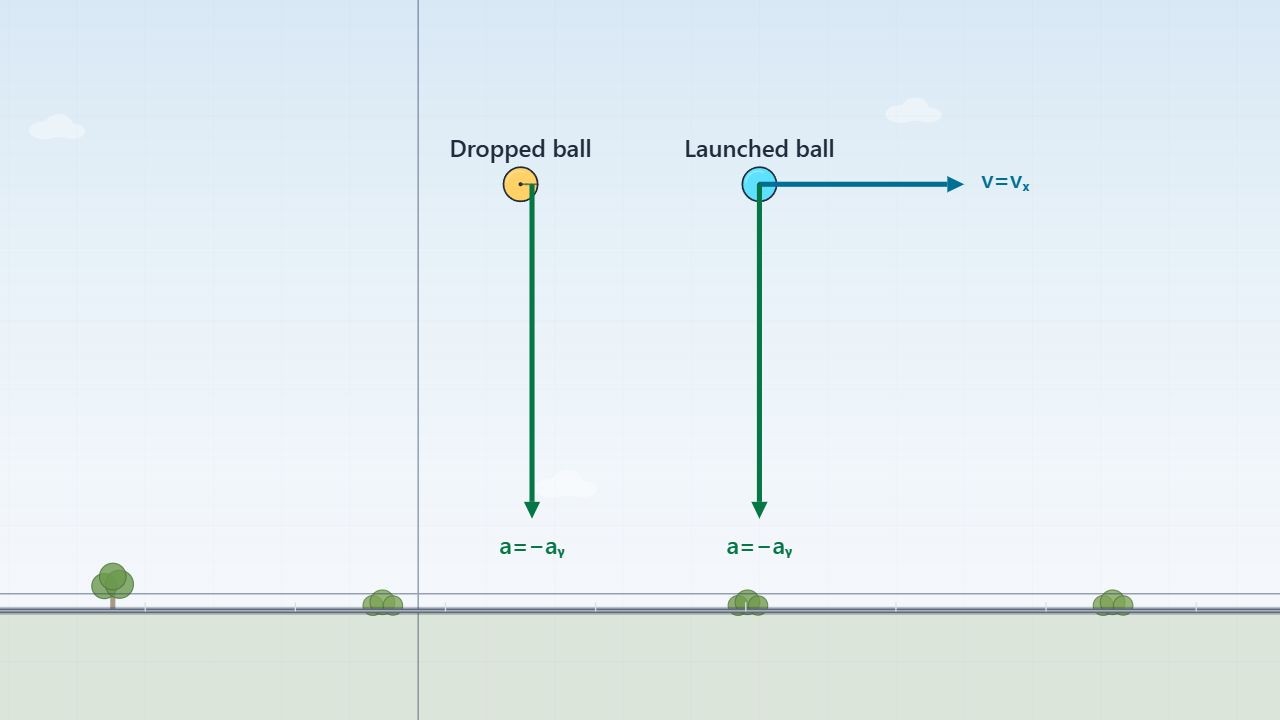
Two balls start at the same height at separated positions along a ledge. One is dropped from rest; the other is launched horizontally. They are released simultaneously, and air resistance is negligible. Which reaches the lower level first?
Try it in the practice setKey ideas
With gravity acting vertically, horizontal acceleration is zero. Use the horizontal displacement and velocity to find the time at a target or barrier.
Use the same time in the vertical-motion equation. At the peak of an angled launch, vertical velocity is zero while horizontal velocity generally remains nonzero.
See the physics
Check your answer, then run the prepared launch. Compare dropped and horizontally launched balls, inspect velocity components, and see whether a calculated trajectory clears its barrier or reaches the target.
Use a hint for a starting point or open a worked solution to follow the reasoning. Your progress saves in this browser, so you can return to unfinished questions.
Begin with a conceptual question, then work through the calculations.