Locate weights and moment arms
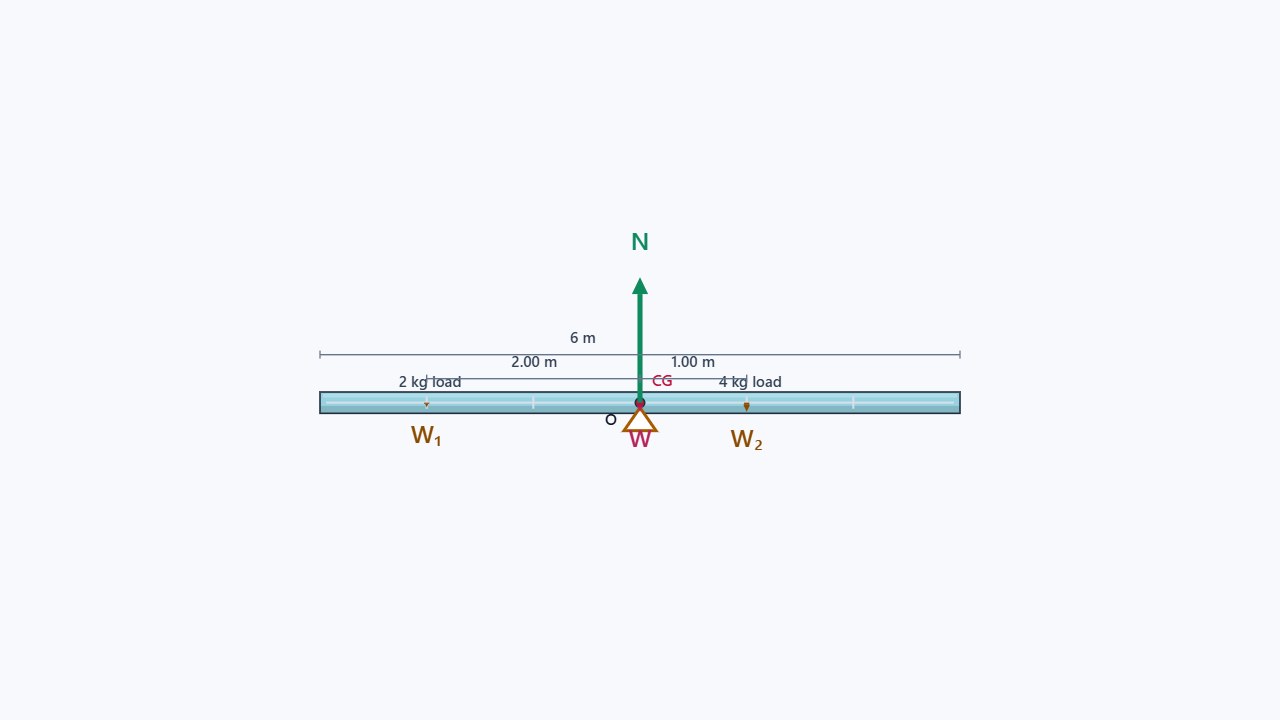
Use the measured balance mark of a nonuniform stick and retain a uniform beam’s own weight. Distinguish a load coordinate from its distance to the support.
 BuildPhysics
AP Physics 1 · Unit 5 · Rotation
Use force balance and moment balance together. Find a forearm’s muscle force, infer a meter stick’s mass, follow a beam toward tipping, resolve three rope tensions, and calculate the cable and hinge forces supporting a sign.
12 questions6 conceptual · 6 calculation
Start practiceFree · No account required · Self-paced
 Open interactive practice
What you’ll practice
Use the measured balance mark of a nonuniform stick and retain a uniform beam’s own weight. Distinguish a load coordinate from its distance to the support.
Resolve muscle, cable, and hinge forces using the stated angle reference. Use both horizontal and vertical force equations after a moment equation eliminates convenient unknowns.
Distinguish steady rotation from static equilibrium, change a moment reference without moving the support, and identify tipping when a pushing support unloads.
A question from this set
A rigid wheel about a fixed axle has zero net torque. Which motion is consistent with rotational equilibrium?
Try it in the practice setKey ideas
Taking moments about a support removes that support force from the moment equation. It does not remove the force from the physical system or from other equilibrium equations.
A resting contact can push upward but cannot hold a beam down. A hinge or joint can exert signed components in either direction, and a taut rope pulls along its length. These distinctions determine which equilibrium solutions are possible.
See the physics
After attempting the questions, inspect measured force and moment sums. The moving worker load advances along a free beam on two supports; the recorded unloading event identifies the tipping position. Other trials compare cable angles, support references, and alternative load placements.
Use a hint for a starting point or open a worked solution to follow the reasoning. Your progress saves in this browser, so you can return to unfinished questions.
Begin with a conceptual question, then work through the calculations.