
Core idea
Work measures energy transferred through displacement
A force does work when it has a component along an object’s displacement. For a constant force, the amount and sign are set by the force magnitude, the distance traveled, and the angle between them:
W = Fd cosθ = Fparalleld
Positive work transfers energy into the object, negative work removes kinetic energy, and a perpendicular force does zero work. The work–kinetic energy theorem connects the total work from all forces to the object’s change in translational kinetic energy:
Wnet = ΔK = Kf − Ki
K = ½mv2
Direction matters
Use the angle between force and displacement. A force can be large and still do zero work if it is perpendicular to the path.
Speed is squared
At fixed mass, doubling speed makes kinetic energy four times larger. Kinetic energy is a scalar, not a vector.
Guided lesson path
Test the sign, size, and source of every energy change
- Observe constant kinetic energy. A 3 kg block moving at 4 m/s on a frictionless track has K = ½(3)(42) = 24 J. With no net work, the graph stays level.
- Compare two speeds. For equal 3 kg masses moving at 2 m/s and 4 m/s, kinetic energies are 6 J and 24 J. Doubling speed quadruples K.
- Compare two masses. At the same 3 m/s speed, 2 kg and 6 kg masses have 9 J and 27 J. At fixed speed, K scales directly with mass.
- Remember that energy is a scalar. Reversing a 4 m/s velocity does not make kinetic energy negative. The squared speed still gives 24 J for a 3 kg block.
- Define work with displacement. A work calculation requires force, displacement, and the angle between them. Mass and elapsed time alone are not enough.
- Predict positive work. An 8 N force to the right moving a block 3 m right does W = (8 N)(3 m) = +24 J.
- Check the work–energy theorem. In the positive-work trial, the +24 J net work matches the increase from 0 J to 24 J of kinetic energy.
- Predict negative work. An 8 N braking force to the left while a 3 kg block moves 3 m right does −24 J and removes the block’s initial 24 J of kinetic energy.
- Stop the block with negative work. When K changes from 24 J to 0 J, the signed work is ΔK = 0 − 24 = −24 J. The block stops after the braking force has removed its kinetic energy.
- Test a perpendicular force. A 12 N upward force on a block moving horizontally has θ = 90°, so W = Fd cos90° = 0 J even though the force is present.
- Identify all zero-work support forces. Weight, normal force, and the upward applied force each do zero work during a purely horizontal displacement because each is perpendicular to the path.
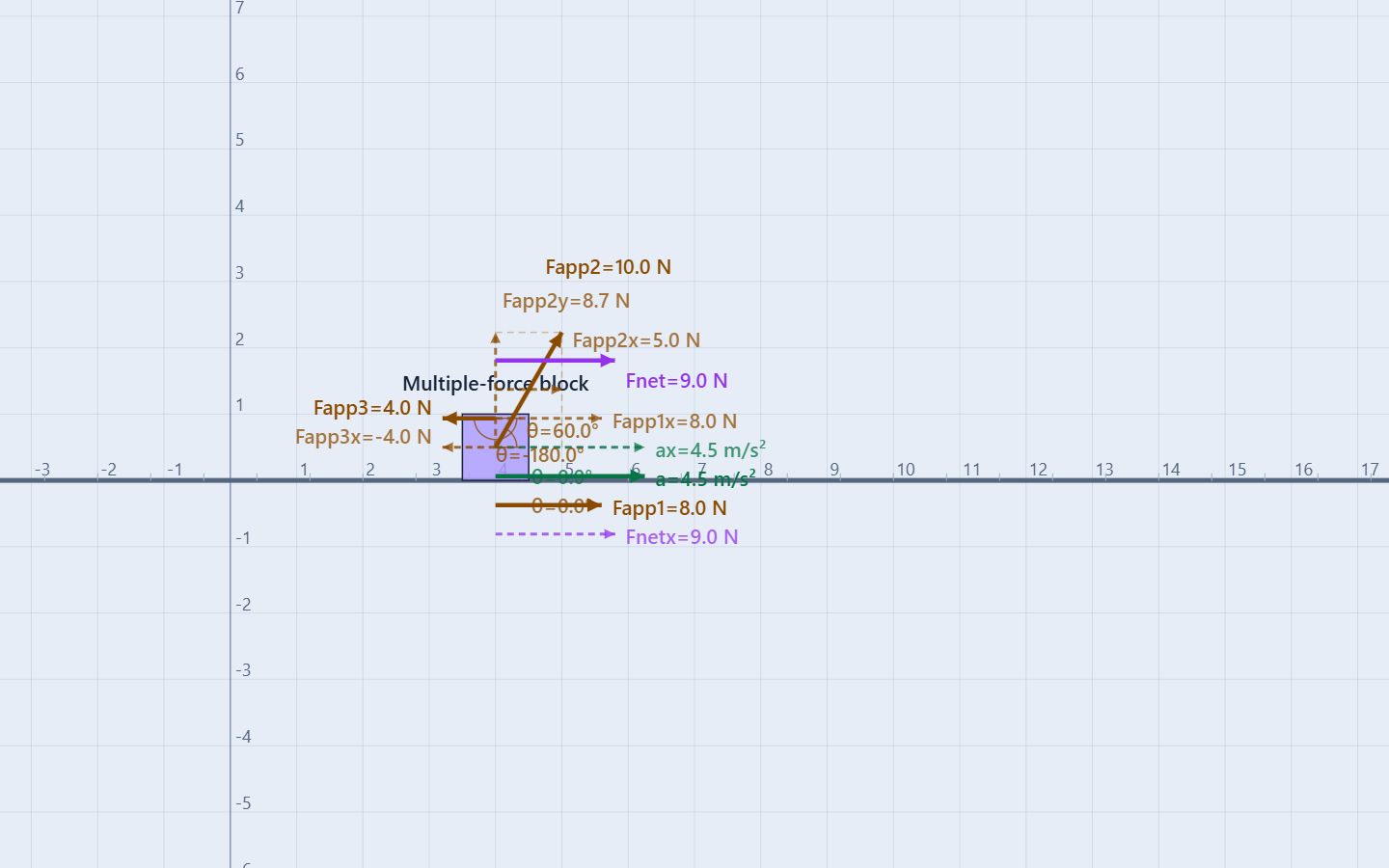
- Resolve an angled force. A 10 N force at 60° above a 4 m horizontal displacement has Fparallel = 10 cos60° = 5 N and W = 20 J.
- Connect angled work to ΔK. Only the 5 N horizontal component changes the block’s kinetic energy. The vertical component changes the normal-force balance but does no work without vertical displacement.
- Add work from multiple forces. Calculate each force’s signed work, then add them. The net work is the sum of work contributions, not the largest individual work.
- Use net work to find final speed. Rearrange Kf = Ki + Wnet, then solve vf = √(2Kf/m). Work can predict speed without solving for time.
- Compare equal work intervals. Equal positive work gives equal changes in kinetic energy. The speed change itself need not be equal because K depends on v2.
- Measure friction work. A 4 N kinetic-friction force opposite a 4 m displacement does −16 J. The negative sign records energy transferred out of the moving object.
- Finish with the theorem. State the system, identify every force that does work, assign each sign from its direction, add the contributions, and compare Wnet with Kf − Ki.
| Force relative to displacement | Angle | Work sign | Effect on kinetic energy |
|---|---|---|---|
| Same direction | 0° | Positive | Increases K |
| Opposite direction | 180° | Negative | Decreases K |
| Perpendicular | 90° | Zero | No change from that force |
| Angled | 0° < θ < 180° | F d cosθ | Depends on the parallel component |
Worked examples
Keep the signs and units visible
For a 3 kg block moving at 4 m/s:
Ki = ½mv2 = ½(3 kg)(4 m/s)2 = 24 J
For an 8 N force parallel to a 3 m displacement:
W = Fd cos0° = (8 N)(3 m)(1) = +24 J
Kf = Ki + Wnet = 0 + 24 = 24 J
For an 8 N braking force over the same 3 m path:
W = Fd cos180° = (8 N)(3 m)(−1) = −24 J
ΔK = Kf − Ki = 0 − 24 = −24 J
For a 10 N force at 60° over 4 m:
Fparallel = F cos60° = 10(0.5) = 5 N
W = Fd cos60° = (10 N)(4 m)(0.5) = 20 J
Force and position
Use the area under the curve for varying force
When force changes with position, the work is the area under the curve on a force-versus-position graph. Regions above the position axis contribute positive work, and regions below it contribute negative work. Add the positive and negative regions to find total work before applying Wnet = ΔK.
| Graph region | Area calculation | Work |
|---|---|---|
| Constant 8 N from 0 to 3 m | Rectangle: (8 N)(3 m) | +24 J |
| Force drops from 4 N to 0 N over 3 m | Triangle: ½(3 m)(4 N) | +6 J |
| Force is −4 N from 3 to 8 m | Rectangle: (−4 N)(5 m) | −20 J |
| Complete profile from 0 to 8 m | +6 J + (−20 J) | −14 J |
The endpoint force alone does not determine work. A varying-force graph records how much force acts at every position, so the area under the curve captures the full energy transfer.
Force accounting
Add contributions before using kinetic energy
For a block moving horizontally, gravity and the normal force can be large while doing zero work if there is no vertical displacement. A horizontal push and friction can have opposite signed work. Calculate each contribution with its own direction, then use the total:
Wnet = Wpush + Wfriction + Wgravity + Wnormal
Do not call a force’s work “zero” merely because the object is accelerating. Check the angle and the displacement component for that specific force.
Predict motion
Use work to solve for final speed
Once the net work and initial kinetic energy are known, the final speed follows from the energy change:
Kf = Ki + Wnet
vf = √(2Kf/m)
This method avoids finding the elapsed time. It is especially useful when force varies with position or when the path is easier to measure than the time history.
Common misconceptions
Check the reasoning
Does every force on a moving object do work?
No. A perpendicular force can act continuously while doing zero work because it has no component along the displacement.
Is kinetic energy negative when velocity is negative?
No. Kinetic energy uses speed squared, so it is a nonnegative scalar.
Does force magnitude alone determine work?
No. Work also depends on displacement and the angle between force and displacement.
Does a force pointing down always do negative work?
No. The sign depends on displacement. A downward force does positive work during a downward displacement and negative work during an upward displacement.
Does zero acceleration mean zero work?
Zero acceleration means the net force is zero, so the net work and kinetic-energy change are zero. Individual forces can still do work that cancels: if an 8 N push moves a block 3 m right at constant speed, the push does +24 J while 8 N of friction does −24 J. The block’s speed stays the same because the total work is 0 J.
Does equal work produce equal speed changes?
Equal net work produces equal changes in kinetic energy, not equal changes in speed. For example, adding 24 J to a 3 kg block at rest changes its speed from 0 to 4 m/s. Adding the same 24 J to that block already moving at 4 m/s raises its kinetic energy from 24 J to 48 J, so its speed only rises to about 5.66 m/s. Because K = ½mv2, the same energy addition usually creates a smaller speed change when the object is already moving quickly.
Can I use only the final force value on a varying-force graph?
No. Use the area under the curve across the full displacement interval.
For teachers
Make direction and area carry the explanation
Begin with the 3 kg block moving at 4 m/s and ask students to calculate its initial kinetic energy before running the graph: Ki = ½mv2 = ½(3 kg)(4 m/s)2 = 24 J. Then alternate positive, negative, and perpendicular force trials so the sign comes from the force–displacement angle rather than from a memorized rule.
Have students record each force’s work separately in the angled and multiple-force trials. Finish with a force-versus-position graph and require them to describe each rectangle or triangle as an area under the curve before using the work–kinetic energy theorem.
Continue with Conservation of Mechanical Energy for potential-energy accounting, Work Done by Varying Forces for graph areas, and Power for the rate of energy transfer.