
Core idea
Work comes from area under a force–position curve
When a force changes with position, one endpoint force multiplied by the full displacement cannot describe the transfer. Read the force component parallel to motion at each position, then add the area under the curve, keeping the signs from regions above and below the axis.
W = area under the curve
Wnet = ΔK and P = Fxvx
Area above the position axis represents positive work. Area below the axis represents negative work. A changing force can produce triangles, rectangles, or several regions whose signs must be combined before using the work–energy theorem.
Graph height
At one position, the vertical value gives the force component at that location.
Graph area
Across an interval, the area under the curve gives work in joules. Regions above and below the axis contribute with different signs.
Guided lesson path
Read the graph, combine regions, and test the energy result
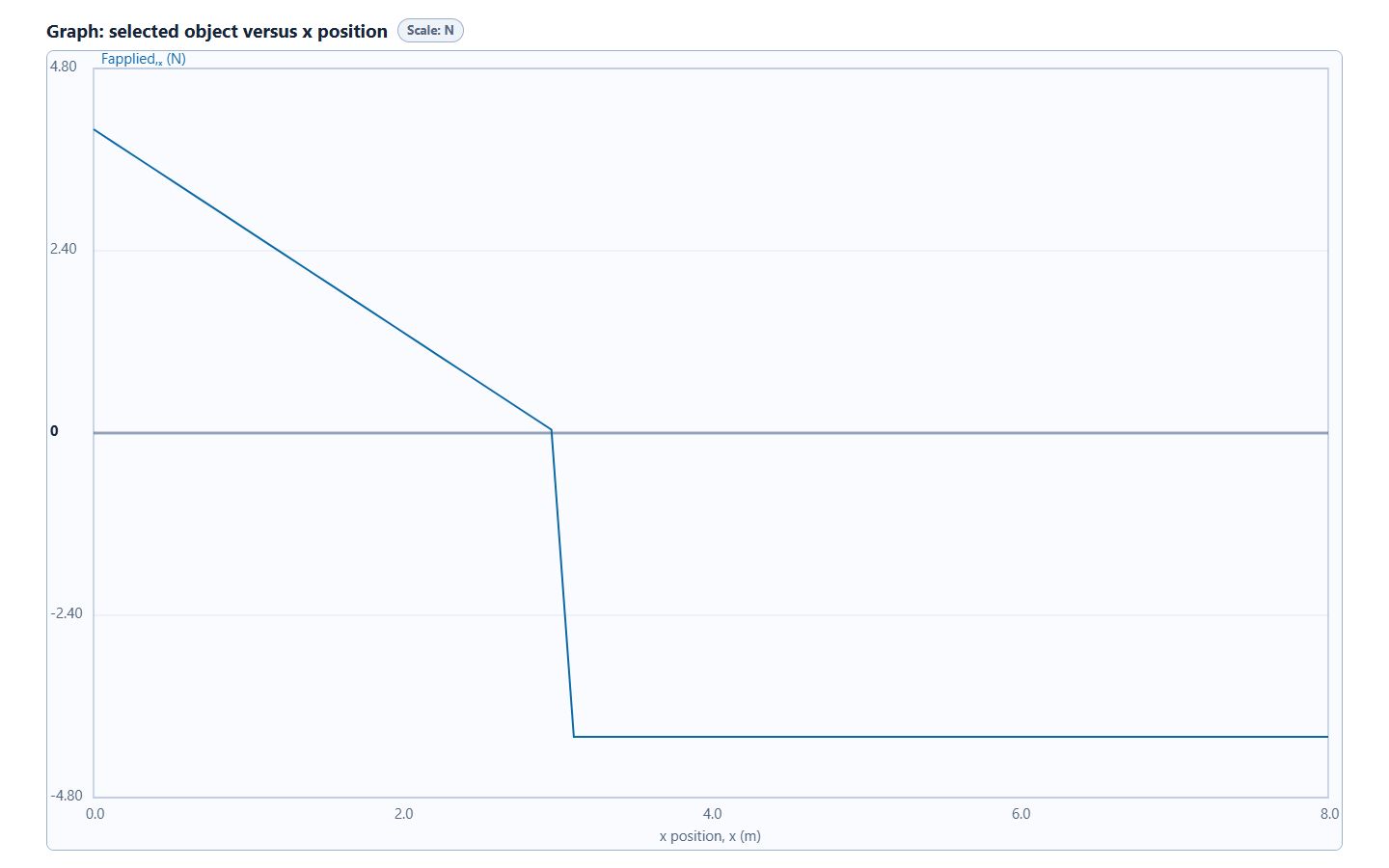
- Observe a changing force. A 4 kg cart starts at 4 m/s. Its horizontal force falls from +4 N to 0 N over the first 3 m, then becomes −4 N through x = 8 m.
- Read the axes. The horizontal axis is position x, not time. The graph height is the force component parallel to the cart’s displacement.
- Locate the first boundary. At x = 3 m the sloped positive-force line reaches the axis, so the force is 0 N at that position.
- Measure the positive region. From x = 0 to 3 m, the graph forms a triangle above the axis. Its area is ½(3 m)(4 N) = +6 J.
- Interpret the negative region. From x = 3 to 8 m, the force is −4 N while displacement remains positive. This below-axis rectangle represents negative work.
- Measure the negative region. The rectangle has width 5 m and height −4 N, so its work is (5 m)(−4 N) = −20 J.
- Combine the regions. The complete 0–8 m area is +6 J − 20 J = −14 J of net work.
- Reject the endpoint shortcut. The final force is −4 N, but total work is −14 J because the cart accumulated work across every position.
- Apply the work–energy theorem. Net work changes kinetic energy. Starting from Ki = 32 J, the cart finishes with Kf = 18 J.
- Calculate final speed. With m = 4 kg, 18 J = ½(4 kg)vf2, so vf = 3 m/s.
- Check the motion. Negative work makes the cart slow after the force changes sign, but it can continue moving right while its speed decreases.
- Compare a constant-force graph. An 8 N force over 4 m makes a rectangle with area +32 J, the same work as a 4 N force over 8 m.
- Use a spring graph. A spring force that rises linearly to 16 N over 4 m makes a triangle with area 32 J. The graph area is the energy transferred by the spring or external stretching force, with sign set by the chosen direction.
- Double the spring displacement. At fixed k, both the graph base and height double, so the triangular work area grows by a factor of four.
- Recheck each region with the Area tool. Select the complete 0–3 m triangle, the 3–8 m rectangle, and then the entire profile. The displayed values should be +6 J, −20 J, and −14 J.
- Reverse the path. Traveling from x = 8 m back to x = 0 m reverses the displacement direction, so the same profile gives +14 J instead of −14 J.
- Connect work with average power. If the forward interval takes 7 s, Pavg = −14 J ÷ 7 s = −2 W.
- Read local instantaneous power. At x = 8 m, Fx = −4 N and vx = +3 m/s, so P = −12 W at that instant.
- Keep work and power separate. Area over position gives work. Dividing total work by time gives average power. Multiplying local force by local velocity gives instantaneous power.
- Finish with the graph sequence. Read height, calculate each signed region, add the areas, apply Wnet = ΔK, and only then calculate speed or power.
| Region | Shape | Signed area | Meaning |
|---|---|---|---|
| 0–3 m | Triangle above axis | +6 J | Positive work |
| 3–8 m | Rectangle below axis | −20 J | Negative work |
| 0–8 m | Combined regions | −14 J | Net work and ΔK |
Read the graph
Height is force; area is work
At x = 2 m, the graph tells you the force at x = 2 m. It does not tell you the kinetic energy at t = 2 s, the average power through 2 m, or the impulse. Those quantities require different variables and intervals.
Above the axis
Force and positive displacement point in the same direction, so the region contributes positive work.
Below the axis
Force opposes positive displacement, so the region contributes negative work and removes kinetic energy.
Worked examples
Keep the geometry and signs visible
For the first triangular region:
W1 = ½(base)(height) = ½(3 m)(4 N) = +6 J
For the below-axis rectangle:
W2 = (5 m)(−4 N) = −20 J
For the complete interval and final speed:
Wnet = W1 + W2 = −14 J
Kf = Ki + Wnet = 32 J − 14 J = 18 J
vf = √(2Kf/m) = 3 m/s
Rectangles and triangles
Use the shape that matches the force profile
A constant force makes a rectangle: W = FxΔx. A force that rises linearly from zero makes a triangle: W = ½FfinalΔx. Break a more complicated graph into simple regions, assign each region a sign, and add them.
| Graph shape | Example dimensions | Work |
|---|---|---|
| Rectangle | 8 N across 4 m | +32 J |
| Triangle above axis | 0 to 16 N across 4 m | +32 J |
| Rectangle below axis | −4 N across 5 m | −20 J |
| Triangle plus rectangle | +6 J and −20 J | −14 J |
Spring connection
A linear spring makes a triangular work area
For an ideal spring, the restoring force changes linearly with displacement. Stretching from 0 to 4 m against a 4 N/m spring requires an external force rising from 0 to 16 N, so the area under the external-force graph is 32 J. The same result is Us = ½kx2.
When a stretched spring pulls an object toward equilibrium, the spring’s force and displacement can point in the same direction during that part of the motion, giving positive spring work. Keep the force direction and graph convention explicit.
Work and power
Power uses the local force and velocity
Average power uses the total area under the curve, including its positive or negative sign, over the elapsed time. Instantaneous power uses the force and velocity at one position or time:
Pavg = W/Δt
P = Fxvx
For the complete varying profile, W = −14 J over 7 s gives −2 W average. At the endpoint, the local values Fx = −4 N and vx = +3 m/s give −12 W instantaneous power.
Direction matters
Reversing displacement reverses the work
Work is the dot product of force and displacement. If the cart traverses the same force profile from x = 8 m to x = 0 m, the displacement direction reverses and the total work changes from −14 J to +14 J. Reversing a path is a useful sign check.
Common misconceptions
Check the reasoning
Can I multiply the final force by the total distance?
No. For a varying force, work depends on the area under the curve across the entire force–position graph.
Is every area under a graph positive?
No. Regions below the position axis represent negative work for positive displacement.
Does negative work mean the cart must immediately reverse?
No. Negative work can slow a cart while it continues moving in the same direction.
Does net work equal final kinetic energy?
No. Net work equals the change in kinetic energy: Wnet = Kf − Ki.
Is a force–position graph a force–time graph?
No. Its horizontal coordinate is position. Its area has work units, not impulse units.
Does a large force always mean large power?
No. Power also depends on velocity and force direction. A perpendicular force has zero instantaneous power.
Does reversing the path leave work unchanged?
No. Reversing the displacement reverses the sign of work for the same force field along the path.
For teachers
Make students select the whole interval
Begin with the piecewise profile and have students identify the axes before calculating anything. Ask them to predict +6 J for the triangle, −20 J for the rectangle, and −14 J for the combined area. Use the Area tool so the sign is visible rather than treating the graph as a picture to estimate.
Follow with the constant-force rectangle and spring triangle to compare geometry. Then require students to use Wnet = ΔK to predict 3 m/s and to distinguish total work from local instantaneous power at x = 8 m.
Continue with Work and Kinetic Energy for the theorem, Power and Energy Transfer for rates, and Conservation of Energy with External Work for system-boundary accounting.