
Core idea
Mechanical energy changes form while the total is tracked
Mechanical energy is the sum of the kinetic and potential energies included in the chosen system. In a closed model with only conservative internal interactions, energy moves between forms while the total mechanical energy stays constant.
Emech = K + Ug + Us
Ki + Ui = Kf + Uf
Friction and an applied push can transfer energy across the system boundary. Mechanical energy can then decrease or increase even though total energy is still conserved in a larger accounting system. Start by naming the system, the initial and final states, and the reference level.
Conservative exchange
Gravity and ideal springs trade potential and kinetic energy without changing the mechanical-energy total.
External transfer
Friction and applied work move energy across the chosen boundary, so include their work or account for the transformed energy.
Guided lesson path
Follow energy from the starting state to the final state
- Identify the stores. List kinetic energy, gravitational potential energy, and elastic potential energy that belong to the chosen system.
- Write the conservation equation. For a frictionless system, use Ki + Ui = Kf + Uf and state which potential-energy terms are present.
- Recognize the condition. Mechanical energy is conserved only when the chosen model has no non-conservative energy transfer across its boundary.
- Choose the boundary, states, and reference. Decide which objects are included, record initial and final positions and speeds, and set Ug = 0 at a convenient level.
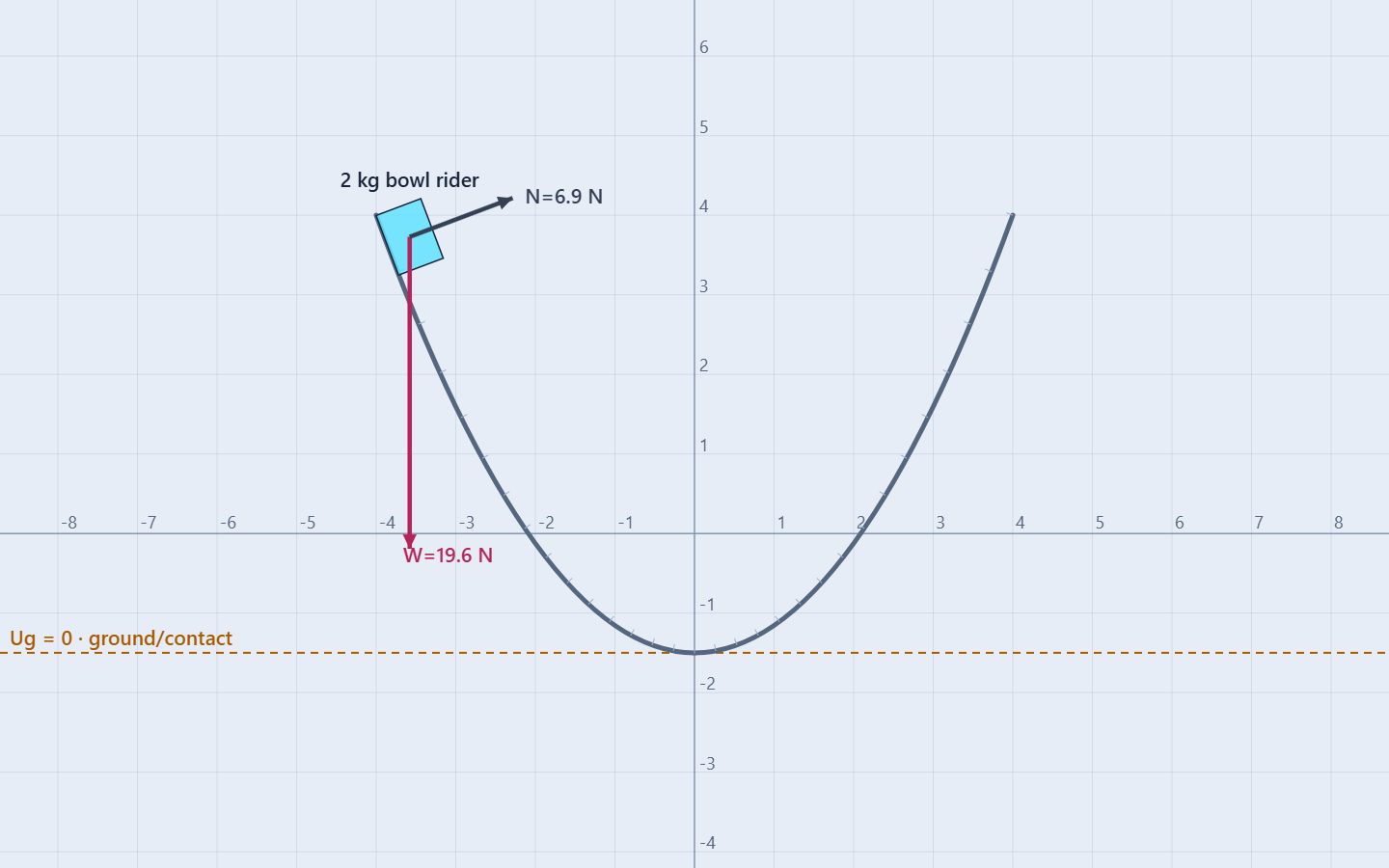
- Predict the frictionless bowl. A skater released high on one side converts gravitational potential energy into kinetic energy while descending.
- Watch Ug decrease. As height falls, gravitational potential energy decreases by the same amount that kinetic energy increases.
- Watch K increase. Speed is greatest near the bottom because the skater has converted the largest available amount of Ug into K.
- Test the total. Add K and Ug at several positions. The total should remain approximately constant in the frictionless run.
- Interpret the bottom state. At the lowest point, Ug is smallest relative to the reference and K is largest, but the mechanical-energy total is unchanged.
- Follow energy to the opposite side. The skater slows as K changes back into Ug. Equal heights on opposite sides correspond to equal speeds in the ideal model.
- Explain the normal force. The bowl’s normal force changes the direction of velocity but does no work when it remains perpendicular to the path, so it does not change the mechanical-energy total.
- Predict a vertical drop. For a 2 m drop from rest, gravitational work changes kinetic energy by mgh = (m)(9.8)(2). The mass cancels when solving the final speed.
- Measure ΔUg. A downward 2 m change gives ΔUg = −mgh. The negative potential-energy change matches positive gravitational work.
- Measure ΔK. In the frictionless drop, ΔK = +mgh, so ΔK + ΔUg = 0.
- Calculate the final speed. From rest after a 2 m drop, Kf = mgh and vf = √(2gh) ≈ 6.26 m/s, independent of mass.
- Use height–speed reasoning. A larger vertical drop provides more available gravitational potential energy and therefore a larger final speed in the same ideal model.
- Test mass independence. Changing mass scales K and Ug by the same factor, so the maximum height and speed relationships can remain unchanged.
- Analyze a projectile state. At the apex of a launch, vertical velocity can be zero while horizontal kinetic energy remains. Include both K and Ug in the energy equation.
- Verify the projectile accounting. Compare kinetic energy at launch and at maximum height with the corresponding gravitational potential-energy increase. The mechanical-energy total should agree.
- Finish with the decision test. If the total mechanical energy changes, identify the external work, friction, or other non-conservative transfer responsible before declaring energy “lost.”
| Position | Gravitational energy | Kinetic energy | Mechanical total |
|---|---|---|---|
| Release point | Largest | Small or zero | Constant |
| Descending side | Decreasing | Increasing | Constant |
| Bottom | Smallest | Largest | Constant |
| Opposite side | Increasing | Decreasing | Constant |
Worked examples
Write the initial and final energy states
For a 2 kg object released from rest and dropping 2 m:
Ki + Ugi = Kf + Ugf
0 + mgh = ½mvf2 + 0
vf = √(2gh) = √(2·9.8·2) = 6.26 m/s
The energy changes show the same result:
ΔUg = (2 kg)(9.8 m/s2)(−2 m) = −39.2 J
ΔK = +39.2 J; ΔEmech = ΔK + ΔUg = 0 J
For an object launched from ground level with horizontal and vertical velocity components, use total kinetic energy at launch and at the apex:
K = ½m(vx2 + vy2); at the apex, vy = 0 but vx can remain nonzero.
System boundaries
“Conserved” depends on what the system includes
If the skater and Earth are included, gravitational potential energy is an internal store and gravity transfers energy between Ug and K. If Earth is outside the system, gravitational work crosses the boundary and must appear as an energy transfer.
With friction, the skater–Earth system can still conserve total energy while mechanical energy decreases. The missing mechanical energy has become thermal energy at the contact. A changing Emech is evidence of a transfer or transformation, not energy disappearing.
| Chosen system | Energy terms | What changes |
|---|---|---|
| Skater + Earth, frictionless | K + Ug | Emech remains constant |
| Skater + Earth, with friction | K + Ug + thermal energy | Total energy remains constant; Emech decreases |
| Skater only | K plus external work by gravity and contact | Work crosses the boundary |
| Object with an elastic spring | K + Us | Spring energy trades with kinetic energy |
Reference levels
Changing Ug = 0 does not change motion
Choose a zero level that makes the states easy to describe. Every Ug value shifts when the reference moves, but differences between the same two heights do not:
ΔUg = mg(yf − yi)
Use the same reference in the initial and final terms of one equation. Mixing reference levels can create an artificial energy imbalance even when the physical model is correct.
Friction and energy
Mechanical energy can decrease while total energy is conserved
Friction does negative work on the moving object. In a mechanical-energy-only account, that lowers Emech. In a larger energy account that includes the surfaces, the same amount appears as thermal energy generated at the contact.
This is why a skater with friction does not return to the same height on the opposite side. Some of the initial mechanical energy has been transferred into thermal energy, so the next turning point is lower.
Common misconceptions
Check the reasoning
Does conservation mean K and U stay constant individually?
No. In a frictionless bowl, K and Ug change continuously while their sum remains constant.
Does a zero mechanical-energy change mean no forces act?
No. Gravity and the normal force act throughout the bowl. Gravity changes energy form, and the normal force can redirect motion without doing work.
Does friction destroy energy?
No. Friction transfers mechanical energy into thermal energy. Total energy remains conserved in a sufficiently large system.
Does changing the zero reference change speed?
No. It changes individual potential-energy values but not energy differences or physical predictions.
Does mass change the speed after the same frictionless drop?
No. Mass scales both the available gravitational energy and the kinetic-energy requirement, leaving v = √(2gh).
Is kinetic energy zero at the top of a projectile?
Only the vertical component of velocity is zero there. Horizontal velocity can remain, so the projectile can still have kinetic energy.
For teachers
Make the energy total a measured claim
Start by asking students to list the energy stores before they run the frictionless bowl. Have them record K, Ug, and Emech at the release point, bottom, and opposite side instead of treating “conservation” as a slogan.
Next, add friction and ask where the mechanical-energy decrease went. Finish with the 2 m drop and projectile apex trials so students see mass cancellation, horizontal kinetic energy, and the importance of the system boundary.
Continue with Conservative Forces and GPE for path independence and reference levels, Work and Kinetic Energy for the work–energy theorem, and the Conservation of Mechanical Energy simulation for the full measurement sequence.