
Core idea
Power measures how quickly energy is transferred
Work measures the amount of energy transferred by a force. Power measures the rate of that transfer. The same 32 J of work can be delivered slowly or quickly, so the two processes can have different power even when their final energy change is the same.
Pavg = W/Δt
P = F · v = F∥v = Fv cosθ
Average power describes a complete time interval. Instantaneous power describes one moment. Only the component of force parallel to velocity contributes to instantaneous mechanical power: a perpendicular force can be large while doing zero power.
Average
Divide the total signed work or energy transfer by the elapsed time. The result can summarize a changing rate.
Instantaneous
Use the force component along the current velocity and the speed at that instant.
Guided lesson path
Start with one force, then resolve its direction
- Observe positive transfer. A 4 N force accelerates a 4 kg cart from rest on a frictionless track. The cart’s speed and kinetic energy increase.
- Define a watt. One watt is one joule per second. Power is a rate, so its units are J/s even when the transferred energy is described as work.
- Calculate baseline work. A 4 N force parallel to an 8 m displacement transfers W = Fd = 32 J.
- Measure the time. With 1 m/s2 acceleration from rest, the cart travels 8 m in 4 s.
- Calculate average power. Pavg = 32 J ÷ 4 s = 8 W. This is the average over the full interval.
- Derive instantaneous power. For a short displacement, P = F∥(Δx/Δt) = F∥v. The velocity is the position–time graph’s tangent slope.
- Check the starting instant. At t = 0 the force is already 4 N, but v = 0, so instantaneous power is 0 W.
- Check the midpoint. At t = 2 s the cart moves at 2 m/s, so the instantaneous power is (4 N)(2 m/s) = 8 W.
- Check the endpoint. At t = 4 s the cart moves at 4 m/s, so endpoint power is 16 W. The full-interval average is still 8 W.
- Compare graph shapes. With a constant parallel force, power is proportional to velocity. A linearly increasing velocity produces a linearly increasing power graph.
- Compare equal-work trials. Trial A transfers 32 J in 4 s. Trial B uses 8 N over 4 m, transfers the same 32 J in 2 s, and averages 16 W.
- Separate work from power. Equal work gives equal kinetic-energy change when it is net work, but it does not guarantee equal time, force, or power.
- Change the mass. Keeping 32 J fixed while doubling mass reduces acceleration and lengthens the transfer time, so average power decreases.
- Model a constant-speed lift. A 6 kg load rises 4 m at 2 m/s. The lifting force balances weight, so acceleration is zero while the lifting force still does positive work.
- Calculate lifting power. The load gains mgh = 235.2 J in 2 s, giving Pavg = 117.6 W.
- Climb faster. The same 235.2 J transferred in 1 s requires 235.2 W. Halving time doubles average power.
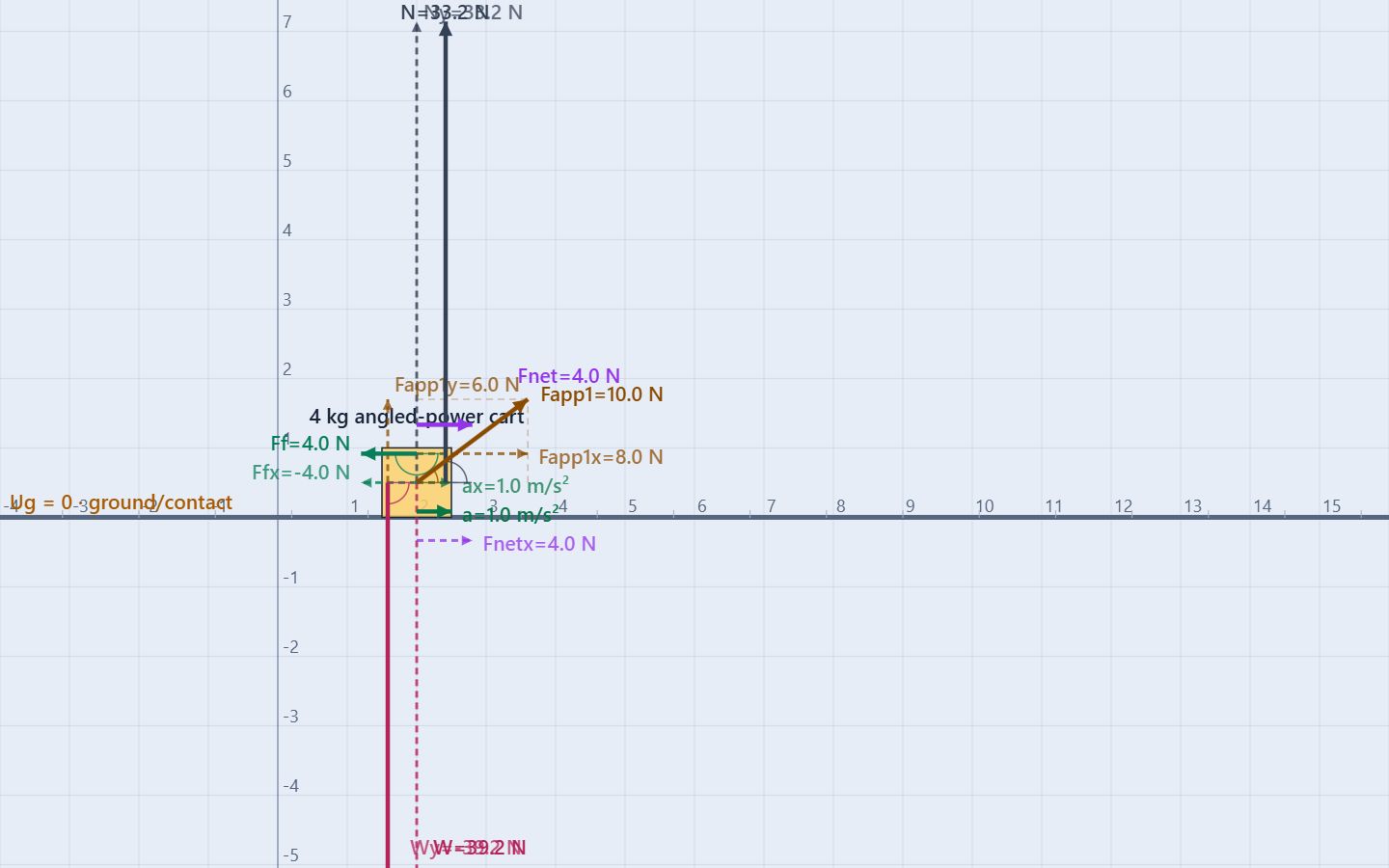
- Resolve an angled force. A 10 N machine force with an 8 N forward and 6 N upward component acts on a horizontally moving cart. Use the 8 N parallel component for power.
- Track a net force separately. If 4 N of friction opposes the 8 N forward component, the net horizontal force is 4 N. Net force determines acceleration; the machine’s own power uses its 8 N component.
- Measure machine power. At 2 m/s, the machine supplies 16 W. At 4 m/s, it supplies 32 W, even though its force component stays fixed.
- Interpret negative power. A braking force opposite velocity has negative power and removes mechanical energy. An 8 N brake removing 32 J in 2 s has average power −16 W.
- Interpret zero power. A 12 N upward force on a block moving horizontally at 3 m/s has P = Fv cos90° = 0 W because it is perpendicular to velocity.
- Finish with the direction test. Choose the interval for average power or the instant for instantaneous power, then project the force onto velocity before multiplying.
| State | Time | Speed | Instantaneous power |
|---|---|---|---|
| Start | 0 s | 0 m/s | 0 W |
| Midpoint time | 2 s | 2 m/s | 8 W |
| End | 4 s | 4 m/s | 16 W |
| Full interval | 4 s | — | Pavg = 8 W |
Average versus instantaneous
One interval can contain many different power values
For the baseline cart, power starts at 0 W, reaches 8 W at the midpoint, and ends at 16 W. The average is 8 W because the power–time graph rises linearly from 0 to 16 W. An average is useful for the whole interval; it does not replace the instantaneous values inside that interval.
Use average power
When you know total work or energy and the total elapsed time: Pavg = ΔE/Δt.
Use instantaneous power
When you know the current force, velocity, and angle: P = Fv cosθ.
Same work, different rate
Faster transfer means greater power
Trial A uses 4 N across 8 m in 4 s. Trial B uses 8 N across 4 m in 2 s. Both transfer 32 J and give the same 32 J kinetic-energy increase for a cart starting from rest, but Trial B has twice the average power.
| Trial | Force | Distance | Time | Average power |
|---|---|---|---|---|
| A | 4 N | 8 m | 4 s | 8 W |
| B | 8 N | 4 m | 2 s | 16 W |
Vertical transfer
Balanced forces can still produce positive power
A 6 kg load rising at constant 2 m/s has zero net force and zero acceleration, but the upward lifting force has positive power because it points with the velocity. Gravity has equal negative power. The load–Earth system gains gravitational potential energy at 117.6 W.
ΔUg = mgh = (6 kg)(9.8 N/kg)(4 m) = 235.2 J
Pavg = ΔUg/Δt = 235.2 J ÷ 2 s = 117.6 W
Force direction
Power uses the projection along velocity
The dot product automatically selects the force component parallel to velocity. For a 10 N force at an angle with an 8 N forward component, P = (8 N)v. The 6 N perpendicular component can change another part of the motion or the contact force without transferring energy through horizontal displacement.
| Force direction | θ | Power sign | Interpretation |
|---|---|---|---|
| With velocity | 0° | Positive | Energy enters the moving object |
| Perpendicular | 90° | Zero | No instantaneous work along the path |
| Against velocity | 180° | Negative | Energy leaves the moving object |
Graphs and units
Keep the axes and time interval explicit
On a position–time graph, tangent slope gives instantaneous velocity. Multiplying that slope by a fixed parallel force gives instantaneous power. On a power–time graph, the area under the curve gives the transferred energy over the selected interval.
Check dimensions as a quick error test: N·m/s = J/s = W. Work is measured in joules; power is measured in watts. A force value alone is not a power value until it is combined with velocity or a time interval.
Common misconceptions
Check the reasoning
Does more power always mean more energy?
No. Power can be larger because the same energy is transferred in less time.
Is power the same as force?
No. Power depends on force and velocity, including their relative direction.
Does a force do power when the object is instantaneously at rest?
No. If v = 0, instantaneous mechanical power is zero even if the force is nonzero.
Does net force determine the power of one force?
No. Net force determines acceleration. Power for a particular interaction uses that interaction’s force component along velocity.
Does a perpendicular force transfer energy through the motion?
No. Fv cos90° = 0, so its instantaneous power is zero.
Can average power be different from endpoint power?
Yes. If power changes during the interval, the average summarizes the whole curve and need not equal the final value.
Is negative power impossible?
No. Braking and friction commonly have negative power because they oppose velocity and remove mechanical energy.
For teachers
Make the time scale and force direction visible
Begin with the 4 N baseline trial. Have students record 0 W at the start, 8 W at the midpoint, 16 W at the end, and 8 W average. Ask them to state why one average cannot replace the changing instantaneous values.
Then compare the equal-work trials so students see that work controls energy change while time controls average power. Use the vertical lift to show that zero acceleration does not imply zero power, and finish with the angled-force and braking trials for positive, zero, and negative power.
Continue with Work and Kinetic Energy for the work–energy theorem, Work Done by Varying Forces for graph area, and Conservation of Energy with External Work for system-boundary accounting.