
Core idea
Work is energy crossing a system boundary
Energy conservation is always available, but the equation depends on what you include in the system. Kinetic and potential energies describe energy stored within the chosen system. Work describes energy transferred across its boundary by an external force.
Ei + Wnc = Ef
Ki + Ui + Wnc = Kf + Uf
Choose the system before deciding whether gravity, a spring, tension, or friction belongs as a potential-energy change, an internal transfer, or work across the boundary. A change in mechanical energy does not mean energy disappeared; it means energy entered, left, or changed form outside the mechanical stores you are tracking.
Narrow system
For the block alone, gravity can appear as external work. The block’s mechanical energy changes because work crosses the boundary.
Expanded system
For block + Earth, gravity is internal and belongs in Ug. For block + surfaces, friction can become thermal energy inside the larger system.
Guided lesson path
Build the accounting from one force to a connected system
- Name the system and states. Write the initial state, final state, and every object whose kinetic or potential energy you will include.
- Observe energy entering a block system. A 24 N upward force lifts a 2 kg block while its 19.6 N weight acts downward. The net force is 4.4 N upward, so the block accelerates upward.
- Calculate the applied work. Through a 2 m upward displacement, the lifting force transfers Wext = (24 N)(2 m) = +48 J.
- Track gravitational energy. The block–Earth separation increases by 2 m, so ΔUg = (2 kg)(9.8 N/kg)(2 m) = +39.2 J.
- Find the remaining kinetic change. The 48 J transfer is split between potential and kinetic energy: ΔK = 48 J − 39.2 J = +8.8 J.
- Do not double-count gravity. For a block–Earth system, represent gravity with ΔUg. Do not also add work by weight for the same interaction in the same equation.
- Write the full equation. List K, Ug, and Us at both states, then add signed non-conservative work across the boundary.
- Compare mechanical-energy change with work. When there is no elastic-energy change, Wnc = Δ(K + Ug). The mechanical-energy total rises by exactly the energy transferred in.
- Classify interactions. Gravity and an ideal spring can be represented with potential energy. An applied push and kinetic friction commonly appear as work terms for the selected system.
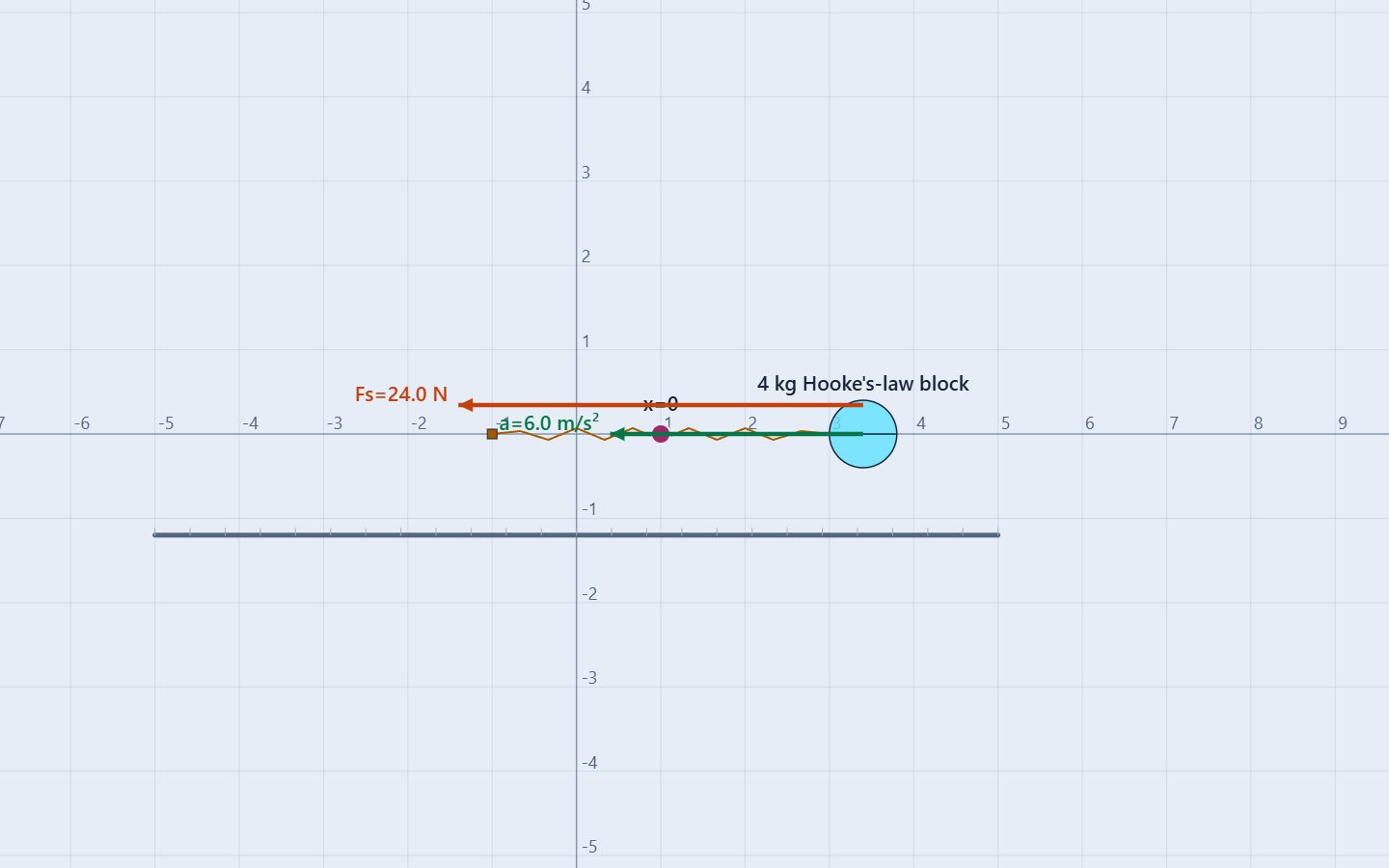
- Track a spring launch. A 4 kg block leaves a k = 8 N/m spring at x = 2 m. The spring supplies Us = 16 J, which becomes kinetic energy before friction acts.
- Measure friction’s work. A 4 N kinetic-friction force over 4 m does Wf = −(4 N)(4 m) = −16 J, bringing the 16 J block to rest.
- Explain the mechanical-energy decrease. The block’s K falls, but the energy is transferred into thermal energy at the contact. Total energy remains accounted for when the surfaces are included.
- Add a competing drive. An 8 N drive and 4 N friction act through 4 m. The signed work is +32 J − 16 J = +16 J, so K increases by 16 J.
- Use a conservative special case. A 2 kg block drops 4 m without friction or an applied force. Ug decreases by 78.4 J while K increases by about 78.4 J.
- State the conservation condition. Mechanical energy stays constant when net non-conservative work across the selected boundary is zero. Forces can still act and motion can still change.
- Include both parts of a connected system. A 4 kg table mass and a 2 kg hanging mass move with equal speed magnitudes because an ideal taut rope couples their motion.
- Inventory the initial kinetic energy. If both masses begin at 4 m/s, the table mass has 32 J and the hanging mass has 16 J, for Ki = 48 J.
- Separate internal and external forces. Tension between the masses is internal to the two-mass system. A 36 N pull and kinetic friction cross the boundary; gravity is represented by the hanging mass’s Ug.
- Add signed external work. Over 2 m, the pull does +72 J and 9.8 N friction does −19.6 J, so Wnc = +52.4 J.
- Track every final store. The hanging mass gains 39.2 J of Ug. The total K rises from 48 J to 61.2 J, so ΔEmech = 52.4 J, matching Wnc.
- Calculate the shared final speed. With Kf = 61.2 J and total mass 6 kg, ½(6 kg)vf2 = 61.2 J, giving vf ≈ 4.52 m/s.
- Change one transfer at a time. Reduce the pull or remove friction, run the same distance, and predict how the signed work and final kinetic energy respond.
- Finish with the decision test. Choose the boundary, list stores, assign reference levels, identify internal interactions, add signed external work, and compare both sides of the equation.
| Quantity | Value | Meaning |
|---|---|---|
| Wext | +48 J | Energy transferred into the system |
| ΔUg | +39.2 J | Energy stored in block–Earth separation |
| ΔK | +8.8 J | Remaining mechanical-energy increase |
| Δ(K + Ug) | +48 J | Matches the external work |
System boundaries
The same interaction can be described in two valid ways
For a block alone, Earth’s gravity crosses the boundary and can do work. For a block–Earth system, gravity is internal and changes Ug. Both descriptions predict the same final speed when used consistently.
| Chosen system | Gravity | Friction | Useful equation |
|---|---|---|---|
| Block only | External work | External work from the surface | Ki + Wg + Wf = Kf |
| Block + Earth | Ug inside system | External work unless surfaces are included | Ki + Ugi + Wf = Kf + Ugf |
| Block + Earth + surfaces | Ug inside system | Thermal energy inside system | Ei = Ef |
| Two masses + rope + Earth | Ug for height changes | External work from pull and contact | Ei + Wnc = Ef |
Friction and work
Negative work transfers mechanical energy into thermal energy
Kinetic friction points opposite the relative sliding and therefore does negative work when the object moves. For a constant friction magnitude, Wf = −fkd. The distance matters: a longer rough path transfers more mechanical energy out of K + U.
When the surfaces are included in the system, the same transfer appears as an increase in thermal or internal energy. Mechanical energy is not the same thing as total energy, so a decreasing K + U does not violate conservation.
16 J − (4 N)d = 0
d = 4 m
Connected systems
Use the rope constraint and count both masses
For the 4 kg table mass and 2 kg hanging mass, the ideal rope makes their speed magnitudes equal. The initial kinetic inventory is 32 J + 16 J = 48 J. After a 2 m interval, the pull and friction contribute +52.4 J of net non-conservative work while the hanging mass gains 39.2 J of gravitational potential energy.
ΔEmech = (61.2 J + 39.2 J) − 48 J = 52.4 J
vf = √(2Kf/(mtable + mhang)) = 4.52 m/s
Tension does not appear in the complete-system energy equation because it is internal to the selected boundary. If you isolate one mass instead, tension reappears as an external force on that smaller system.
Conservative special case
Zero non-conservative work gives mechanical-energy conservation
When Wnc = 0, the mechanical-energy total at the initial and final states is equal:
Ki + Ui = Kf + Uf
This does not require every force to vanish. Gravity can convert Ug into K, and an ideal spring can convert Us into K. The requirement is that no net non-conservative energy transfer crosses the chosen boundary.
Common misconceptions
Check the reasoning
Does a decrease in mechanical energy mean energy was destroyed?
No. The energy may have become thermal energy or crossed the boundary through friction or another external interaction.
Should gravity be counted as both work and Ug?
Choose one description for the same gravitational interaction. Use work when Earth is outside the system, or use Ug when the object–Earth pair is inside it.
Does energy conservation mean K stays constant?
No. K, U, and thermal energy can change while their total accounting remains consistent.
Is positive external work automatically all kinetic energy?
No. Work can become gravitational or elastic potential energy as well as kinetic energy.
Should internal tension appear in the two-mass system equation?
No. Tension forces act between objects inside that system and cancel in the complete accounting. They return when one mass is isolated.
Is friction always a violation of energy conservation?
No. Friction makes mechanical energy non-conservative, but total energy is conserved when the relevant thermal energy is included.
Does zero non-conservative work mean no forces act?
No. Conservative forces can still change velocity by exchanging kinetic and potential energy.
For teachers
Make the boundary choice precede the algebra
Start with the 2 kg lift and have students predict where the 48 J goes before opening the energy graph. Require them to calculate +39.2 J in Ug and +8.8 J in K, then ask why gravity should not be entered as a second work term for the block–Earth system.
Follow with the 16 J spring launch and 4 m rough-path trial so negative friction work has a measurable stopping distance. Finish with the connected 4 kg and 2 kg system: have students inventory both initial kinetic energies, remove internal tension from the system sum, and compare ΔEmech with Wnc.
Continue with Conservation of Mechanical Energy for frictionless energy exchanges, Conservative Forces and Gravitational Potential Energy for path independence, and Work and Kinetic Energy for the work–energy theorem.