
Plan the investigation
Connect two linear masses to a rotating pulley
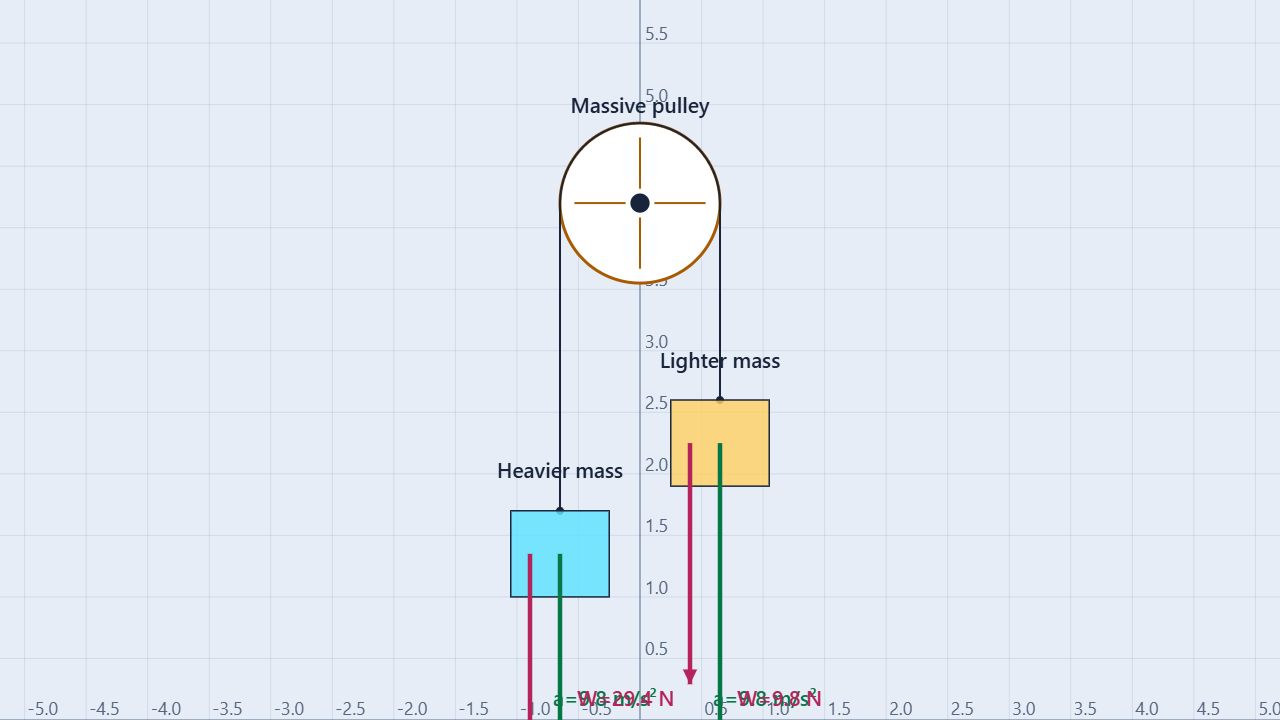
The prepared scene is an Atwood machine with a 3.00 kg heavier mass on the left, a 1.00 kg lighter mass on the right, and a 3.00 kg pulley with radius 0.65 m. The pulley has inertia factor k = 0.50, so it is modeled as a solid disk. The rope does not slip, which couples the masses’ linear acceleration to the pulley’s angular acceleration.
Keep fixed
Masses, pulley radius, rope connection, gravity at 9.80 m/s², and the starting positions for a controlled trial.
Change one variable
Change the pulley mass or inertia factor, then reset before comparing acceleration and both rope tensions.
The heavier mass descends and the lighter mass rises. A massive pulley does not remove the driving force; part of the mass difference’s effect accelerates the pulley’s rotation.
Build the model
Use three linked equations
Let a be the magnitude of the heavier mass’s downward acceleration. Because the rope does not slip, the pulley’s angular acceleration is α = a/R. Write Newton’s second law for each hanging mass and torque balance for the pulley:
mHg − TH = mHa
TL − mLg = mLa
(TH − TL)R = Ipα
For the pulley model, Ip = kMpR². Substituting α = a/R into the torque equation gives an effective rotational mass Ip/R² = kMp:
a = (mH − mL)g / (mH + mL + Ip/R²)
a = (mH − mL)g / (mH + mL + kMp)
With a massless pulley, both tensions are equal. With rotational inertia, the heavier-side tension is larger than the lighter-side tension; their difference supplies the pulley’s net torque.
Procedure
Measure acceleration and both tensions
- Load and inspect. Open Massive-Pulley Atwood Machine and select the pulley, heavier mass, and lighter mass. Record each mass, the pulley radius, inertia factor, and whether the pulley has mass enabled.
- Predict the baseline. Calculate Ip = kMpR², then use the coupled acceleration equation. Calculate both tensions from the two mass equations.
- Run the prepared scene. Start from rest and run briefly. The heavier mass should move down, the lighter mass should move up, and the pulley should rotate in the same direction as the rope motion.
- Read the evidence. Pause and record linear acceleration, angular acceleration, heavier-side tension, lighter-side tension, and pulley angular velocity from the Data or Properties panel.
- Check the coupling. Test whether |a| ≈ |α|R. Then calculate the tension difference and compare it with Ipα/R.
- Change one setting. Reset, change only the pulley inertia factor or mass, and repeat at least three trials. Keep the hanging masses fixed while testing pulley inertia.
| Quantity | Calculation | Prediction |
|---|---|---|
| Pulley inertia | Ip = 0.50(3.00)(0.65²) | 0.6338 kg·m² |
| Linear acceleration | 2(9.80)/(3 + 1 + 1.50) | 3.56 m/s² |
| Heavier-side tension | 3(9.80 − 3.56) | 18.71 N |
| Lighter-side tension | 1(9.80 + 3.56) | 13.36 N |
| Pulley angular acceleration | 3.56/0.65 | 5.48 rad/s² |
The simulator may report slightly different rounded values while the rope and pulley constraints settle. Use readings from one paused frame when calculating residuals.
Worked example
Why the tensions are unequal
For the prepared pulley, the rotational inertia contributes an effective mass of:
Ip/R² = kMp = (0.50)(3.00) = 1.50 kg
The total effective mass in the acceleration denominator is therefore 3.00 + 1.00 + 1.50 = 5.50 kg:
a = (3.00 − 1.00)(9.80)/5.50 = 3.56 m/s²
α = a/R = 3.56/0.65 = 5.48 rad/s²
Using the mass equations gives TH = 18.71 N and TL = 13.36 N. Their difference is about 5.35 N, and that difference creates the pulley torque. If the pulley were massless, the acceleration would be 4.90 m/s² and both tensions would be 14.70 N.
Compare trials
Remove or increase pulley inertia
Keep both hanging masses fixed while changing only the pulley inertia factor. These ideal rows show the expected trend: increasing k increases the effective rotational mass, lowers linear acceleration, and increases the tension difference required to spin the pulley.
| Inertia factor k | Acceleration (m/s²) | TH (N) | TL (N) | TH − TL (N) |
|---|---|---|---|---|
| 0.00 | 4.90 | 14.70 | 14.70 | 0.00 |
| 0.50 | 3.56 | 18.71 | 13.36 | 5.35 |
| 1.00 | 2.80 | 21.00 | 12.60 | 8.40 |
Plot acceleration against k or against the denominator mH + mL + kMp. The latter makes the inverse relationship easier to see.
Interpret the evidence
Use the acceleration and tension graphs together
The two hanging masses should have equal acceleration magnitudes with opposite vertical signs. The pulley’s angular acceleration should satisfy the no-slip relation, while the tension graph should show two distinct values when the pulley has mass.
Ra = |a| − |α|R
Rτ = (TH − TL)R − Ipα
RF,H = mHg − TH − mHa
Small residuals support the coupled model. A large residual usually means the samples were taken before the rope constraint settled, the signs were mixed, or the displayed values came from different time points.
Common misconceptions
Check the reasoning
Are the two tensions always equal?
No. Equal tension is the ideal massless-pulley approximation. A rotating pulley needs a net torque, so its two rope tensions differ.
Does pulley mass directly add to both hanging masses?
No. The pulley contributes through I/R², or kMp for this model. Its rotational inertia acts like an effective mass in the acceleration equation.
Does the heavier mass have the larger tension?
In this prepared direction, yes. The heavier-side tension is less than its weight but greater than the lighter-side tension; the difference spins the pulley.
Can I use the massless Atwood equation after turning on pulley mass?
No. The massless formula omits the pulley torque equation and overestimates the acceleration. Include Ip/R² in the denominator.
For teachers
Make the system boundary explicit
Have students draw separate free-body diagrams for the heavier mass, lighter mass, and pulley before combining equations. Ask them to identify which tension acts on each side and why the tension difference, rather than either tension alone, produces the pulley torque.
Use the inertia-factor table as a controlled investigation. Then hold pulley inertia fixed and vary the hanging-mass difference to test the numerator of the acceleration equation. Require students to report both acceleration and tension residuals, with signs defined before calculation.
Review Atwood Machines and Two-Body Systems, Newton’s Second Law, and Rotational Inertia Versus Angular Acceleration. Physics reference: OpenStax, University Physics Volume 1, §10.5. Learn about the educator behind the simulations on the BuildPhysics About page.