
Core idea
One rope couples two motions
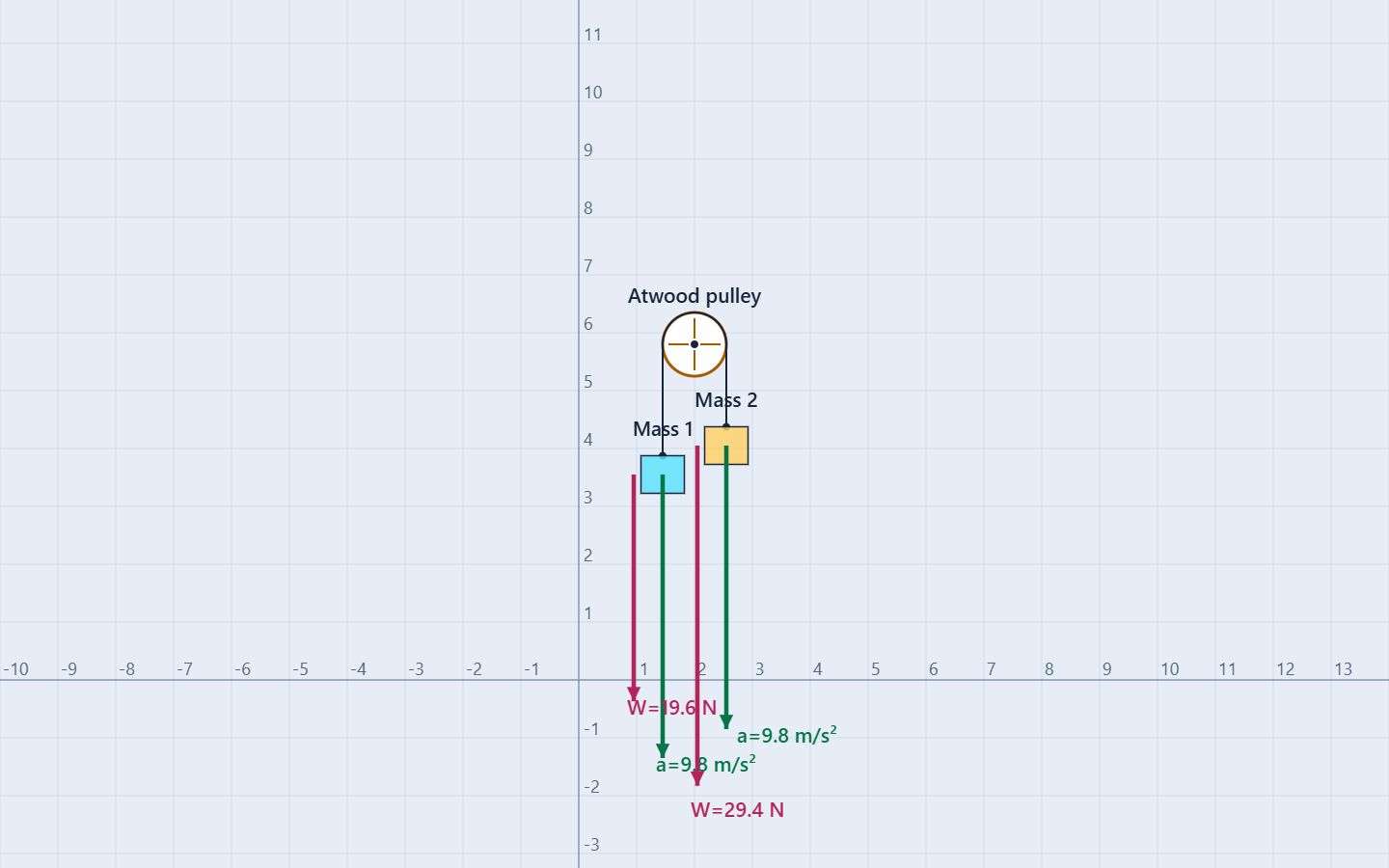
An ideal Atwood machine has two masses connected by a taut, massless rope over a frictionless, massless pulley. If m2 is heavier than m1, the heavier mass accelerates down while the lighter mass accelerates up. Their acceleration magnitudes are equal because the rope length stays fixed.
For the complete two-mass system, tension is internal and the unequal weights provide the external driving force:
a = (m2 − m1)g/(m1 + m2)
To find tension, isolate one object. For the lighter mass with upward positive, T − m1g = m1a. For the heavier mass with downward positive, m2g − T = m2a.
Choose the boundary
Use the whole system to find shared acceleration efficiently, then use one object’s diagram to find the rope tension.
Keep the constraint visible
A taut inextensible rope gives equal acceleration magnitudes in opposite directions, even though the signs of the vertical components differ.
Guided lesson path
Build the model from the rope constraint to real variations
- Observe an ideal Atwood machine. Run 2 kg and 3 kg masses. The 3 kg mass descends and the 2 kg mass rises with equal acceleration magnitudes.
- Classify internal and external forces. For a system containing both masses and the rope, the two tension forces are internal and cancel in the complete-system force sum. The unequal weights remain external.
- State the ideal assumptions. The rope is taut, massless, and inextensible; the pulley is massless and frictionless; and air resistance is ignored. These assumptions produce one tension magnitude throughout the rope.
- Write the complete-system equation. The difference in weights drives the combined mass: (m2 − m1)g = (m1 + m2)a.
- Calculate the shared acceleration. For 2 kg and 3 kg, a = [(3 − 2)(9.8)]/(2 + 3) = 1.96 m/s2.
- Inspect the lighter object. Tension is larger than m1g, so the lighter mass has an upward net force and accelerates upward.
- Inspect the heavier object. m2g is larger than tension, so the heavier mass has a downward net force and accelerates downward.
- Calculate rope tension. Substituting a = 1.96 m/s2 into the lighter-mass equation gives T = 23.52 N. Tension lies between the two weights.
- Change the heavier mass. Keep the 2 kg mass fixed and choose a new integer Mass 2 value from 4 kg to 6 kg. A larger mass difference increases the shared acceleration.
- Test equal masses. With 2 kg on each side, the weight difference is zero. The masses have zero acceleration when released from rest, but tension and weight remain nonzero and balanced.
- Move to a modified Atwood machine. A 2 kg hanging mass pulls a 4 kg block across a frictionless table. The rope still gives equal acceleration magnitudes along its two directions.
- Use the modified system equation. The table block’s vertical normal force and weight cancel, leaving the hanging weight to accelerate the total translational mass: mHg = (mT + mH)a.
- Calculate modified-Atwood acceleration. With mT = 4 kg and mH = 2 kg, a = (2)(9.8)/(4 + 2) = 3.27 m/s2.
- Inspect the table mass. Along the table, tension is the unbalanced force: T = mTa ≈ 13.07 N. The normal force is perpendicular to the motion and does no work along the horizontal direction.
- Inspect the hanging mass. With downward positive, mHg − T = mHa. Its weight exceeds tension by the amount needed to produce the shared acceleration.
- Test the ratio limits. When mH is much larger than mT, acceleration approaches g from below. When the table mass is much larger than the hanging mass, acceleration approaches zero.
- Transfer the method. For a cart pulled by a truck or connected to hanging masses, include only forces crossing the selected system boundary. Internal rope forces cancel; external pulls, friction, and relevant weight components remain.
| m1 (kg) | m2 (kg) | Difference (kg) | |a| (m/s2) | T (N) |
|---|---|---|---|---|
| 2.50 | 2.50 | 0.00 | 0.00 | 24.50 |
| 2.25 | 2.75 | 0.50 | 0.98 | 24.26 |
| 2.00 | 3.00 | 1.00 | 1.96 | 23.52 |
| 1.75 | 3.25 | 1.50 | 2.94 | 22.30 |
| 1.50 | 3.50 | 2.00 | 3.92 | 20.58 |
Worked examples
Use a system equation, then an object equation
For the 2 kg and 3 kg ideal machine, take upward as positive for the lighter mass and downward as positive for the heavier mass:
a = [(3.00 − 2.00)(9.80)]/(2.00 + 3.00) = 1.96 m/s2
Now isolate the 2 kg mass:
T − (2.00 kg)(9.80 m/s2) = (2.00 kg)(1.96 m/s2)
T = 23.52 N
For the modified Atwood setup with a 4 kg table mass and 2 kg hanging mass:
a = (2.00 kg)(9.80 m/s2)/(4.00 kg + 2.00 kg) = 3.27 m/s2
T = (4.00 kg)(3.27 m/s2) = 13.07 N
System boundaries
The same apparatus supports different equations
| Chosen system | External forces along motion | Best use |
|---|---|---|
| Lighter hanging mass | T upward and m1g downward | Find or check tension |
| Heavier hanging mass | m2g downward and T upward | Check the sign of acceleration |
| Both hanging masses | m2g − m1g | Find shared acceleration |
| Modified cart plus hanging mass | mHg along the rope | Find acceleration without internal tension |
Internal tension still acts on each individual mass. It disappears only from the complete-system equation because the rope forces are equal-and-opposite interactions between parts inside the selected boundary.
Pulley models
Adding pulley inertia changes the tension model
With a massless pulley, the same ideal rope tension appears on both sides. If the pulley has rotational inertia I, part of the driving effect accelerates its rotation. A useful model is:
a = (m2 − m1)g/(m1 + m2 + I/R2)
The acceleration is smaller than in the massless-pulley case, and the two rope tensions can differ because their torque difference spins the pulley. Compare the ideal and massive-pulley presets only after identifying which assumptions changed.
Common misconceptions
Check the reasoning
Is tension equal to either hanging weight?
Only in a zero-acceleration case. During ideal Atwood motion, tension is greater than the lighter weight and less than the heavier weight.
Why divide by the sum of the masses?
Both masses accelerate. The weight difference is the driving force, but the total mass supplies the translational inertia.
Do equal masses mean no forces act?
No. Equal masses produce zero acceleration when released from rest, while tension and weight remain nonzero and balance on each mass.
Do third-law tension forces cancel on one mass?
No. The two tension forces act on different objects. They cancel in the complete-system equation only after both objects are included inside one boundary.
Does a massive pulley still have one tension?
Its rotational inertia can require different tensions on the two sides. State the pulley model before using the massless-pulley equation.
Does the hanging mass accelerate at g?
Usually no. The rest of the system also accelerates, and the rope tension opposes the hanging weight. The magnitude approaches g only when the hanging mass dominates the total mass.
For teachers
Make the boundary and signs explicit
Have students draw both individual free-body diagrams before they write the whole-system equation. Use the fixed-total-mass trials to show that acceleration depends on the mass difference divided by total mass, then have students verify the opposite acceleration signs and equal magnitudes.
For the modified machine, require one equation for the table mass and one for the hanging mass after the complete-system calculation. Finish by comparing a massless pulley with a massive pulley so students can explain why acceleration changes and why the two tensions no longer match.
Continue with Free-Body Diagrams for system boundaries, Newton’s Second Law for the net-force model, and the Atwood Machine experiment for the complete simulation workflow.