
Core idea
Acceleration is set by net force and mass
Newton’s Second Law is a vector relationship: ΣF⃗ = msysa⃗sys. Add every external force on the chosen system before dividing by its mass. The acceleration vector points in the direction of the net force, and its magnitude is the net-force magnitude divided by mass.
For a fixed mass, doubling the net force doubles the acceleration. For a fixed net force, doubling the mass halves the acceleration. The law also works one direction at a time: ΣFx = msysax and ΣFy = msysay.
Change force
Hold mass fixed and compare the net-force and acceleration vectors. Their ratio gives the same mass in every direction.
Change mass
Hold net force fixed and compare how a larger system responds. More mass means less acceleration for the same force.
Guided lesson path
Test the law before applying it to complex forces
- Observe a baseline trial. A 2.0 kg block starts from rest on a frictionless surface with a +6.0 N horizontal net force. Its acceleration is +3.0 m/s2, and the acceleration vector points with the net force.
- Reverse the force. Change the horizontal force from +6.0 N to −6.0 N. The force and acceleration reverse together; a negative component describes direction relative to the selected axis.
- Compare two force values. With the same 2.0 kg mass, compare 4.0 N and 12.0 N trials. The larger force produces three times the acceleration.
- Build force–acceleration data. Run 4.0 N, 8.0 N, and 12.0 N trials at 2.0 kg. A graph of net force versus acceleration is a straight line through the origin; its slope is the system mass.
- Compare two masses. With the same +12.0 N net force, compare 2.0 kg and 6.0 kg. Tripling the mass reduces the acceleration to one third.
- Design a target acceleration. Choose a mass and adjust the force until the block reaches +3.0 m/s2. Different force–mass pairs work when their ratio is the same.
- Apply the law to opposing forces. A 6 kg crate has an 18 N push right and 6 N kinetic friction left. The net force is 12 N right, so the horizontal acceleration is 2.0 m/s2 right.
- Separate force from velocity. Reduce the crate’s push until it balances friction. The crate can already be moving right while its zero net force gives zero acceleration and approximately constant velocity.
- Choose axes and components. For a 10 N net force at 36.87° north of east on a 2 kg boat, compare east and north components rather than treating the angled arrow as one-dimensional.
- Reconstruct the vector. The boat’s components are 8 N east and 6 N north, giving 4 m/s2 east and 3 m/s2 north. Together they make a 5 m/s2 acceleration at 36.87° north of east.
- Explain free fall. A 2 kg and a 6 kg object have different weights but the same downward acceleration when weight is the only force. In −mg = may, the mass cancels and ay = −g.
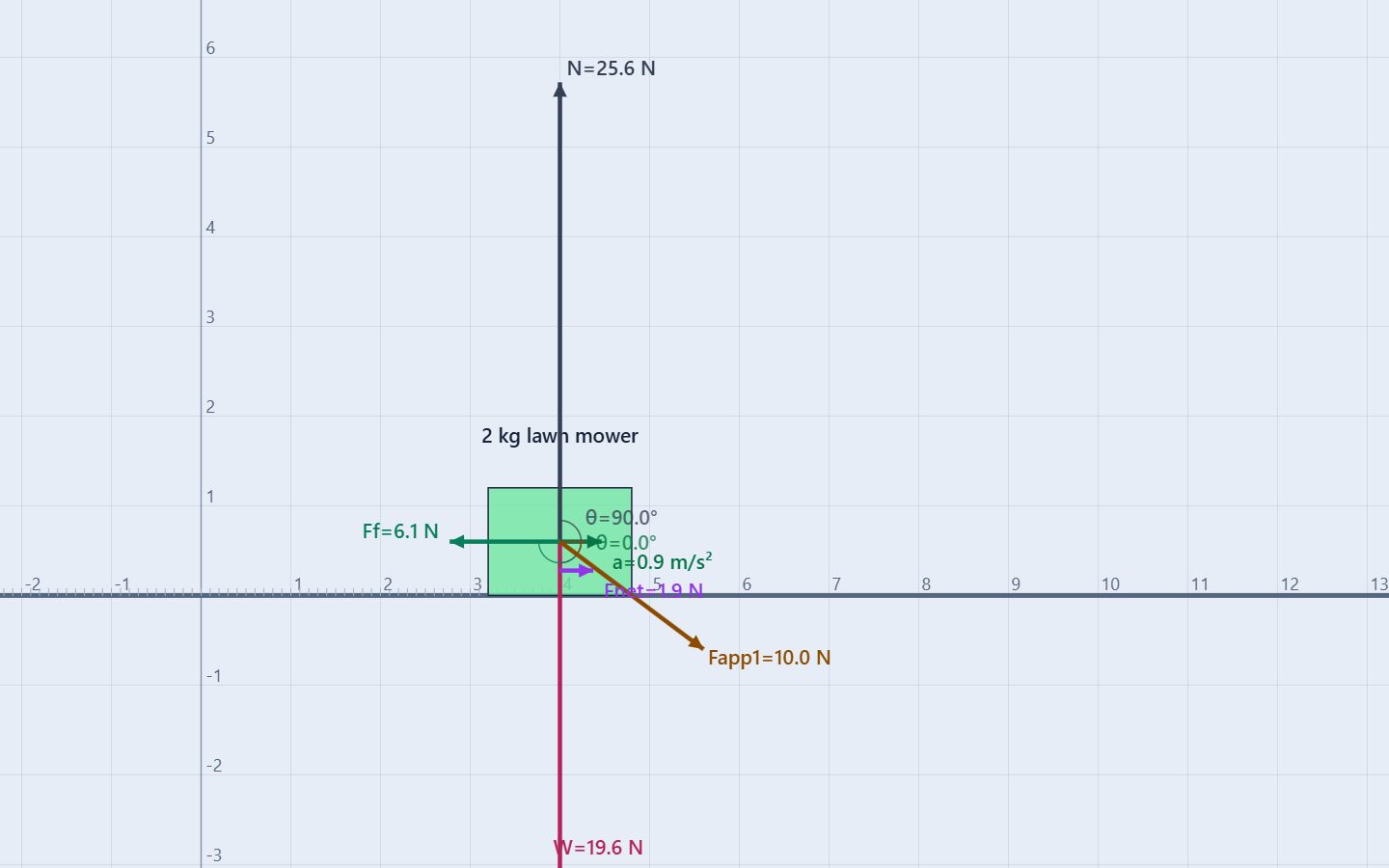
- Analyze an angled push. A 10 N push 36.87° below horizontal has an 8 N horizontal component and a 6 N downward component. On a rough surface, the downward component increases the normal force while friction reduces the horizontal net force.
- Connect acceleration to displacement. Once the mower’s constant acceleration is known, its position follows the kinematics model. From rest at 2.0 m/s2, it moves about 16 m in 4.0 s.
| Controlled trial | What stays fixed | What changes | Prediction |
|---|---|---|---|
| Force series | m = 2.0 kg | ΣF = 4, 8, 12 N | a scales directly with ΣF |
| Mass series | ΣF = 12 N | m = 2.0, 6.0 kg | a scales inversely with m |
| Target design | a = +3.0 m/s2 | Choose m and ΣF | ΣF/m must equal 3.0 |
| Free fall | Only weight acts | m = 2.0, 6.0 kg | ay = −g for both |
Worked examples
Write the net-force equation before calculating
For the baseline 2.0 kg block:
ax = ΣFx/m = (6.0 N)/(2.0 kg) = +3.0 m/s2
For the rough crate, take right as positive:
ΣFx = 18 N − 6 N = 12 N; ax = 12 N/(6 kg) = +2.0 m/s2
For a designed 3.0 m/s2 trial with a 5 kg system:
ΣFx = m ax = (5.0 kg)(3.0 m/s2) = 15 N
For the boat, resolve the 10 N force before dividing by mass:
ΣFx = 10 cos(36.87°) = 8 N; ax = 8/2 = 4 m/s2
ΣFy = 10 sin(36.87°) = 6 N; ay = 6/2 = 3 m/s2
Components and direction
One vector law becomes one equation per axis
Choose axes that make the force model clear. An angled force can be replaced by perpendicular components without changing its physical effect: Fx = F cos θ and Fy = F sin θ when θ is measured from the +x axis. Then solve each direction independently.
| Direction | Force equation | Acceleration result |
|---|---|---|
| Horizontal | ΣFx = msysax | ax = ΣFx/msys |
| Vertical | ΣFy = msysay | ay = ΣFy/msys |
| Angled force | Fx = F cos θ; Fy = F sin θ | Resolve first, then apply the law to each component |
Acceleration has the same direction as net force because mass is positive. Velocity can point elsewhere while the object turns or slows; do not use the velocity direction as a substitute for the net-force direction.
Special cases
Use the same law for weight, normal force, and friction
In free fall, the only force is weight: ΣFy = −mg. Substituting into Newton’s Second Law gives −mg = may, so ay = −g regardless of mass. The heavier object has a larger weight arrow, but it also has proportionally more inertia.
On a surface, do not assume normal force equals weight. An angled push can add a downward component, making FN larger than mg. Friction then enters the horizontal equation with the sign that opposes the relative sliding at the contact.
Common misconceptions
Check the reasoning
Does the largest individual force determine acceleration?
No. Add all external forces as vectors. Acceleration depends on the net force after cancellation and addition.
Does a moving object need a forward force?
No. A nonzero net force changes velocity. With zero net force, an object can continue at constant velocity.
Does negative force mean negative acceleration is “less” acceleration?
No. A negative component indicates direction relative to the chosen axis. Its magnitude tells how large the acceleration component is.
Does zero vertical acceleration mean no vertical forces act?
No. Normal force and weight can cancel while a horizontal component produces nonzero horizontal acceleration.
Why do equal and opposite forces not always cancel?
Third-law pairs act on different objects. They cancel in a system equation only when both forces act inside the same chosen system; otherwise identify which object each force acts on.
Does greater mass create an extra force?
No. Mass measures resistance to changing velocity. It is the denominator in a = ΣF/m, not another arrow on the free-body diagram.
For teachers
Make the ratio and the signs visible
Begin with the 2 kg, 6 N baseline and ask students to predict the acceleration before they run it. Then have them change one quantity at a time and record force, mass, acceleration, and direction in a table. The force-series graph makes the slope–mass relationship concrete.
Require students to write the system boundary and positive axes before solving the crate, boat, free-fall, or mower trials. Ask them to distinguish individual forces from the net-force vector, and to explain why a zero component can coexist with acceleration in the perpendicular direction.
Continue with Free-Body Diagrams for force models, Newton’s First Law for zero-net-force motion, and the Newton’s Second Law experiment for a hands-on simulation sequence.