
Plan the investigation
Keep total mass fixed; change the imbalance
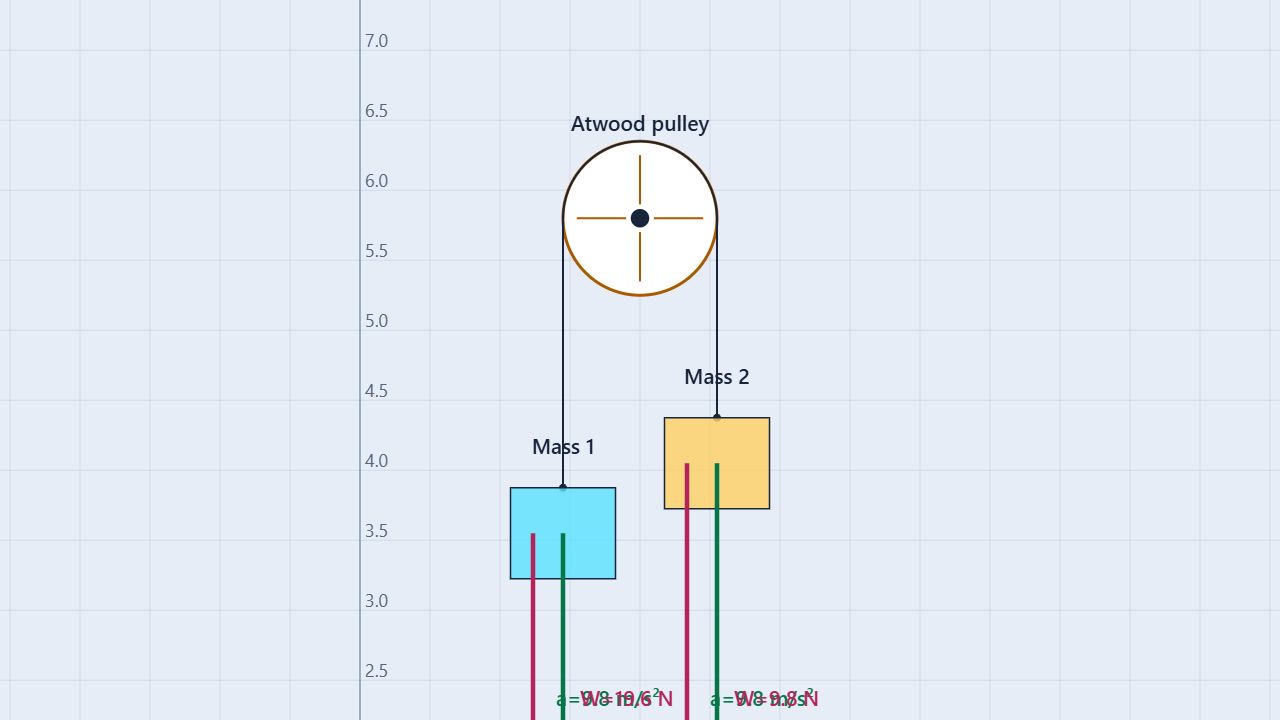
Use an ideal, massless pulley and a taut, inextensible rope with negligible mass. Ignore air resistance and axle friction. Set gravitational acceleration to 9.80 m/s², release both blocks from rest, and analyze motion before either block hits the pulley or floor.
Change
Transfer mass from Mass 1 to Mass 2. Keep m1 + m2 = 5.00 kg.
Measure
Record vertical acceleration ay and rope tension |T| for each block. Compare the acceleration magnitudes.
Procedure
A useful five-trial workflow
- Load and set up. Launch the simulation and select Atwood machine in the experiment menu if a saved scene appears. Open Properties and select each block in the Objects list to edit its Mass. The preset starts at 2 kg and 1 kg; replace those values with the first row below.
- Check the controls. Select Atwood pulley and leave “Pulley has mass and moment of inertia” unchecked. Check gravity in World. Set the run duration beside Play to 0.5 seconds.
- Predict, then run. Calculate acceleration and tension for the mass pair before pressing Play. Keep starting positions and all other settings the same.
- Read the evidence. Select Mass 2 in Properties, then open the Data panel. In Graph, choose Mass 2 as Object 1 and enable aᵧ and |T| as measurements. The Data tab lists the numerical samples. Compare values from 0.133 to 0.500 s; exclude the initial constraint adjustment.
- Repeat and explain. Reset the trial before entering each new mass pair. Collect all five rows, then graph acceleration magnitude against mass difference. Check Mass 1 as well: its acceleration should have the opposite sign and the same magnitude.
| m1 (kg) | m2 (kg) | Difference (kg) | |a| (m/s²) | T (N) |
|---|---|---|---|---|
| 2.50 | 2.50 | 0.00 | 0.00 | 24.50 |
| 2.25 | 2.75 | 0.50 | 0.98 | 24.26 |
| 2.00 | 3.00 | 1.00 | 1.96 | 23.52 |
| 1.75 | 3.25 | 1.50 | 2.94 | 22.30 |
| 1.50 | 3.50 | 2.00 | 3.92 | 20.58 |
Worked example
Predict motion for 2 kg and 3 kg
Let m1 = 2.00 kg and m2 = 3.00 kg. Take upward as positive for Mass 1 and downward as positive for Mass 2. Both blocks then have the same positive acceleration a.
- T − m1g = m1a
- m2g − T = m2a
Add the equations to eliminate tension. The weight difference accelerates the combined mass:
a = [(3.00 − 2.00) × 9.80] / (2.00 + 3.00) = 1.96 m/s²
Substitute into the equation for the lighter block:
T = m1(g + a) = 2.00 × (9.80 + 1.96) = 23.52 N
Mass 1 accelerates up and Mass 2 accelerates down. Tension lies between their weights, 19.60 N and 29.40 N.
Simulation check
Compare the prediction with sampled data
A BuildPhysics run with Mass 1 = 2 kg, Mass 2 = 3 kg, a massless pulley, and a 0.5 s duration produced the following readings for Mass 2. The simulation uses positive y upward, so its downward acceleration is negative.
| Time (s) | ay (m/s²) | |T| (N) |
|---|---|---|
| 0.200 | −1.960 | 23.520 |
| 0.300 | −1.960 | 23.520 |
| 0.400 | −1.960 | 23.520 |
| 0.500 | −1.960 | 23.520 |
The acceleration magnitude and tension match the prediction at the displayed precision. On a velocity–time graph, Mass 2 should have a straight line with slope −1.96 m/s² during this interval; its position–time graph should curve downward.
Common misconception
Why isn’t tension equal to either weight?
A moving block is not necessarily in force balance. The lighter block accelerates upward, so T exceeds its weight. The heavier block accelerates downward, so T is less than its weight. Equal tension on both sides does not mean zero net force on each block.
Why divide by the sum of the masses?
The weight difference supplies the net driving force, but both masses must accelerate. Dividing by only the heavier mass leaves out part of the system’s inertia.
What happens when the masses are equal?
The net driving force is zero. Released from rest, both blocks remain at rest and T = mg. Zero acceleration does not require zero tension.
What changes with a massive pulley?
Some of the driving effect accelerates the pulley’s rotation. Acceleration is smaller, and the two rope tensions can differ. Try the massive-pulley Atwood experiment to test that model.
For teachers
Use the evidence to test a model
Ask students to draw both free-body diagrams before opening the lab. For the five trials, a graph of |a| against m2 − m1 should have slope g/(m1 + m2) = 1.96 (m/s²)/kg and pass through the origin. As an extension, add the same mass to both blocks: the mass difference stays fixed, but acceleration decreases.
Discuss why real apparatus may differ: axle friction, pulley inertia, rope stretch, and measurement uncertainty. The ideal prediction applies only while the rope remains taut and the blocks move freely.
Physics reference: OpenStax, University Physics Volume 1, §6.1. Learn about the educator behind these simulations on the BuildPhysics About page.