
Plan the investigation
What students will do
Start with a guided comparison, then plan an investigation, analyze a graph, and check a prediction.
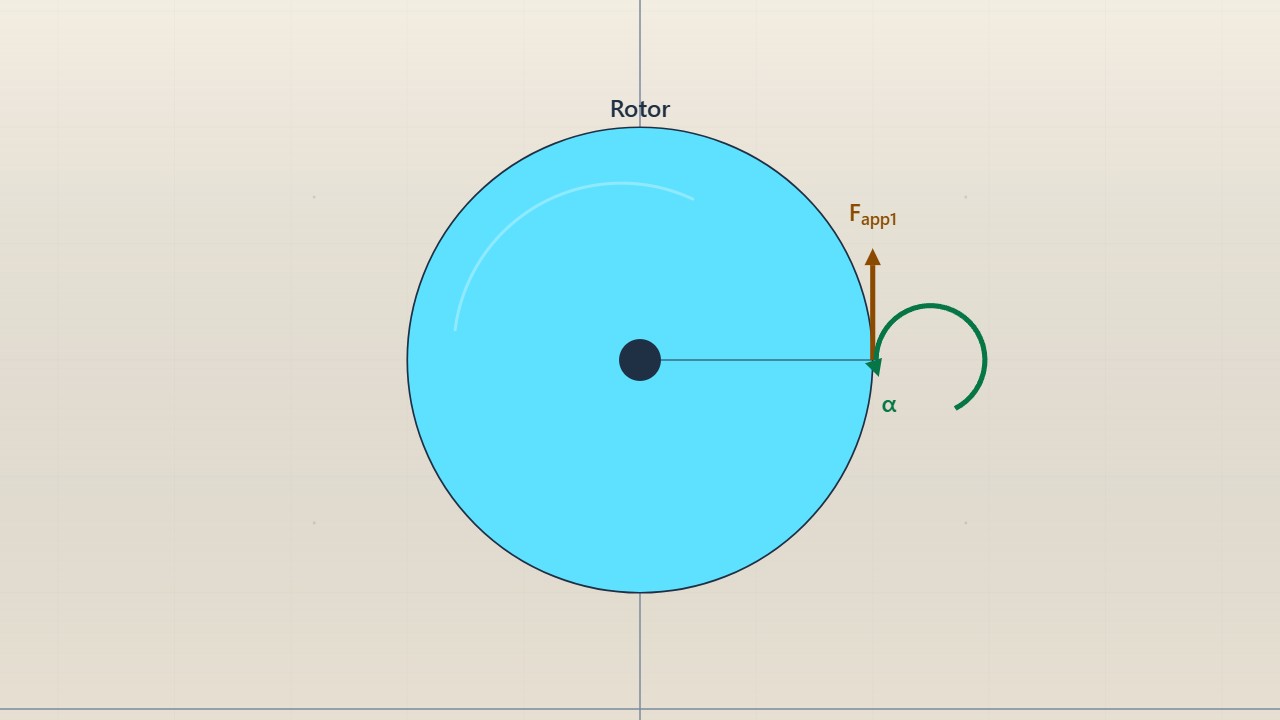
- Compare force positions. Apply the same force on either side of the center and through the center. Compare torque and rotation direction.
- Design and collect. Choose positive, negative, and zero forces while keeping the disk and application point fixed. Read matching torque and acceleration.
- Analyze a graph. Fit angular acceleration versus net torque. Use the slope to determine the rotor’s rotational inertia.
- Explain and predict. Explain the roles of force position and inertia, then predict and test angular acceleration for an unused force.
What students will learn
- Distinguish applied force from torque about a chosen axis.
- Connect signed torque with signed angular acceleration.
- Determine rotational inertia from a fitted slope.
Common misconception
Does every nonzero force produce angular acceleration?
A force through the rotation axis can produce zero torque about that axis.