
Plan the investigation
Follow one system through three stages
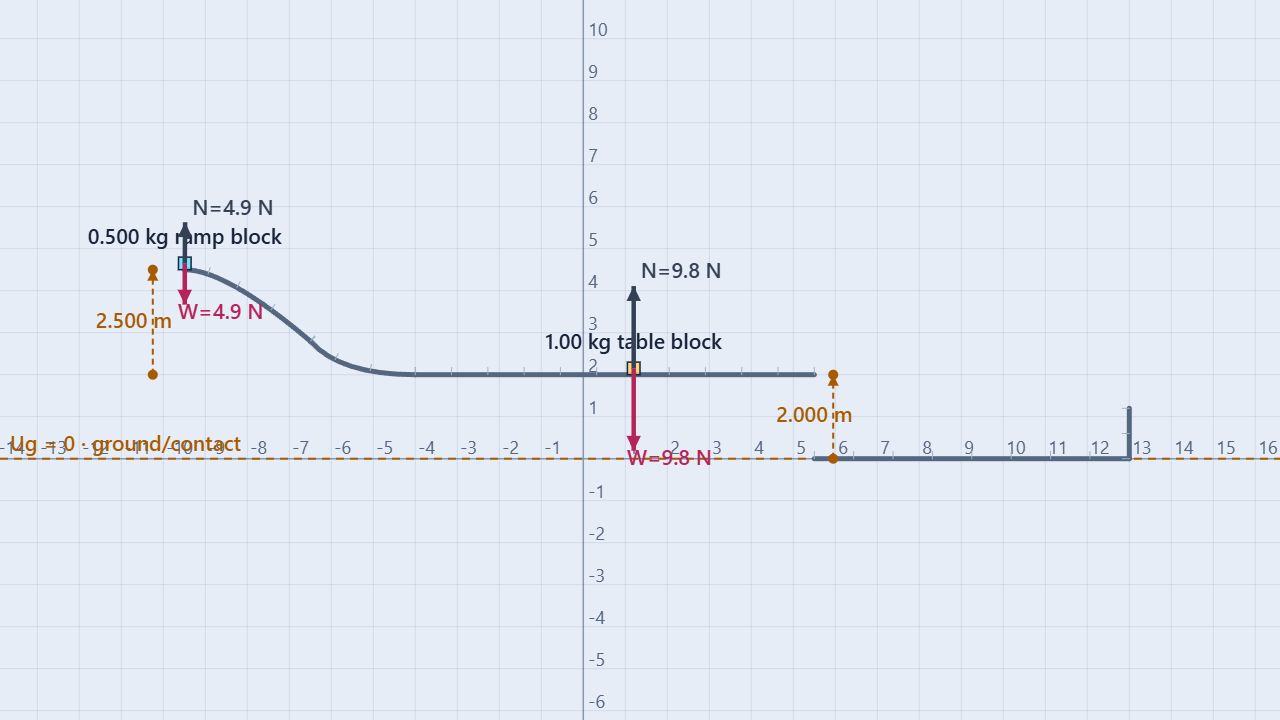
The prepared scene starts a 0.500 kg ramp block from rest, with its track surface about 2.50 m above the 2.00 m-high table. It collides elastically with a stationary 1.00 kg table block. After the collision, the lighter block reverses and climbs back up the ramp while the heavier block travels to the table edge and launches horizontally.
Keep fixed
Gravity at 9.80 m/s², frictionless tracks and table, table edge, ground height, and elastic restitution at 1.
Measure each stage
Record the pre-collision speed, both post-collision velocities, the rebound height, the flight time, and each landing distance from the table edge.
Use a new system boundary at each stage. The ramp block and table block are separate before the collision, a two-block system during the collision, and separate projectiles after they leave the table.
Build the model
Choose the conservation law for each interval
Stage 1: ramp to collision. The 0.500 kg block starts from rest and drops through Δh = 2.50 m:
mAgΔh = ½mAvA,i²
vA,i = √(2gΔh) = √(2 × 9.80 × 2.50) ≈ 7.00 m/s
Stage 2: one-dimensional elastic collision. Block B starts at rest. Momentum and kinetic energy are conserved for the two-block system:
vA,f = (mA − mB)/(mA + mB)vA,i
vB,f = 2mA/(mA + mB)vA,i
Stage 3: table edge to ground. Each block leaves with horizontal velocity and zero vertical velocity. For a table height h = 2.00 m:
tflight = √(2h/g) ≈ 0.639 s
R = |vx|tflight
The rebound block uses energy again after the collision: hrebound = vA,f²/(2g). Its rise is measured above the table level, not above the original ramp release.
Procedure
Pause at the collision and table edge
- Load and inspect. Open Ramp, Elastic Collision & Projectile Motion. Select the 0.500 kg ramp block and record both masses, the 2.50 m ramp-to-table height difference, the table height, and the table-edge position.
- Predict stage 1. Use energy to calculate the ramp block’s speed immediately before impact. Run slowly and pause just before the collision to read its velocity.
- Predict stage 2. Use the elastic-collision equations to calculate both final velocities. Run through the impact, then pause after the blocks separate and record their measured velocities.
- Track the rebound. Follow the lighter block back up the ramp. Measure its maximum center height above the table and compare it with vA,f²/(2g).
- Predict stage 3. Calculate the common flight time from the 2.00 m table height. Multiply each horizontal launch speed by that time to predict its landing distance from the edge.
- Measure and compare. Use the displacement rulers or Data panel to record both landing distances. Keep calculated predictions, sampled values, and percent differences in separate columns.
| Quantity | Calculation | Prediction |
|---|---|---|
| Speed before collision | √(2 × 9.80 × 2.50) | 7.00 m/s |
| Ramp block after collision | ((0.500 − 1.00)/1.500)(7.00) | −2.33 m/s |
| Table block after collision | (2 × 0.500/1.500)(7.00) | +4.67 m/s |
| Rebound height above table | 2.33²/(2 × 9.80) | 0.278 m |
| Flight time | √(2 × 2.00/9.80) | 0.639 s |
| Landing distances from edge | 2.33(0.639), 4.67(0.639) | 1.49 m and 2.98 m |
Finite block size and the exact point at which a block clears the table can shift a measured range from the centerline prediction. Define the launch time and launch position from the simulation sample you actually use.
Worked example
Why the lighter block rebounds
With mA = 0.500 kg, mB = 1.00 kg, and vA,i = 7.00 m/s:
vA,f = (0.500 − 1.00)/1.500 × 7.00 ≈ −2.33 m/s
vB,f = (2 × 0.500)/1.500 × 7.00 ≈ +4.67 m/s
The negative sign means block A reverses direction. Its rebound height is:
hrebound = 2.33²/(2 × 9.80) ≈ 0.278 m above the table
Block B keeps moving right at 4.67 m/s. With a 0.639 s flight, its ideal range from the table edge is about 2.98 m.
Compare trials
Change the mass ratio
Keep the incoming speed at 7.00 m/s and the table block at 1.00 kg. Changing the ramp-block mass changes whether it rebounds and how much speed the table block receives.
| mA (kg) | vA,f (m/s) | vB,f (m/s) | Interpretation |
|---|---|---|---|
| 0.250 | −4.20 | +2.80 | Strong rebound |
| 0.500 | −2.33 | +4.67 | Prepared baseline |
| 1.000 | 0.00 | +7.00 | Equal masses; first block stops |
| 2.000 | +2.33 | +9.33 | Heavier block continues forward |
For every ideal elastic trial, check both momentum and kinetic energy. A velocity result can look plausible while still failing one of the conservation checks.
Interpret the evidence
Use the graphs to locate stage changes
The velocity graph should show the ramp block accelerating down the track, a sudden sign change at the collision, and a later horizontal flight. The table block begins at rest, jumps to its post-collision velocity, and then keeps nearly constant horizontal velocity until it lands.
Plot total mechanical energy for the ramp and collision interval, and calculate total momentum for the two-block collision interval. Gravity changes the energy of each block during the ramp, while the collision forces are internal to the two-block system. After launch, use the vertical position graph to verify the common flight time.
Common misconceptions
Check the reasoning
Can I use one conservation equation for the whole run?
No. The useful system and assumptions change at the ramp, collision, rebound, and flight stages. State the interval before choosing an equation.
Does the elastic collision conserve each block’s kinetic energy?
No. The total kinetic energy of the two-block system is conserved. One block can lose kinetic energy while the other gains it.
Does a negative velocity mean negative speed?
No. Negative velocity indicates direction along the chosen x-axis. Speed is the nonnegative magnitude.
Does horizontal velocity change the fall time?
No. With zero initial vertical velocity and negligible air resistance, flight time depends on vertical height. Horizontal velocity changes range.
For teachers
Make the system boundaries explicit
Have students draw four snapshots: release, just before impact, just after impact, and table edge. Under each snapshot, label the system, known velocities, and conservation law. This prevents energy from being applied across the inelastic-looking track contacts or momentum from being treated as constant while gravity acts.
Have groups vary the mass ratio, then compare the measured velocities with elastic-collision predictions. Finish by checking the rebound height and landing ranges. Review Conservation of Energy, Projectile Motion, and One-Dimensional Collision.
Physics reference: OpenStax, Physics, types of collisions. Learn about the educator behind the simulations on the BuildPhysics About page.