
Plan the investigation
What changes when a collision is less bouncy?
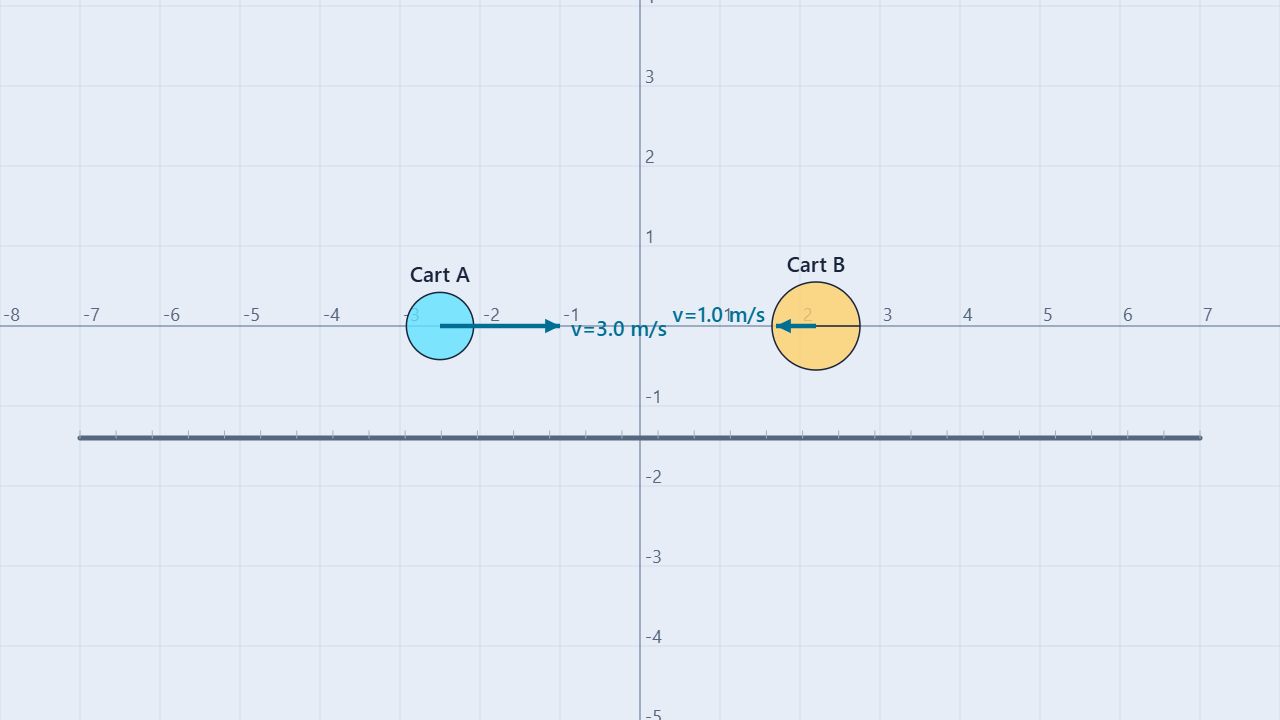
The prepared scene sends Cart A, mass 1 kg, rightward at +3 m/s toward Cart B, mass 2 kg, moving leftward at −1 m/s. Both start at the same height. Their initial restitution is 0.95, so the prepared impact is close to elastic but not perfectly elastic.
Change
Collision restitution e: 0, 0.25, 0.50, 0.75, and 1.00.
Keep fixed
The two masses, original positions, initial x velocities +3 and −1 m/s, zero y velocities, and zero gravity, drag, and friction.
Use the two carts together as the system. During their short collision, contact forces exchange momentum between them. With no external impulse along x, their total x momentum remains constant.
Build the model
Keep the velocity signs
ptotal = mAvA + mBvB
Ktotal = ½mAvA² + ½mBvB²
Momentum can be positive or negative; kinetic energy cannot. For this starting pair, total momentum is 1(3) + 2(−1) = +1 kg·m/s and kinetic energy is ½(1)(3²) + ½(2)(1²) = 5.50 J.
The restitution coefficient relates relative separation speed to relative approach speed:
vB,f − vA,f = e(vA,i − vB,i) = 4e
Combine this equation with momentum conservation to predict both final velocities. These equations describe a central, one-dimensional collision without external impulse.
Procedure
A useful five-trial workflow
- Load and inspect. Launch the simulation and choose One-dimensional collision if a saved scene appears. Check World gravity and drag are zero and friction is disabled.
- Set the contact behavior. Set restitution to the trial value for both Cart A and Cart B and the World default. Check for any contact-pair override that would replace those settings. Keep the prepared masses and velocities.
- Predict and run. Calculate the expected final velocities. Set a 2-second run duration beside Play. The prepared carts meet after about 0.93 s, so this duration includes the first collision.
- Read before and after. Open the Data panel and record each cart’s x velocity at matching times before contact and after separation, away from the collision transient. Select each cart in turn or export CSV. Calculate system momentum and kinetic energy from the same pair of times.
- Reset and repeat. Reset before changing restitution to the next value. Restore the original positions and velocities. Compare all five outcomes and note any difference from the ideal predictions.
| e | Final vA (m/s) | Final vB (m/s) | Final K (J) |
|---|---|---|---|
| 0.00 | +0.333 | +0.333 | 0.167 |
| 0.25 | −0.333 | +0.667 | 0.500 |
| 0.50 | −1.000 | +1.000 | 1.500 |
| 0.75 | −1.667 | +1.333 | 3.167 |
| 1.00 | −2.333 | +1.667 | 5.500 |
Every row retains total momentum +1 kg·m/s, allowing for displayed rounding. At e = 0, the carts have the same velocity immediately after impact; zero restitution does not necessarily create a permanent bond between objects.
Worked example
Half the relative rebound speed
For e = 0.50, momentum and restitution give:
vA,f + 2vB,f = 1
vB,f − vA,f = 2
Therefore vA,f = −1 m/s, vB,f = +1 m/s
The final momentum is −1 + 2 = +1 kg·m/s. Final kinetic energy is ½(1)(1²) + ½(2)(1²) = 1.50 J. Translational kinetic energy decreases by 4.00 J while system momentum is unchanged.
For the preset e = 0.95, the ideal final velocities are approximately −2.20 and +1.60 m/s, with final kinetic energy 4.98 J. Do not expect the default run to conserve kinetic energy exactly.
Common misconception
Does lost kinetic energy mean momentum is lost?
No. Momentum and kinetic energy are different quantities with different conservation conditions. In an inelastic collision, energy can enter deformation, heat, and sound without changing the isolated system’s total momentum.
Does each cart conserve its own momentum?
No. Each cart receives an impulse from the other. Their momentum changes are equal and opposite, so the sum stays constant.
Does the heavier cart exert a larger force?
The interaction forces have equal magnitude and opposite direction at each instant. Their accelerations can differ because their masses differ.
Can I use speed instead of velocity?
Not for momentum. Replacing Cart B’s −1 m/s with +1 m/s would change the initial total from +1 to +5 kg·m/s.
Predict before running
What if the two masses are equal?
Set both carts to 1 kg, keep their original velocities, and choose e = 1. Predict the outcome.
Reveal the ideal result
The carts exchange velocities: A leaves at −1 m/s and B at +3 m/s. Total momentum remains +2 kg·m/s and kinetic energy remains 5 J. This velocity swap is specific to equal masses in a one-dimensional elastic collision.
For teachers
Check impulses as well as totals
Calculate ΔpA and ΔpB for each trial and compare their sum with zero. Also compare the center-of-mass velocity, ptotal/(mA + mB), before and after; it is +1/3 m/s for the original pair.
Explain the collision using a clearly defined system and a short before-and-after interval. Avoid samples during overlap or later boundary impacts. The table uses an ideal restitution model; report simulation discrepancies rather than replacing measured values with predictions.
Continue with the Ballistic Pendulum to separate momentum conservation during impact from energy conservation during the swing. Review Newton’s Third Law. Physics reference: OpenStax, University Physics Volume 1, §9.4. Learn about the educator behind the simulations on the BuildPhysics About page.