
Core idea
Projectile motion is two one-dimensional motions sharing one clock
In the ideal model, air resistance is ignored. Gravity gives the projectile a constant downward acceleration, while horizontal velocity remains constant. The path is curved because the horizontal and vertical components combine at every instant, not because the object switches from horizontal motion to vertical motion.
Choose +x to the right and +y upward. Then ax = 0 and ay = −g. Resolve an angled launch before calculating: v0x = v0 cos θ and v0y = v0 sin θ. Both components use the same elapsed time.
Horizontal model
With no horizontal acceleration, vx stays fixed and Δx = vxΔt.
Vertical model
Vertical velocity changes by −g each second, so height and flight time come from constant-acceleration equations.
Guided lesson path
From independence to a target landing
- Compare a drop and a horizontal launch. A dropped ball and a ball launched at 6.0 m/s horizontally start at the same height. Their vertical positions and vertical velocities match even though their horizontal motion differs.
- Check the acceleration components. During ideal flight, ax = 0 and ay = −9.8 m/s². Horizontal speed does not create horizontal acceleration.
- Compare horizontal speeds. Projectiles launched at 4.0 m/s and 8.0 m/s from the same height have the same landing time, but the faster projectile travels about twice as far horizontally.
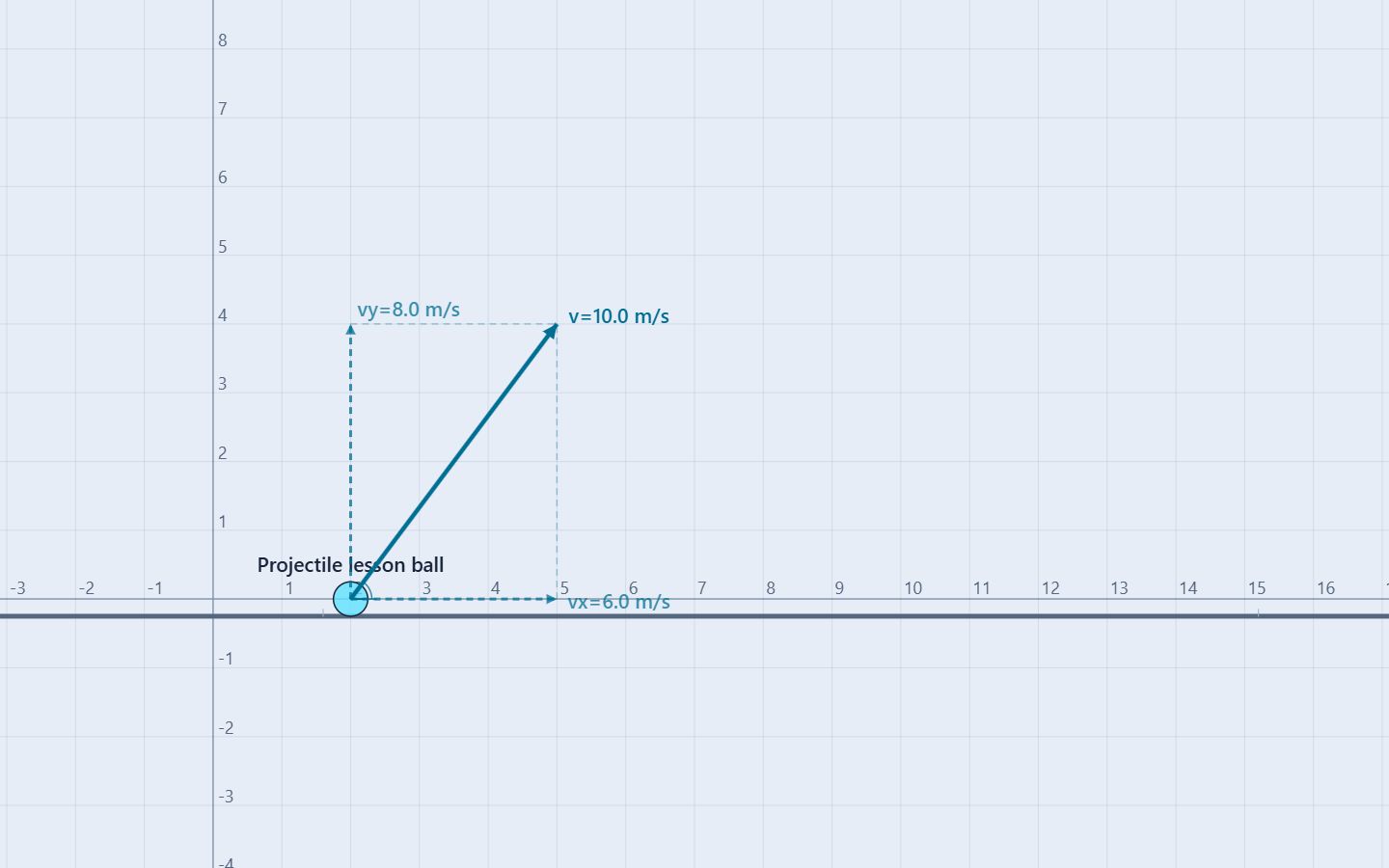
- Build a 6–8–10 launch vector. Set vx = +6.0 m/s and vy = +8.0 m/s. The initial speed is 10.0 m/s. As the projectile rises, vx stays fixed while vy decreases.
- Pause at the apex. At the highest point, vy = 0 for an instant, but vx = +6.0 m/s and acceleration remains 9.8 m/s² downward.
- Read one graph at a time. x–t is a straight line, y–t is concave down, vx–t is horizontal, and vy–t is a straight line with slope −9.8 m/s².
- Analyze the rescue package. A package released from a moving plane keeps the plane’s horizontal velocity. Use its apex, impact, and range measurements to connect the graphs with calculations.
- Solve the target challenge. Different vx and vy pairs can land on the same platform because horizontal displacement and vertical flight time trade off.
| Change | Direct effect | What stays independent |
|---|---|---|
| Increase vx only | Greater horizontal range | Vertical motion and landing time |
| Increase vy only | Longer flight and greater maximum height | Horizontal speed |
| Gravity downward | Decreasing vy | vx in the ideal model |
Worked examples
Use the vertical motion to find time, then the horizontal motion to find range
For a 6–8–10 launch with v0x = 6.0 m/s and v0y = 8.0 m/s:
|v0| = √(6.02 + 8.02) = 10.0 m/s
At the apex, use vfy = 0 in the vertical velocity equation:
0 = 8.0 − 9.8t; tapex = 0.816 s
For a launch that returns to the same height, the total flight time is twice the apex time, about 1.633 s. The horizontal displacement is then:
Δx = vxt = 6.0(1.633) = 9.80 m
At the same launch height, the return vertical velocity is −8.0 m/s. Equal heights give equal vertical-speed magnitudes with opposite directions when air resistance is neglected.
Application
Use one shared time for the rescue package
The guided rescue scenario launches a package with approximately v0x = 39.39 m/s and v0y = 6.95 m/s from a raised position. The vertical component determines when the package reaches its apex and returns to the ground; the horizontal component determines how far it travels during that same interval.
| Checkpoint | Useful relationship | Approximate result |
|---|---|---|
| Apex time | t = v0y/g | 0.709 s |
| Horizontal displacement to apex | Δx = v0xtapex | 27.92 m |
| Maximum height | Read y when vy = 0 | 102.46 m above ground |
| Impact vertical velocity | vfy = v0y − gt | −44.81 m/s |
| Total range | v0xtflight | 208.05 m |
The simulation pauses at exact apex and impact events so the measurement can be compared with the prediction. A data row may fall between those events, so use the event state rather than the nearest sampled row when checking a maximum or impact value.
Graph reading
Match each graph shape to its component model
| Graph | Shape | Physical meaning |
|---|---|---|
| x versus t | Straight line | Constant horizontal velocity |
| y versus t | Concave-down curve | Constant downward acceleration |
| vx versus t | Horizontal line | ax = 0 |
| vy versus t | Straight line with negative slope | ay = −g |
At the apex, the y–t graph has its peak and the vy graph crosses zero. The slope of vy versus time is the downward acceleration. Keep only the needed series visible while measuring so the graph answers one question at a time.
Common misconceptions
Check the reasoning
Does horizontal motion stop when gravity acts?
No. Gravity changes the vertical component. With no air resistance, the projectile keeps its horizontal velocity after release.
Does the projectile land sooner if it moves faster horizontally?
No. If height, initial vertical velocity, and gravity are unchanged, flight time is unchanged. A larger vx only increases range.
Is acceleration zero at the apex?
No. vy is zero for an instant, while acceleration remains downward at g.
Does 45° always produce the greatest range?
Only under the matching fixed-speed, equal-height, no-air-resistance assumptions. The lesson’s component comparisons often hold vy fixed instead, so the question is different.
For teachers
Make the shared clock visible
Ask students to predict which component changes before displaying vector components. Have them compare the dropped and horizontally launched objects, then explain why their vertical positions match while their x positions diverge.
Require one graph at a time: x–t for horizontal motion, y–t for the apex, vx–t for constant velocity, and vy–t for acceleration. Follow with the Projectile Motion Independence lab and Projectile Target Challenge. Review the component method in 2D Vectors and Relative Motion and the vertical model in Free Fall Motion.