
Plan the investigation
What students will do
Start with a signed-work comparison, then plan an investigation, analyze a graph, and check a prediction.
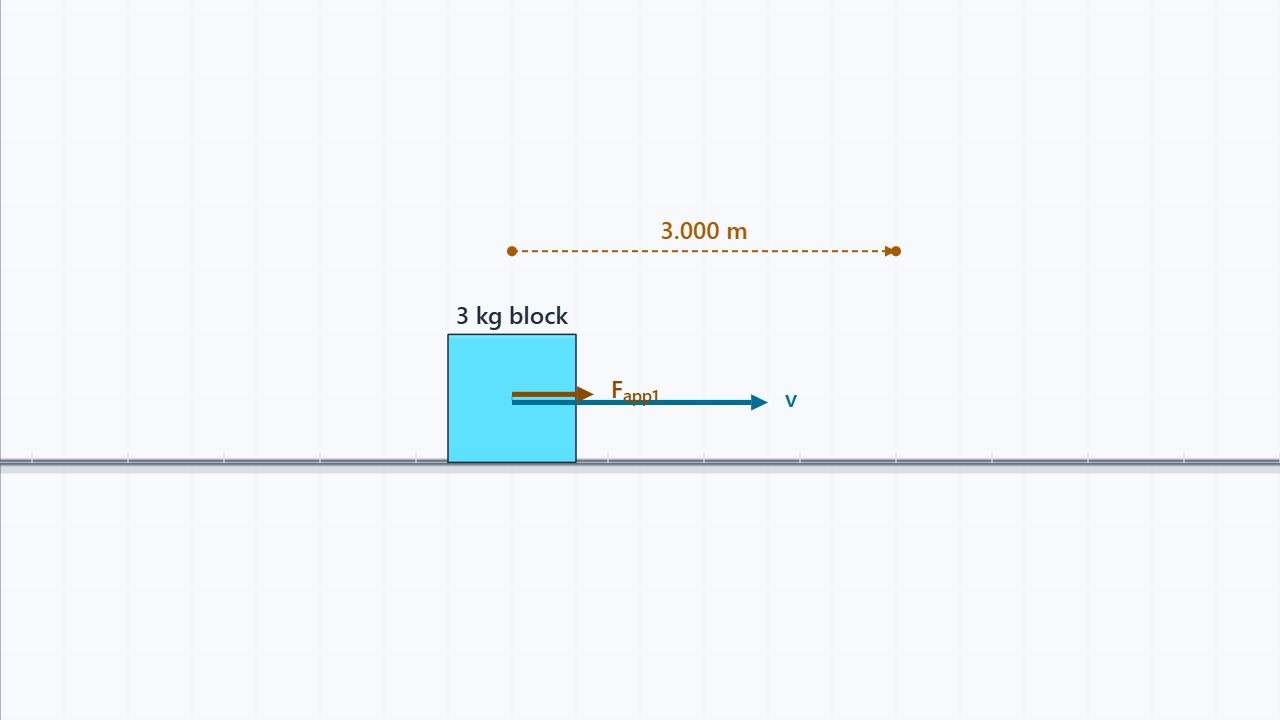
- Compare signed work. Test an opposing force, zero force, and a forward force. Measure displacement and final velocity, then compare net work with the change in kinetic energy.
- Design and collect. Choose at least five masses. Keep applied force and initial velocity fixed, and measure final velocity at approximately the same displacement.
- Linearize the data. Transform mass and final-speed measurements to form a straight-line graph. Use the slope to determine net work and interpret the intercept.
- Explain and predict. Explain why negative work does not mean negative kinetic energy. Predict and check final velocity for an unused mass.
What students will learn
- Connect the sign of net work with changes in kinetic energy.
- Control force, displacement, and initial velocity while varying mass.
- Determine net work from a graph and test a velocity prediction.
Common misconception
Does negative work mean negative kinetic energy?
An opposing force can reduce kinetic energy while the block continues moving. Students compare signed work with changes in the always nonnegative kinetic energy.