BuildPhysics

AP Physics 1 · Unit 2, Part 1 · Forces

Inclined Planes

Tilt a ramp, resolve the weight, and connect force components with the block’s acceleration and motion.

Start lesson
  • Free
  • No account required
  • Self-paced
Inclined Planes guided lesson preview Start guided lesson
Explore the model. Make predictions. Check your thinking.

Learn by doing

Three ideas you’ll put into motion

Choose helpful axes

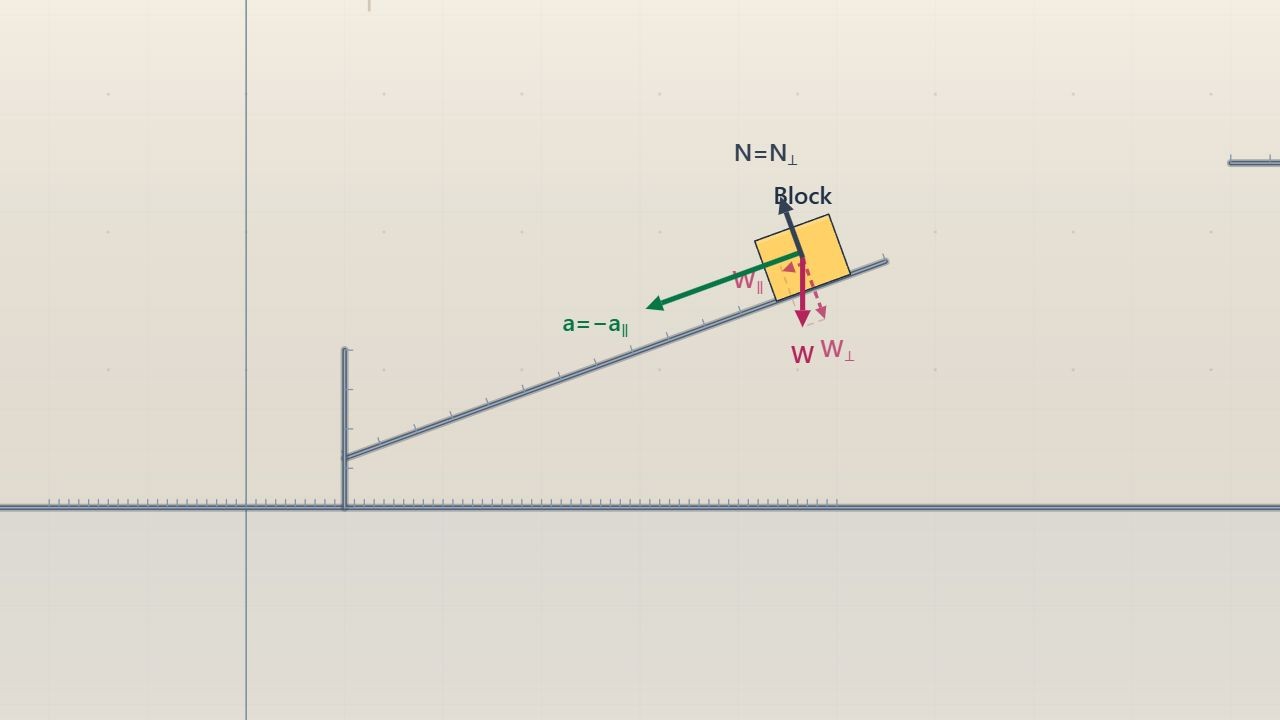
Separate directions parallel and perpendicular to the ramp.

Test the angle

Change the incline angle and compare the downhill acceleration.

Connect force and motion

Use a force model and the recorded slide to check a prediction.

The big idea

The key ideas, at a glance.

Weight stays vertical

Gravity acts downward, even when the axes rotate. Its downhill component is mg sin θ and its into-ramp component is mg cos θ.

The normal force is perpendicular

For a supported block with no other perpendicular forces, N = mg cos θ. The downhill force model also includes friction when present.

A quick comparison

Increase the angle of a frictionless ramp, keeping the block supported.

Downhill acceleration increases.

weightnormalsteeper → larger mg sin θ
Teaching this topic?Classroom fit, AP connections, and support
Classroom fit
Use for a concept introduction, guided independent practice, or a projected class discussion.
Before students begin
Free-body diagrams, Newton’s second law, and basic sine and cosine.
Built-in support
Prepared scenes, guided prompts, and feedback on lesson questions.
AP Physics 1 connections
Unit 2: force components, ramp motion, and system modeling.
Check for understanding
Ask why the normal force is usually smaller than mg on a simple incline.
Optional extension
Investigate further with the Inclined Plane lab.
Meet the educator behind Build Physics

Ready to test your thinking?

The first scene is set up. Start the lesson and explore.

Start lesson