
Plan the investigation
Does a heavier block slide down faster?
Compare five masses on the same frictionless ramp. Predict both acceleration and normal force before running: one stays the same while the other changes.
Change
Block mass: 1, 2, 3, 4, and 5 kg.
Keep fixed
Ramp geometry, starting position, zero initial velocity, gravity at 9.80 m/s², and friction disabled.
The prepared ramp rises 3.50 m over a horizontal distance of 7.00 m, so θ = arctan(3.50/7.00) ≈ 26.565°. It slopes upward to the right; downhill motion is leftward and downward.
Disable Friction Enabled in World before collecting these trials. The predictions below describe a frictionless surface. Keep the block on the straight ramp and stop before it reaches the floor or catch wall.
Build the model
Resolve weight along the ramp
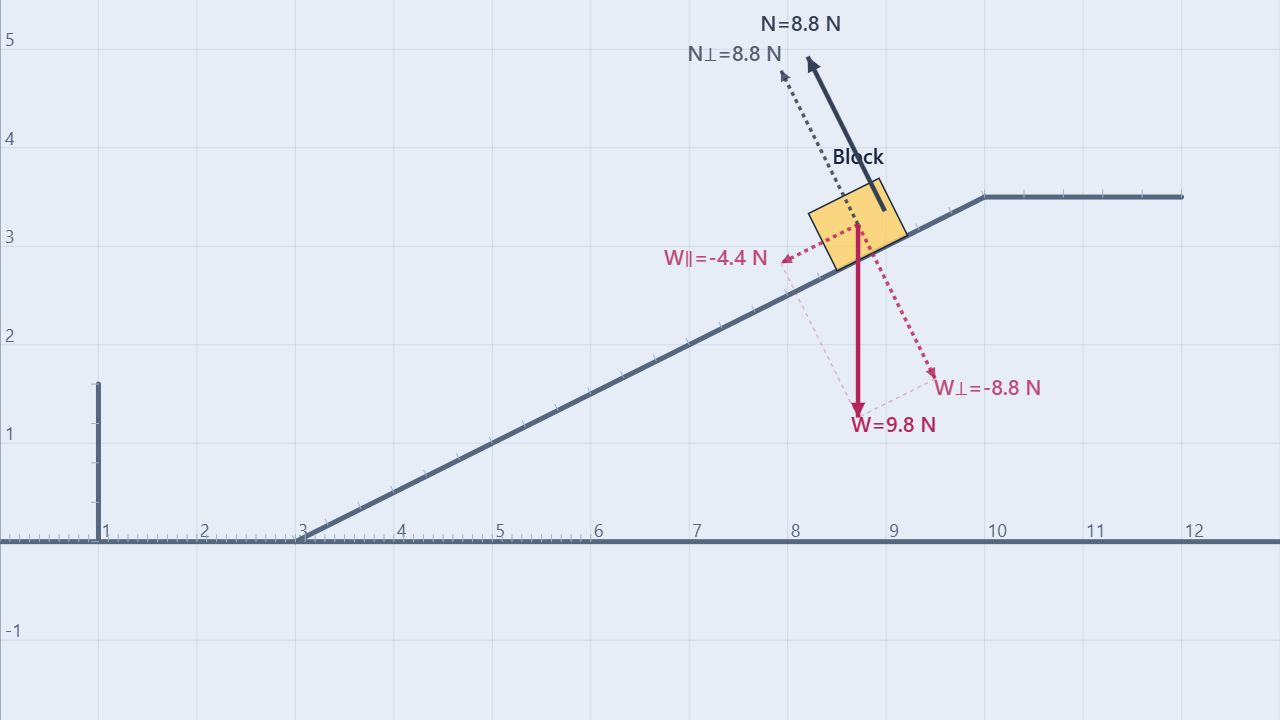
Choose a positive axis downhill and a perpendicular axis away from the surface. The actual forces are weight, mg, vertically downward and normal force, N, perpendicular to the ramp. Resolve weight into mg sin θ downhill and mg cos θ into the surface.
ΣF⊥ = N − mg cos θ = 0, so N = mg cos θ
ΣF∥ = mg sin θ = ma∥, so a∥ = g sin θ
These equations assume continuous contact with a straight, stationary ramp, no friction, and no additional applied forces. The block has no acceleration perpendicular to the surface.
Procedure
A useful five-trial workflow
- Load the scene. Launch the simulation. If a saved scene appears, choose Inclined plane from the experiment menu. Open World, disable friction, and check gravity is 9.80 m/s².
- Set the mass. Open Properties, select Block, and set Mass to 1 kg. Keep the original ramp and starting position. Start each trial from rest.
- Predict and run. Calculate acceleration and normal force. Set the run duration beside Play to 0.5 seconds, then run the simulation.
- Collect evidence. Open the Data panel with Block selected. Choose acceleration magnitude and normal-force magnitude as graph measurements, then read a sample after motion begins and before any collision. Record its time, mass, acceleration, and normal force. Use the same sampled time for every trial.
- Reset and repeat. Reset before changing mass to 2, 3, 4, and 5 kg. Recheck friction and the starting conditions. Compare your readings with the calculated table and export CSV to keep the evidence.
| Mass (kg) | Downhill force (N) | Normal force (N) | Acceleration (m/s²) |
|---|---|---|---|
| 1.00 | 4.383 | 8.765 | 4.383 |
| 2.00 | 8.765 | 17.531 | 4.383 |
| 3.00 | 13.148 | 26.296 | 4.383 |
| 4.00 | 17.531 | 35.062 | 4.383 |
| 5.00 | 21.913 | 43.827 | 4.383 |
Worked example
A 2 kg block on the prepared ramp
The block weighs 2.00 × 9.80 = 19.60 N. Using the unrounded ramp angle:
Fdownhill = 19.60 sin θ ≈ 8.765 N
N = 19.60 cos θ ≈ 17.531 N
a∥ = 8.765 / 2.00 ≈ 4.383 m/s²
Starting from rest, the predicted speed after 0.500 s is 2.191 m/s and the distance traveled along the ramp is ½at² ≈ 0.548 m. Those predictions apply only while the block remains on the same straight surface.
Why does the graph show a negative acceleration?
The simulation’s x and y components use horizontal and vertical axes. For this ramp, downhill acceleration has ax = −3.920 m/s² and ay = −1.960 m/s². Neither component alone is the full downhill acceleration. Its magnitude is √(ax² + ay²) ≈ 4.383 m/s².
Common misconception
Are weight components extra forces?
No. The parallel and perpendicular components represent the same weight vector. Draw weight once, or use its two components when adding forces; including both would count gravity twice.
Is normal force always equal to weight?
On this ramp, N = mg cos θ, which is less than mg. It balances the perpendicular component of weight, not the entire weight vector.
Why might the block stay still?
Check friction first. Static friction can prevent sliding when mg sin θ ≤ μsmg cos θ. With no other forces, this means tan θ ≤ μs. Also check that the simulation is running and the block is free to move.
Does a steeper frictionless ramp increase acceleration?
Yes. Increasing θ increases sin θ between 0° and 90°. At a fixed angle, increasing mass increases both downhill force and inertia in the same proportion, leaving acceleration unchanged.
For teachers
Turn the table into a claim supported by evidence
Plot measured acceleration against mass: expect a horizontal trend near 4.383 m/s². Plot normal force against mass: expect a straight line through the origin with slope g cos θ ≈ 8.765 N/kg. Have students explain both graphs using the same force diagram.
As a second investigation, change the ramp angle while holding mass fixed. Measure rise and horizontal run to calculate θ, reposition the block on the ramp at rest, and use only samples before a transition or impact. Plot acceleration against sin θ; the frictionless model predicts a straight line with slope g.
To investigate the onset of slipping, continue with the Critical Angle & Friction experiment. Review the Inclined Planes lesson guide and Free-Body Diagrams guide for force components.
Physics reference: OpenStax, University Physics Volume 1, §6.1. Learn about the educator behind these simulations on the BuildPhysics About page.