
Core idea
Rotate the axes to match the ramp
On an incline, gravity still points vertically downward, but the block’s motion is constrained along the surface. Choose one axis parallel to the ramp and one axis perpendicular to it. The single weight vector can then be represented by a downhill component mg sin θ and a component into the ramp mg cos θ.
For a stationary, frictionless ramp, the perpendicular forces balance and the parallel component produces the acceleration:
ΣF⊥ = FN − mg cos θ = 0, so FN = mg cos θ
ΣF∥ = mg sin θ = ma∥, so a∥ = g sin θ
Mass changes the force magnitudes and the inertia by the same factor, so frictionless ramp acceleration depends on angle rather than mass. The normal force does change with mass and angle.
Parallel axis
Use downhill as positive when the block slides down. The parallel weight component drives motion, while friction or an applied force can oppose or assist it.
Perpendicular axis
Use the surface normal direction to calculate contact force. A block constrained to the ramp has zero acceleration in this direction.
Guided lesson path
Move from components to a connected system
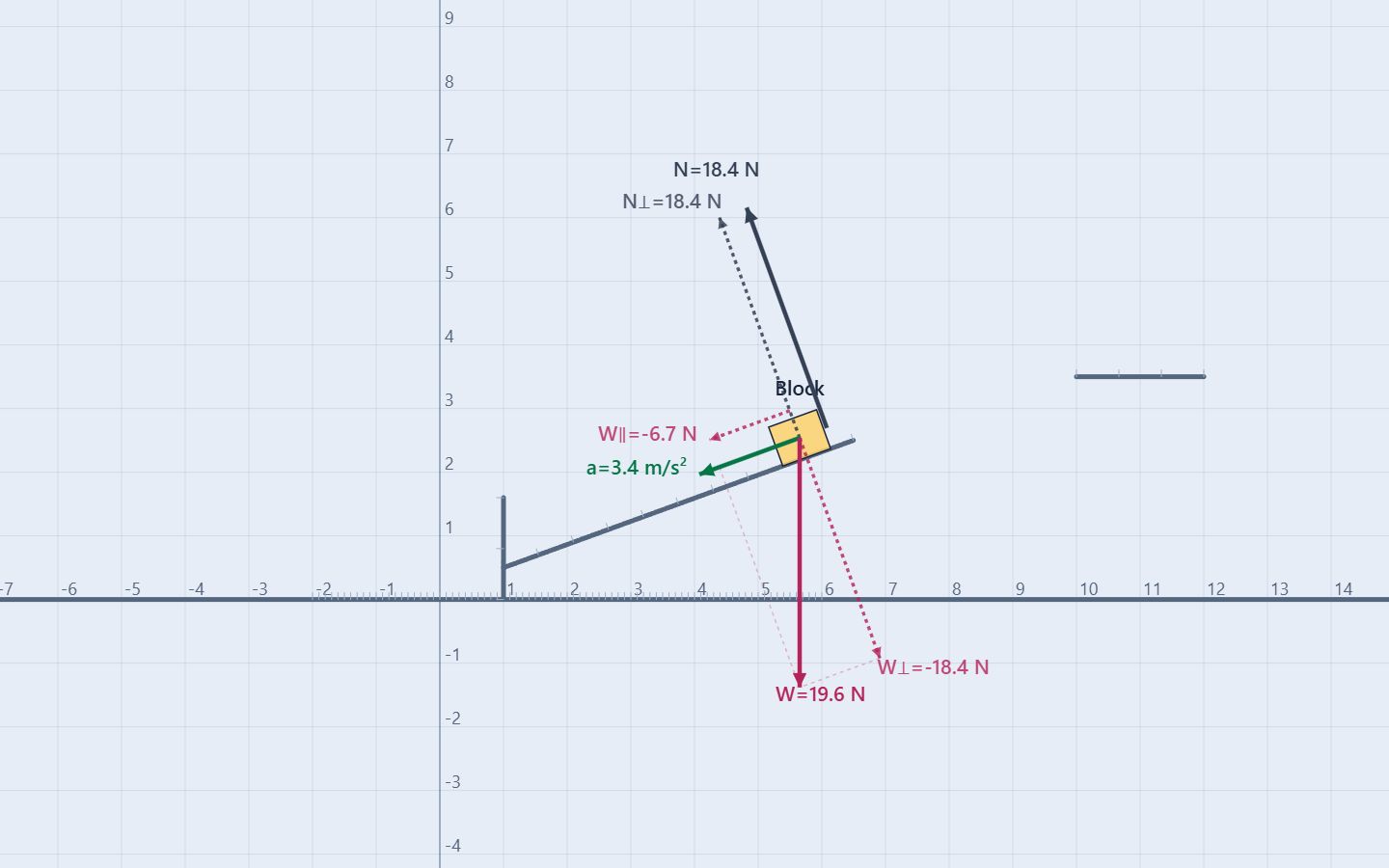
- Observe motion on a 20° frictionless ramp. A 2 kg block starts from rest and accelerates parallel to the surface, down the slope—not vertically downward.
- Choose ramp-aligned axes. The parallel axis follows the motion and the perpendicular axis follows the normal force, making the constraint visible in the equations.
- Inspect the weight components. The downhill component is mg sin θ and the into-the-ramp component is mg cos θ. They are two descriptions of one weight vector.
- Calculate the parallel component. For 2 kg at 20°, Fg∥ = (2)(9.8)sin20° ≈ 6.70 N.
- Calculate the normal force. With no perpendicular acceleration, FN = (2)(9.8)cos20° ≈ 18.42 N.
- Calculate the ramp acceleration. After canceling mass, a∥ = g sin20° ≈ 3.35 m/s2.
- Verify with one graph. A single acceleration-magnitude graph should support the predicted 3.35 m/s2 while the block remains on the straight ramp.
- Find the ramp length. If the ramp rises 2 m, L = h/sinθ ≈ 5.85 m for a 20° incline.
- Connect force to motion. Starting from rest, use L = ½a∥t2 to predict about 1.87 s to travel the full ramp, then use vf2 = 2a∥L to predict about 6.26 m/s at the bottom.
- Change the mass to 4 kg. The weight components and normal force double, but the frictionless acceleration remains g sin20° because mass cancels.
- Compare a 30° ramp. A steeper ramp increases a∥ to 4.90 m/s2 while reducing FN to mg cos30° ≈ 16.97 N for a 2 kg block.
- Connect the ramp to a hanging mass. A 2 kg block on a 30° frictionless ramp is linked to a 2 kg hanging mass. The two objects share an acceleration magnitude along the rope.
- Write the connected-system equation. Tension is internal to the two-mass system. The external driving terms are the block’s parallel weight component and the hanging weight: mBg sinθ + mHg = (mB + mH)a.
- Balance the connected system. A 30 N force applied 11.48° above the ramp supplies a 29.4 N parallel component, balancing the 29.4 N combined driving weight term and producing constant velocity.
- Transfer the method. For any new incline, define the system, choose ramp axes, resolve forces, include friction or applied components with signs, and solve one equation per direction.
| Ramp angle | Fg∥ (N) | FN (N) | a∥ (m/s2) |
|---|---|---|---|
| 20° | 6.70 | 18.42 | 3.35 |
| 30° | 9.80 | 16.97 | 4.90 |
| 45° | 13.86 | 13.86 | 6.93 |
| 90° limit | 19.60 | 0.00 | 9.80 |
Worked examples
Keep the components tied to the geometry
For the prepared 2 kg, 20° ramp:
Fg∥ = (2.00 kg)(9.80 m/s2)sin20° = 6.70 N
FN = (2.00 kg)(9.80 m/s2)cos20° = 18.42 N
The parallel equation gives:
a∥ = Fg∥/m = 6.70 N/2.00 kg = 3.35 m/s2
Starting from rest and traveling L = 5.85 m:
t = √(2L/a∥) ≈ 1.87 s; vf = √(2a∥L) ≈ 6.26 m/s
Friction and critical angle
Add contact physics after the frictionless model
On a rough incline, static friction adjusts to prevent relative slipping until it reaches its maximum value. With no other force components, the block can remain at rest when:
mg sinθ ≤ μsmg cosθ, so tanθ ≤ μs
The critical angle satisfies tanθc = μs. Once the block slides, kinetic friction points up the ramp and the parallel equation becomes:
ΣF∥ = mg sinθ − μkmg cosθ = ma∥
Static friction is not automatically μsFN; that value is its maximum possible magnitude. Use the Critical Angle and Friction experiment to test the onset of slipping.
Connected systems
Internal tension cancels only after choosing the whole system
| Chosen system | Useful external terms | Best use |
|---|---|---|
| Ramp block alone | mg sinθ, FN, friction, applied components, and tension if present | Find the block’s along-ramp acceleration |
| Hanging mass alone | mHg and rope tension | Check the sign and magnitude of its acceleration |
| Ramp block + hanging mass | External weight components and applied forces | Find shared acceleration without internal tension |
| Block on rough incline | mg sinθ and friction along the ramp | Test static balance or kinetic sliding |
Tension still acts on each object’s free-body diagram. It disappears from the complete-system equation because the two rope forces are internal and equal-and-opposite within that boundary.
Common misconceptions
Check the reasoning
Are mg sinθ and mg cosθ extra forces?
No. They are perpendicular components of the one gravitational force. Counting the full weight and both components together would count gravity more than once.
Is the normal force equal to the full weight?
No. For a frictionless incline with no other perpendicular force, FN = mg cosθ, which is less than mg for a nonzero angle.
Does a heavier frictionless block accelerate faster?
No. Its parallel weight component and inertia both scale with mass, leaving a∥ = g sinθ.
Does a negative x or y acceleration mean the block is slowing down?
No. The sign only describes direction relative to the horizontal and vertical axes. The block can accelerate downhill while its speed increases.
Does static friction always equal μsFN?
No. Static friction supplies whatever magnitude is needed up to that maximum. At the critical angle, it reaches the maximum just as slipping begins.
Why does tension disappear from the connected-system equation?
It is internal to a boundary containing both connected objects. Isolate either object again when you need the tension value.
For teachers
Make the axis choice part of the evidence
Have students draw the ramp, mark θ from the horizontal, and label the parallel and perpendicular axes before displaying components. Use the 2 kg block at 20° to predict Fg∥, FN, and a∥, then change mass to show which values scale and which do not.
Next compare 20° and 30° ramps, then add the connected hanging-mass trial. Ask students to identify which force terms cross the system boundary and why internal tension cancels. Finish with friction and the critical angle as a separate model with a different contact rule.
Continue with Free-Body Diagrams for force boundaries, Atwood Machines for connected-mass reasoning, and the Inclined Plane experiment for the full simulation workflow.