
Core idea
A free-body diagram is a force model for one chosen system
Start by isolating and naming one object or system. Then draw one arrow for each external interaction acting on that boundary. Weight comes from Earth, normal force comes from a contact surface, tension comes from a taut rope, applied force comes from a push or pull, and friction comes from relative contact motion. Begin each arrow at the object’s center of mass and point it in the physical direction of the interaction.
A free-body diagram is not a picture of every arrow in the scene. Velocity, acceleration, displacement, and the force the selected object exerts on something else do not belong on that object’s diagram. Net force is the vector sum of the real forces; it summarizes the diagram and is not an additional interaction.
Set the boundary
Write the selected object or system before deciding which forces are external. Changing the boundary changes which interactions belong on the diagram.
Set the axes
Choose convenient positive directions, resolve angled forces into components, and write separate ΣFx and ΣFy equations.
Guided lesson path
Build the diagram from simple contacts to a complete force model
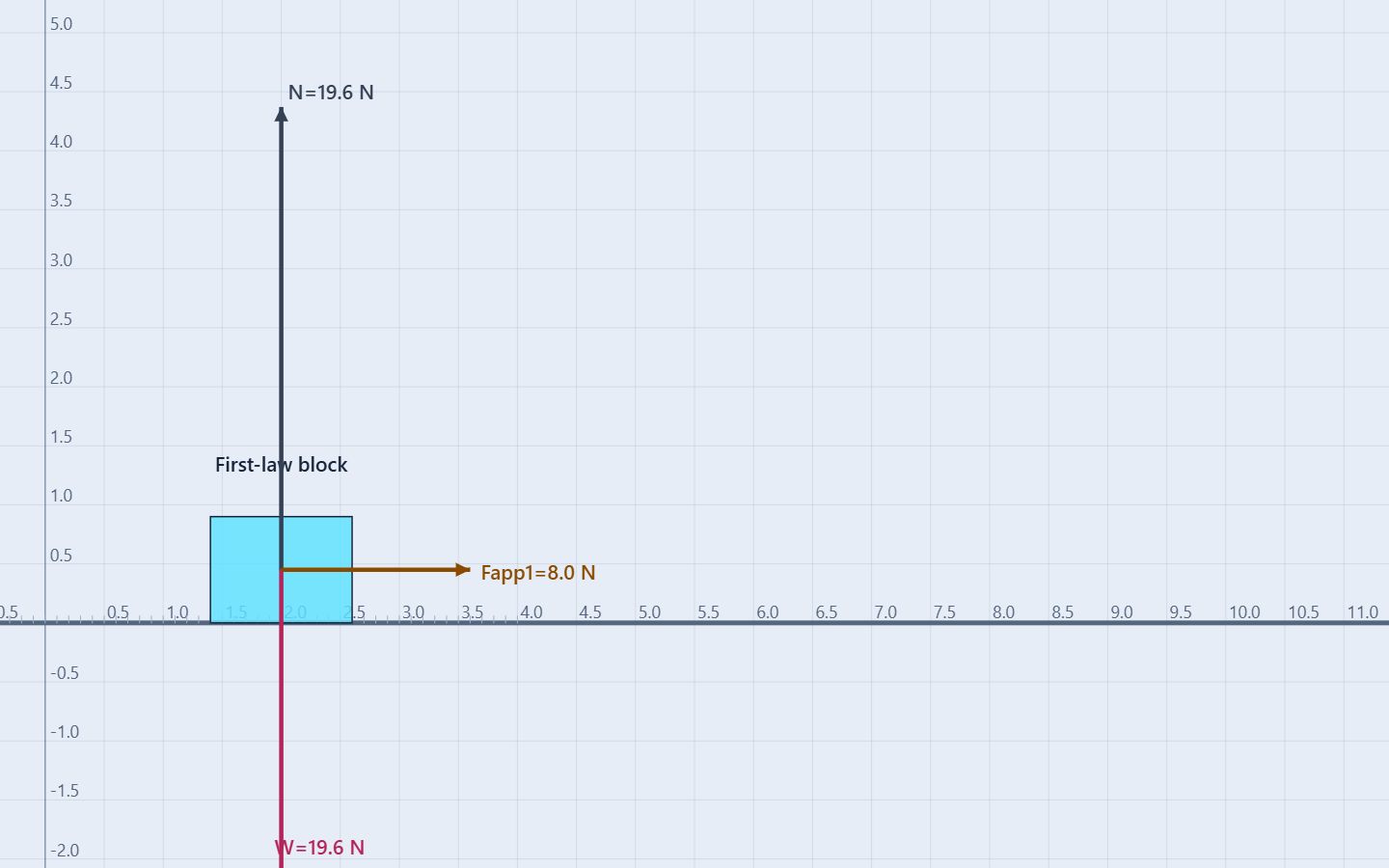
- Isolate a resting block. A 2 kg block on a level floor has weight downward and normal force upward. It can have nonzero forces while remaining at rest because the vertical components balance.
- Use a selected-object filter deliberately. Show only the chosen block when the prompt asks for one object. The filter changes visibility, not the physics or force magnitudes.
- Read a force magnitude. The block’s weight is Fg = mg = (2 kg)(9.8 N/kg) = 19.6 N.
- Add a horizontal applied force. An 8 N push to the right leaves the vertical forces balanced, so ΣFx = +8 N and the acceleration points right.
- Add friction. A 4 kg crate with an 18 N applied force right and 10 N kinetic friction left has ΣFx = 8 N. Friction follows relative sliding, not a rule that it always opposes the object’s position or every velocity in every frame.
- Inspect tension. For a selected hanging mass, tension points along the taut rope away from the mass. Forces from other objects belong only if they act on the selected boundary.
- Match the model to the prompt. If air resistance is ignored, omit it. If it matters, include a force opposite the object’s motion relative to the air.
- Rotate the contact surface. On a 30° frictionless incline, weight remains vertical while normal force is perpendicular to the ramp. The normal magnitude is about 16.97 N for a 2 kg block, less than its 19.6 N weight.
- Complete and calculate. Show weight, normal, applied force, and friction once each, then add their components. Finish by returning to the system boundary and checking that every arrow represents an external interaction.
| Force | Source | Direction rule |
|---|---|---|
| Weight Fg | Earth | Toward Earth; near the surface, downward |
| Normal FN | Contact surface | Perpendicular to the local surface |
| Tension T | Taut rope or cable | Along the rope, pulling away from the object |
| Friction f | Contact with relative motion | Parallel to the surface and opposite relative sliding or attempted sliding |
| Applied Fapp | Push, pull, or actuator | Direction of the applied interaction |
Worked examples
Turn a complete diagram into component equations
For the 2 kg block at rest on a level floor, choose upward as +y:
ΣFy = FN − Fg = 0; Fg = mg = 19.6 N, so FN = 19.6 N
Now add an 8 N applied force to the right and choose right as +x:
ΣFx = Fapp,x = +8 N; ax = ΣFx/m = 8/2 = 4 m/s²
For the rough-floor crate:
ΣFx = Fapp − fk = 18 − 10 = +8 N
The normal and weight still cancel vertically if there is no vertical acceleration. The horizontal imbalance produces the acceleration.
System boundaries
The same scene can require different diagrams
If you select one hanging mass, draw its weight and the upward tension from the rope. If you select the connected masses as one system, the tension forces between the parts are internal and cancel from the system equation. The boundary decides whether a force is external or internal.
| Selected system | Include | Do not include |
|---|---|---|
| Single block on floor | Weight, normal, applied force, friction if present | The block’s reaction force on the hand or floor |
| One hanging mass | Weight and rope tension | Forces acting on the other mass |
| Connected multi-object system | Forces crossing the outer boundary | Internal tension pairs between parts of the system |
| Block on incline | Weight, normal, and friction if the ramp is rough | A normal arrow opposite weight by assumption |
For a rotated axis on an incline, it is often useful to choose one axis parallel to the ramp and one perpendicular to it. Weight then has components along both axes, while normal force lies entirely on the perpendicular axis.
Model choices
Include only interactions the model allows
Air resistance is a force caused by motion through air. If the problem says to ignore air resistance, the free-body diagram should omit it. If the model includes drag, draw it opposite the object’s velocity relative to the air and state any approximation used.
Normal force is not automatically equal to weight. They are equal for a resting block on a level surface when no other vertical force or vertical acceleration is present. On a 30° incline, the normal force is approximately mg cos 30° = 16.97 N for a 2 kg block, while weight remains 19.6 N downward.
Common misconceptions
Check the reasoning
Does a moving object need a force in the direction of motion?
No. Forces determine acceleration, which changes velocity. An object can move at constant velocity with zero net force.
Should velocity and acceleration be drawn on an FBD?
No. They describe motion, not interactions. Keep them visible as separate motion vectors only when the problem asks for them.
Does every third-law pair go on one diagram?
No. A free-body diagram contains forces acting on the selected object or system. The equal-and-opposite partner acts on a different object.
Is normal force always opposite weight?
No. Normal force is perpendicular to the contact surface. On an incline it is tilted, while weight remains vertical.
Does friction always point opposite velocity?
Friction opposes relative sliding or attempted sliding at the contact. Identify the surfaces and their relative motion before choosing its direction.
For teachers
Require a boundary, a direction, and a reason
Before students draw arrows, have them write the selected object or system and the positive axes. Require each label to name the interaction source—Earth, surface, rope, hand, or contact pair—rather than using only “up” or “right.”
Use the selected-object filter for one explicitly isolated check, then turn it off for a complete scene. Ask students to separate individual forces from the net-force summary and to explain why the net arrow is not a fifth interaction.
Continue with Newton’s Second Law to connect the diagram to acceleration, Friction for contact models, and the Net Force and Acceleration experiment for controlled measurements.