
Core idea
Conservative work depends on endpoints
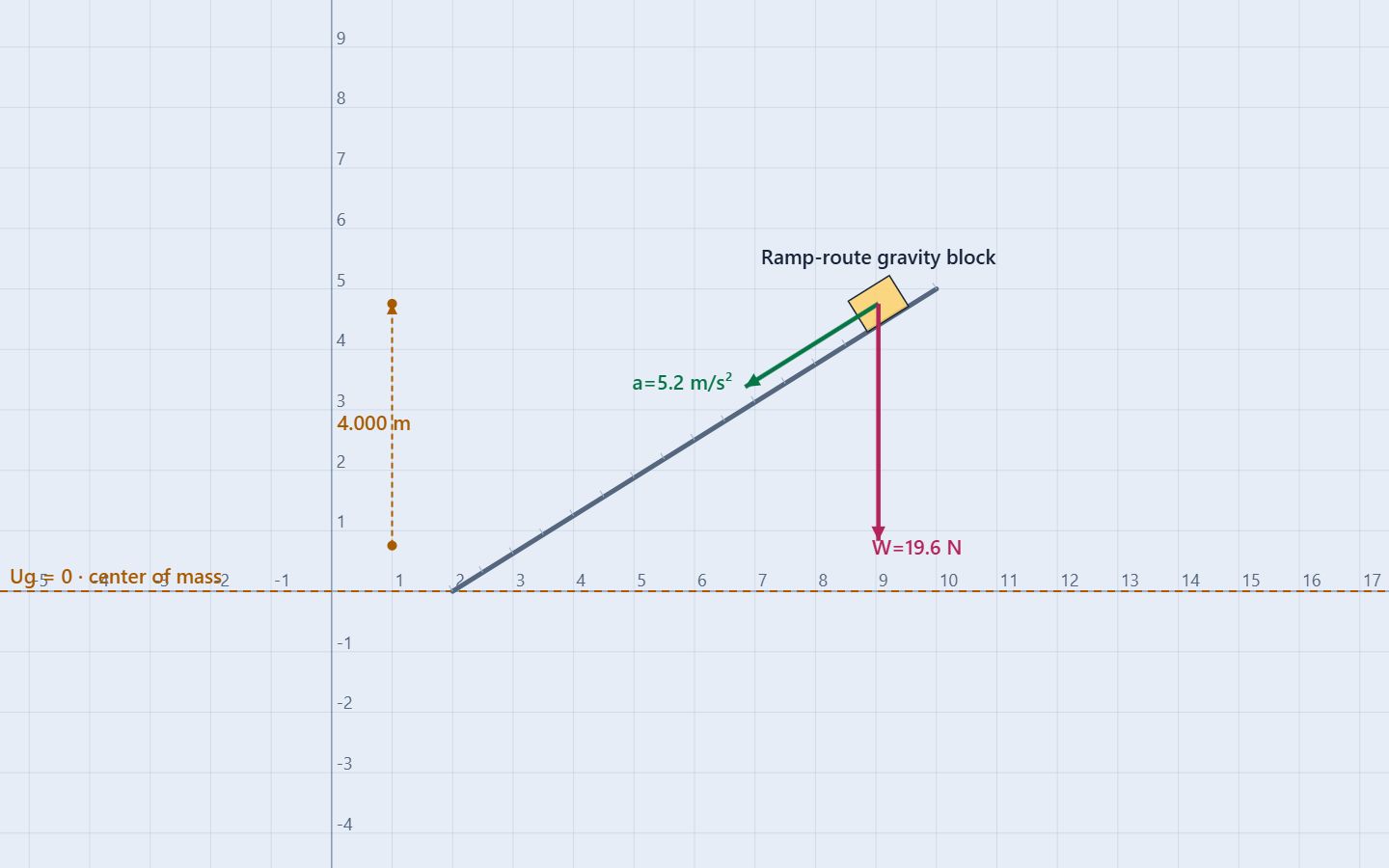
A conservative force does the same work between two positions no matter which path connects them. Gravity is conservative near Earth, so a direct drop and a longer frictionless ramp produce the same gravitational work when they have the same vertical change.
Wc = −ΔU
Ug = mgy and ΔUg = mgΔy
Gravitational potential energy belongs to the object–Earth system. The height-zero line is a reference choice, not a physical surface. Moving that line shifts the numerical Ug values but leaves energy differences, forces, and motion unchanged.
Conservative
Gravity and an ideal spring are path independent. Their work can be represented by a potential-energy change.
Non-conservative
Kinetic friction, air resistance, and many applied pushes depend on the actual path or transfer energy across the chosen system boundary.
Guided lesson path
Compare paths, references, and energy accounting
- Observe a non-conservative force. A 2 kg block sliding against 4 N of kinetic friction loses mechanical energy according to the distance traveled.
- Measure friction on a 4 m path. Friction points opposite displacement, so Wf = (4 N)(4 m) cos180° = −16 J.
- Measure friction on a 6 m path. The same friction force now does −24 J. The endpoints alone do not determine non-conservative work.
- State the path-dependence test. If two routes between the same positions produce different work, the force is non-conservative in the model.
- Test a conservative force. A 2 kg block descends 4 m directly. Gravity does Wg = mgΔh = (2)(9.8)(4) = +78.4 J.
- Take a longer frictionless route. The same 4 m vertical drop along an incline also produces +78.4 J of gravitational work. Ramp length does not change the result.
- Compare gravitational paths. Equal endpoints give equal gravitational work and equal kinetic-energy changes when other work is absent.
- Complete a closed path. A block that rises and returns to its starting height has zero net gravitational work because its initial and final positions are the same.
- Classify common forces. Gravity and ideal spring forces are conservative. Kinetic friction, air resistance, and a person’s push are generally treated as non-conservative transfers.
- Assign potential energy to a system. Ug describes the configuration of the object–Earth system, not energy stored inside the object alone.
- Choose a reference level. Set Ug = 0 at a convenient height, then measure signed height from that line. The reference changes bookkeeping, not motion.
- Calculate a baseline value. A 2 kg block 3 m above the reference has Ug = (2)(9.8)(3) = 58.8 J.
- Compare two heights. Raising the same 2 kg block from 3 m to 6 m doubles Ug from 58.8 J to 117.6 J because Ug is proportional to height.
- Compare two masses. At 3 m, a 6 kg block has Ug = 176.4 J, three times the 2 kg value. Gravitational potential energy is proportional to mass at fixed height.
- Read the ground reference. A 2 kg block at y = 5 m with y0 = 0 has Ug = 98.0 J.
- Shift the zero upward. If y0 changes to 2 m, the same block is 3 m above the reference and Ug becomes 58.8 J. Its motion has not changed.
- Compare the reference choices. Individual Ug values shift, but ΔUg between the same two positions and the predicted motion remain unchanged.
- Relate gravitational work and potential energy. During a 4 m downward displacement, ΔUg = −78.4 J while Wg = +78.4 J. The signs are opposite.
- Compare conservative and non-conservative accounting. Gravity transfers energy between Ug and K without path dependence; friction removes mechanical energy in proportion to the actual path.
- Finish with the endpoint test. Name the system, identify the force, compare paths, select a reference, calculate ΔU, and then use Wc = −ΔU or the appropriate work sum.
| Force or interaction | Path dependence | Useful accounting | Example |
|---|---|---|---|
| Gravity | Independent of path | Wg = −ΔUg | Same vertical drop gives same work |
| Ideal spring | Independent of path | Ws = −ΔUs | Work depends on initial and final stretch |
| Kinetic friction | Depends on path length | Wf = −fkd | 4 m and 6 m paths give different work |
| Applied push | Depends on force and displacement history | W = Fd cosθ for a constant force | Work crosses the system boundary |
Worked examples
Keep the endpoint change and sign together
For a 2 kg block falling 4 m:
ΔUg = mgΔy = (2 kg)(9.8 m/s2)(−4 m) = −78.4 J
Wg = −ΔUg = +78.4 J
For the same block descending a longer frictionless ramp:
Δy = −4 m, regardless of ramp length
Wg = (2 kg)(9.8 m/s2)(4 m) = +78.4 J
For a 2 kg block 5 m above a reference at y0 = 2 m:
h = y − y0 = 5 m − 2 m = 3 m
Ug = mgh = (2 kg)(9.8 m/s2)(3 m) = 58.8 J
For 4 N kinetic friction over 6 m:
Wf = fkd cos180° = (4 N)(6 m)(−1) = −24 J
Path test
Same endpoints do not always mean same work
Gravity is conservative because only the vertical endpoints matter in a uniform gravitational field. A longer ramp can change the force component along the surface and the travel distance, but those changes compensate so the total gravitational work remains mg times the vertical drop.
Friction behaves differently. A longer route creates more contact distance, so the same kinetic-friction force transfers more energy out of the moving object. If the work changes when the route changes, do not represent that force with one endpoint-only potential-energy value.
| Trial | Force | Path | Work |
|---|---|---|---|
| Direct gravitational drop | Gravity | 4 m vertical | +78.4 J |
| Frictionless ramp | Gravity | Longer route, 4 m vertical | +78.4 J |
| Short rough path | 4 N friction | 4 m traveled | −16 J |
| Long rough path | 4 N friction | 6 m traveled | −24 J |
Reference levels
Changing zero changes values, not predictions
Potential energy is defined relative to a chosen zero. With Ug = mg(y − y0), changing y0 adds or subtracts the same constant from every position. The measurable difference between two positions is unchanged:
ΔUg = mg[(yf − y0) − (yi − y0)] = mg(yf − yi)
Choose the ground, the starting point, or another convenient level. State the choice so another reader can interpret the numerical values, then use differences for physical predictions.
System accounting
Potential energy belongs to the interacting system
Gravitational potential energy describes the object–Earth configuration. If Earth is outside the chosen system, gravity can appear as external work. If the object and Earth are both included, gravity is an internal conservative interaction and its energy can be tracked as Ug.
This boundary choice changes the bookkeeping language, not the physical result. Be explicit about which objects are in the system before deciding whether energy is stored internally or transferred by work across the boundary.
Common misconceptions
Check the reasoning
Does a longer ramp make gravity do more work?
No. For the same starting and ending heights, gravity does the same work because it is conservative.
Is gravitational potential energy absolute?
No. Its numerical value depends on the chosen zero level. Energy differences and motion predictions do not.
Is potential energy stored in the object alone?
No. Gravitational potential energy belongs to the interacting object–Earth system.
Does a negative ΔU mean negative gravitational work?
No. For gravity, Wg = −ΔUg. A falling object has negative ΔUg and positive gravitational work.
Can friction be represented by mgh?
No. Friction is non-conservative in this model, so its work depends on the actual path length and belongs in the work or energy-transfer accounting.
Does zero net work mean no forces act?
No. Positive and negative work contributions can cancel, or individual forces can do zero work because they are perpendicular to displacement.
For teachers
Make path and reference choices explicit
Start with the 2 kg, 4 m gravitational drop and have students predict the work before running the longer ramp. Then use the 4 m and 6 m friction trials to make path dependence visible with the same force magnitude.
Have students record Ug at y0 = 0 m and then at y0 = 2 m. Ask them to identify which values shift and which differences remain fixed. Finish by requiring a system boundary before students label gravity as internal potential-energy storage or external work.
Continue with Work and Kinetic Energy for force–displacement work, Conservation of Mechanical Energy for energy transformations, and Conservation of Energy with External Work for system-boundary accounting.