
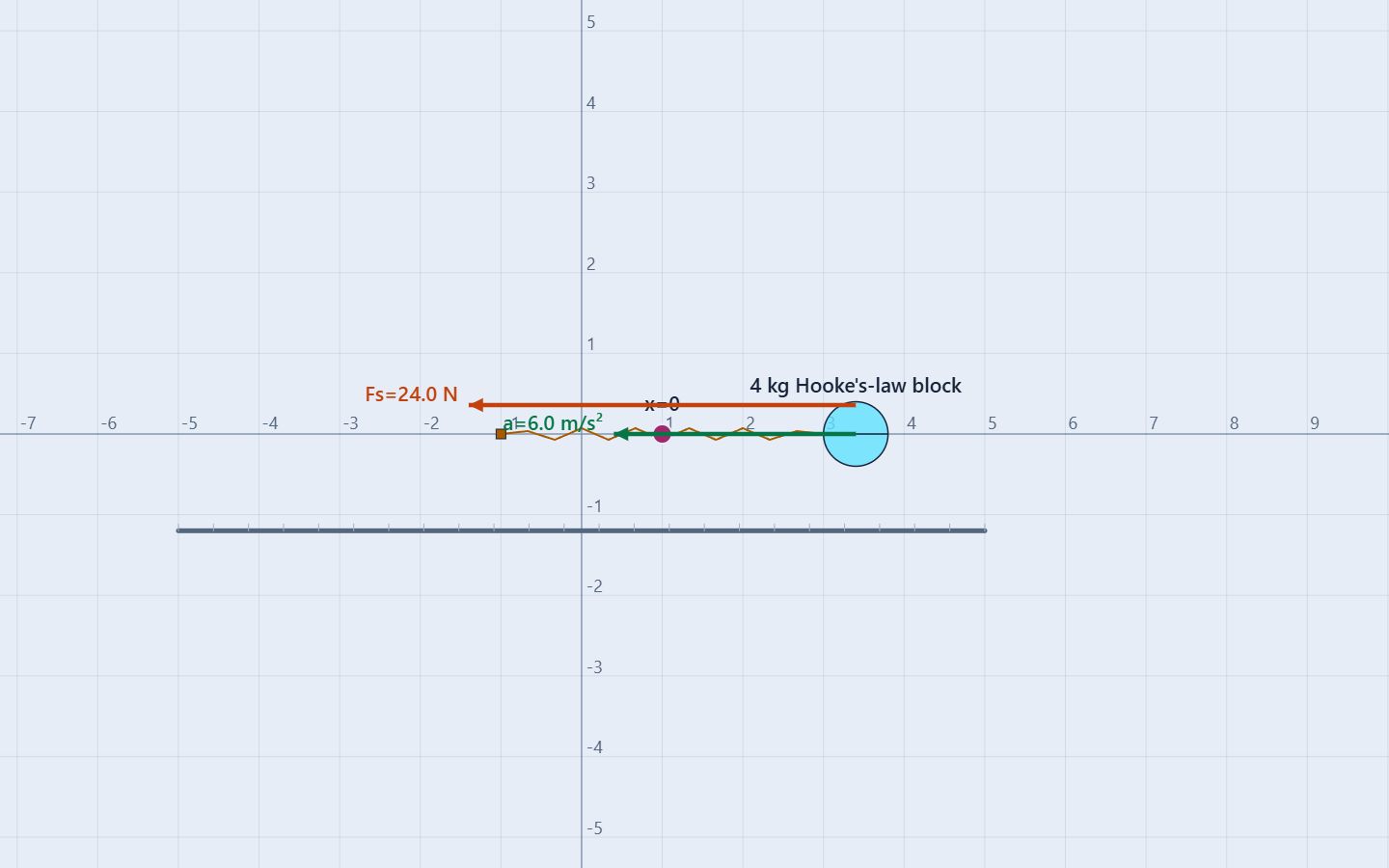
Core idea
Spring force grows with displacement from equilibrium
For an ideal spring, measure x from the equilibrium position. The spring force is a restoring force: it points back toward equilibrium and its magnitude is proportional to the displacement.
Fs,x = −kx
Us = 12kx2 and T = 2π√(m/k)
The minus sign gives direction. If x is positive, the spring force is negative; if x is negative, the spring force is positive. Elastic potential energy is a scalar and depends on x2, so equal stretches and compressions store the same energy.
Equilibrium
At x = 0 the ideal spring force is zero. A block can still be moving fastest there because the spring energy has become kinetic energy.
Displacement
Use distance from equilibrium, not distance from the spring’s natural length, unless the setup explicitly makes those positions the same.
Guided lesson path
Measure a spring, then follow one complete oscillation
- Set the coordinate. Identify the equilibrium position and call it x = 0. A positive x is one side of equilibrium; a negative x is the other.
- Measure the spring constant. Hold a 4 kg block 2 m from equilibrium with k = 4 N/m. The force magnitude is |Fs| = k|x| = 8 N.
- Read the restoring direction. At x = +2 m, Fs,x = −8 N. The force points toward x = 0 rather than in the direction of the displacement.
- Reverse the displacement. At x = −2 m, Fs,x = +8 N. The magnitude is unchanged, but the sign reverses.
- Graph force against position. An ideal spring produces a straight line through the origin. The slope is −k, so the slope magnitude gives the spring constant.
- Double the displacement. Changing |x| from 2 m to 4 m at k = 4 N/m doubles the force magnitude from 8 N to 16 N.
- Compare stored energy. At x = 2 m, Us = 8 J. At x = 4 m, Us = 32 J. Doubling displacement quadruples elastic energy.
- Use the graph area. The work required to stretch from 0 to 4 m is the triangle area under the external-force graph: Wext = ½(4 m)(16 N) = 32 J.
- Start at a turning point. A 4 kg block begins at x = +2 m on a k = 12 N/m spring. It starts from rest, so all 24 J of mechanical energy is elastic potential energy.
- Run toward equilibrium. As |x| decreases, Us decreases and K increases. The spring force is not zero until the block reaches x = 0.
- Find the fastest point. At x = 0, Us = 0 and K is 24 J. The speed is maximum even though the instantaneous spring force is zero.
- Calculate maximum speed. Use 24 J = ½(4 kg)vmax2. The result is vmax = √12 ≈ 3.46 m/s.
- Reach the opposite turning point. At x = −2 m the block stops momentarily, Us returns to 24 J, and K returns to zero.
- Track the cycle. The sequence +2 m → 0 → −2 m → 0 → +2 m repeats when the spring is ideal and no dissipative work occurs.
- Change the mass. With k fixed, a larger mass lowers the oscillation frequency and increases the period because T = 2π√(m/k).
- Change the spring constant. A stiffer spring raises the force at every |x| and shortens the period. The period depends on k, not on the amplitude in the ideal model.
- Separate force from energy. Force is signed and linear in x. Elastic energy is nonnegative and quadratic in x. Do not treat the negative sign in force as negative stored energy.
- Check a hanging equilibrium. If a mass hangs at rest, the spring force can balance weight. The spring may be stretched and store energy even though the net force is zero.
- State the model limits. Real springs can have a non-linear range, damping, and a maximum safe extension. Hooke’s law applies over the ideal linear range represented by the simulation.
- Finish with a prediction. Given m, k, and x, predict force direction, stored energy, speed at equilibrium, and period before pressing Run.
| Position | Fs,x | |Fs| | Us |
|---|---|---|---|
| −4 m | +16 N | 16 N | 32 J |
| −2 m | +8 N | 8 N | 8 J |
| 0 m | 0 N | 0 N | 0 J |
| +2 m | −8 N | 8 N | 8 J |
| +4 m | −16 N | 16 N | 32 J |
Worked examples
Use the same displacement in force, energy, and motion equations
For a k = 12 N/m spring and a block at x = +2 m:
Fs,x = −kx = −(12 N/m)(2 m) = −24 N
Us = ½kx2 = ½(12 N/m)(2 m)2 = 24 J
If a 4 kg block starts from rest at that turning point, then all 24 J becomes kinetic at equilibrium:
24 J = ½(4 kg)vmax2
vmax = 3.46 m/s
The same mass–spring pair has period:
T = 2π√(m/k) = 2π√(4 kg ÷ 12 N/m) = 3.63 s
Force–position graph
Slope gives k; area gives stored energy
On an Fs,x-versus-x graph, the ideal spring is a line through the origin with slope −k. The magnitude of the slope tells how stiff the spring is. If you graph the external force needed to stretch the spring, the line has slope +k and the area under the curve from 0 to x is the elastic energy stored.
Signed force
Keep the sign when finding acceleration or adding forces. The restoring force changes direction across equilibrium.
Energy area
Use the positive area under the external-force curve for the energy transferred into the spring: Us = ½kx2.
Mass–spring motion
Energy moves between elastic and kinetic stores
For an ideal oscillator, K + Us stays constant. At each turning point the speed is zero and the spring energy is greatest. At equilibrium the spring energy is smallest and the speed is greatest. The acceleration also changes sign as the block crosses x = 0.
| Position | K | Us | Speed |
|---|---|---|---|
| +2 m | 0 J | 24 J | 0 m/s |
| 0 m | 24 J | 0 J | 3.46 m/s |
| −2 m | 0 J | 24 J | 0 m/s |
| 0 m | 24 J | 0 J | 3.46 m/s |
Damping or friction changes the ideal picture. Mechanical energy then decreases as thermal energy is generated, while a larger total-energy account can still conserve energy.
Equilibrium and reference position
Zero net force is not the same as zero spring force
For a horizontal spring with no other horizontal force, equilibrium is the spring’s relaxed position. For a hanging mass, equilibrium occurs where the upward spring force balances weight, so the spring is stretched and Fs is not zero. Always define x from the equilibrium used by the model before applying the oscillator equations.
Confusing natural length with equilibrium can shift every force and energy value. Draw the reference position, identify the other forces, and then measure the displacement that appears in Hooke’s law.
Common misconceptions
Check the reasoning
Does the negative sign mean the spring has negative energy?
No. The sign belongs to the force direction. Elastic potential energy ½kx2 is nonnegative relative to the chosen zero.
Is the spring force always in the direction of displacement?
No. An ideal spring force points opposite x, back toward equilibrium.
Is spring force μFN or mg?
No. Hooke’s law gives the spring force from k and displacement. Weight or friction may be separate forces in the same free-body diagram.
Does zero force mean the block stops?
No. At equilibrium the ideal spring force is zero while the oscillator’s speed and kinetic energy are maximum.
Does doubling displacement double energy?
No. Force doubles, but elastic energy scales with x2, so it becomes four times as large.
Is equilibrium always the spring’s natural length?
No. A hanging mass can stretch the spring until the spring force balances its weight.
Does a heavier mass change the spring constant?
No. k describes the spring. Changing mass changes the motion and period, but not the ideal spring’s force at a given displacement.
For teachers
Make the sign, slope, and area visible
Begin with the k = 4 N/m force trials at x = +2 m and x = −2 m. Ask students to predict the signed force before running, then use the graph to identify the slope magnitude. Follow with x = 4 m so the class can compare linear force growth with quadratic energy growth.
Use the 4 kg, k = 12 N/m oscillator to have students record the two turning points and the equilibrium crossing. Require them to distinguish a zero-force instant from a zero-speed instant, then change mass and spring constant separately to test T = 2π√(m/k).
Continue with Work and Kinetic Energy for force–displacement area, Conservation of Mechanical Energy for energy exchange, and the Spring Launch Up a Curved Ramp experiment for elastic energy becoming gravitational potential energy.