
Core idea
Distance describes the path; displacement compares endpoints
Distance is the total path length an object covers. Displacement is the final position minus the initial position, so it describes the net change along the chosen axis. Distance is a nonnegative scalar; one-dimensional displacement keeps a sign that tells you whether the change points toward +x or −x.
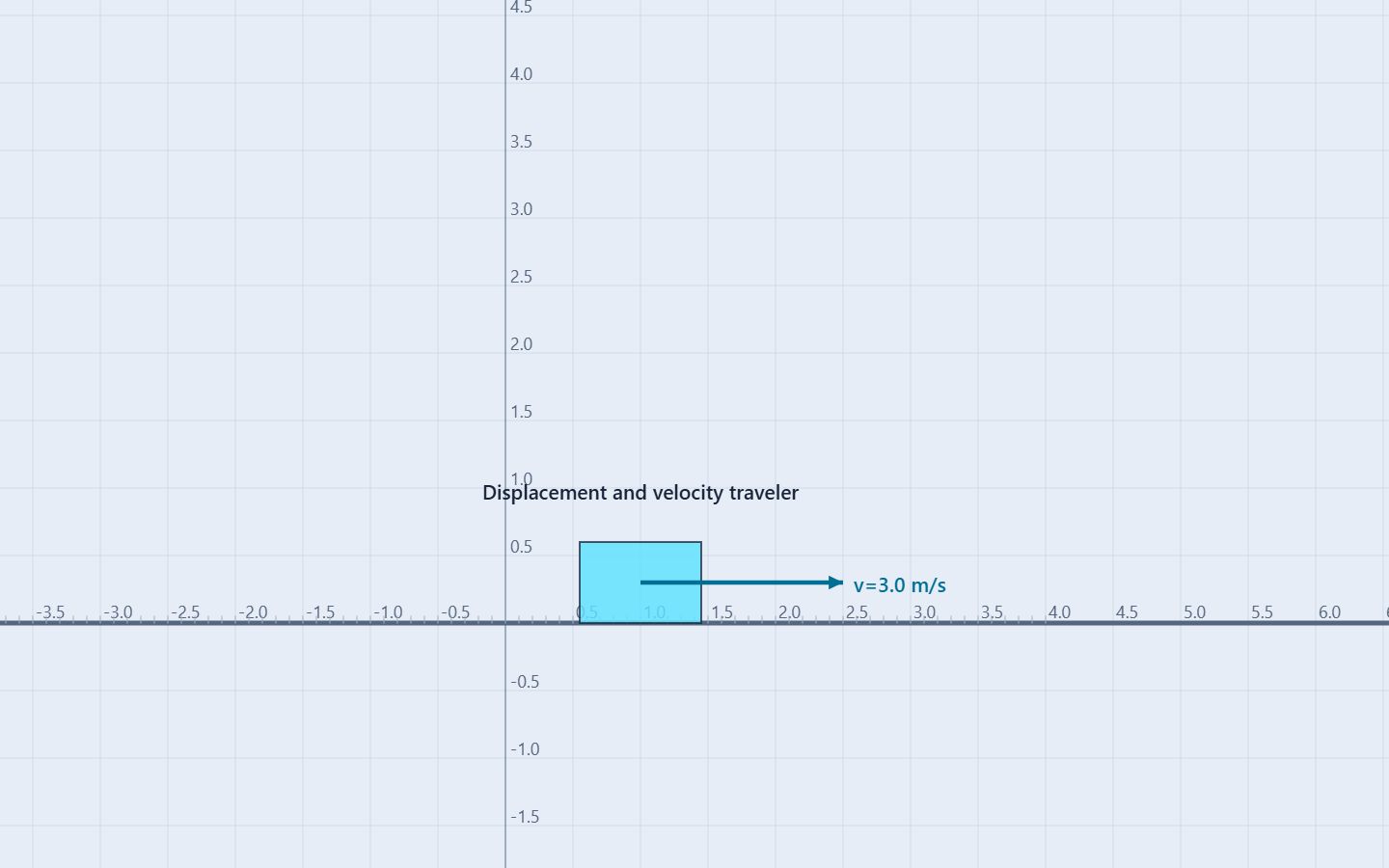
Speed is the magnitude of velocity. Velocity includes direction, so a traveler moving left at −3.0 m/s has a speed of 3.0 m/s. A negative position is also different from negative velocity: position tells where the object is, while velocity tells how its position is changing.
Track the endpoints
Write down xi and xf before calculating. The sign of Δx comes from the order xf − xi, not from whether the final coordinate is positive or negative.
Track the path
Add the magnitudes of every route segment for distance. Direction changes do not make distance negative, but they can make the net displacement smaller or even zero.
Guided lesson path
A useful progression from vectors to averages
- Observe the velocity vector. Run a traveler at +3.0 m/s, then reverse it to −3.0 m/s. The speed magnitude stays 3.0 m/s while the velocity direction changes.
- Calculate signed displacement. Start at xi = 1.00 m and run right at +2.20 m/s. At t = 1.00 s, xf = 3.20 m, so the displacement is +2.20 m.
- Compare a leftward trip. Start at xi = 8.00 m and move at −2.50 m/s. At t = 1.20 s, xf = 5.00 m: distance is 3.00 m and displacement is −3.00 m.
- Break a route into segments. For A = 0 m → B = +5 m → C = +3 m, add path lengths for distance and subtract endpoints for displacement.
- Read graphs and averages. Use x–t slope for velocity, signed v–t area for displacement, and the correct numerator for average speed or average velocity.
| Trip | Initial position | Final position | Distance | Displacement |
|---|---|---|---|---|
| Rightward | 1.00 m | 3.20 m | 2.20 m | +2.20 m |
| Leftward | 8.00 m | 5.00 m | 3.00 m | −3.00 m |
| A → B → C | 0.00 m | 3.00 m | 7.00 m | +3.00 m |
For a route with a reversal, distance and displacement no longer have the same magnitude. Keep the segment signs for displacement, but use positive segment lengths when adding distance.
Worked examples
Use the quantity that matches the question
For the rightward trial from xi = 1.00 m to xf = 3.20 m:
Δx = xf − xi = 3.20 − 1.00 = +2.20 m
Because this trial never reverses, its distance is also 2.20 m. For the leftward trial from 8.00 m to 5.00 m:
Δx = 5.00 − 8.00 = −3.00 m; distance = 3.00 m
For A → B → C, the signed segment displacements are +5 m and −2 m. The complete trip therefore has:
distance = |+5| + |−2| = 7 m; Δx = +5 + (−2) = +3 m
Graph reading
Read direction from slope and displacement from area
| Representation | What to read | Typical constant-velocity pattern |
|---|---|---|
| x–t graph | Slope gives velocity | Straight rising line for positive velocity; falling line for negative velocity |
| vx–t graph | Height gives signed velocity; area gives displacement | Horizontal line at the constant velocity |
| Motion vector | Arrow direction gives velocity direction; length gives magnitude | Same length and direction for straight constant-velocity motion |
A graph below x = 0 can still have a positive slope, and a graph above x = 0 can have a negative slope. Position and velocity signs answer different questions. In a circular path, speed can stay nearly constant while velocity changes because the arrow direction changes.
Complete trips
Average speed and average velocity use different numerators
Both averages divide by the same total elapsed time. Average speed uses total distance, while average velocity uses net displacement:
average speed = total distance / Δt; vavg = Δx / Δt
For the guided biker trip, the first leg covers 20 m to the right in 2.0 s. The second covers 32 m to the left in 8.0 s, ending at x = −12 m.
| Quantity | Calculation | Result |
|---|---|---|
| Total distance | 20 m + 32 m | 52 m |
| Net displacement | +20 m − 32 m | −12 m |
| Average speed | 52 m / 10 s | 5.2 m/s |
| Average velocity | −12 m / 10 s | −1.2 m/s |
A round trip can have positive distance and average speed while displacement and average velocity are zero. Returning to the starting point cancels the net position change, not the path traveled.
Common misconceptions
Check the reasoning
Can distance be negative?
No. Distance is a path length and is never negative. Displacement can be negative because its sign records direction.
Does negative displacement mean the final coordinate is negative?
No. An object can move from x = 8 m to x = 5 m. Both coordinates are positive, but the displacement is −3 m because x decreased.
Does constant speed guarantee constant velocity?
No. Velocity also includes direction. An object moving around a circular path can keep nearly constant speed while its velocity changes continuously.
Does zero displacement mean the object did not move?
No. A complete lap or round trip can cover a positive distance and finish with zero displacement.
For teachers
Make the signs and numerators visible
Ask students to write xi, xf, and a direction convention before they calculate. Have them label each route segment with both its signed displacement and its positive path length.
For graph analysis, show only one data series at a time. Ask students to predict the x–t slope before running, then use the velocity graph’s signed area to verify the endpoint displacement. Finish with a round-trip prompt so students must explain why distance and average speed remain positive when net displacement is zero.
Continue with the Constant Speed Motion Simulation and Virtual Lab, then connect graph slope and area to Position and Velocity Graphs and changing velocity to Constant Acceleration. The prepared experiment page includes the student-ready lab resources.