
Core idea
One vector can describe two simultaneous directions
A two-dimensional vector has a magnitude and a direction, but you can also describe it with perpendicular components. Choose +x and +y axes, then resolve the vector into its horizontal and vertical parts. The components act at the same time; they are not two separate legs of the object’s path.
For a vector of magnitude A at angle θ measured from +x, Ax = A cos θ and Ay = A sin θ. The signs carry the quadrant: a westward component is negative x and a southward component is negative y.
Resolve
Break one arrow into perpendicular components, keeping the angle convention and signs visible.
Recombine
Add x components and y components separately, then use the resultant components to recover magnitude and direction.
Guided lesson path
Build from components to relative motion
- Watch simultaneous component motion. Set vx = +4.0 m/s and vy = +3.0 m/s. In 1.2 s the object moves in both directions at once, reaching Δx = 4.8 m and Δy = 3.6 m.
- Recover the vector. The 3–4–5 relationship gives |v| = 5.0 m/s and θ = tan−1(3/4) = 36.9° north of east.
- Use signs for a different quadrant. A 6.0 m/s vector at 30° north of west has vx ≈ −5.2 m/s and vy = +3.0 m/s. Negative x tells you the object moves west.
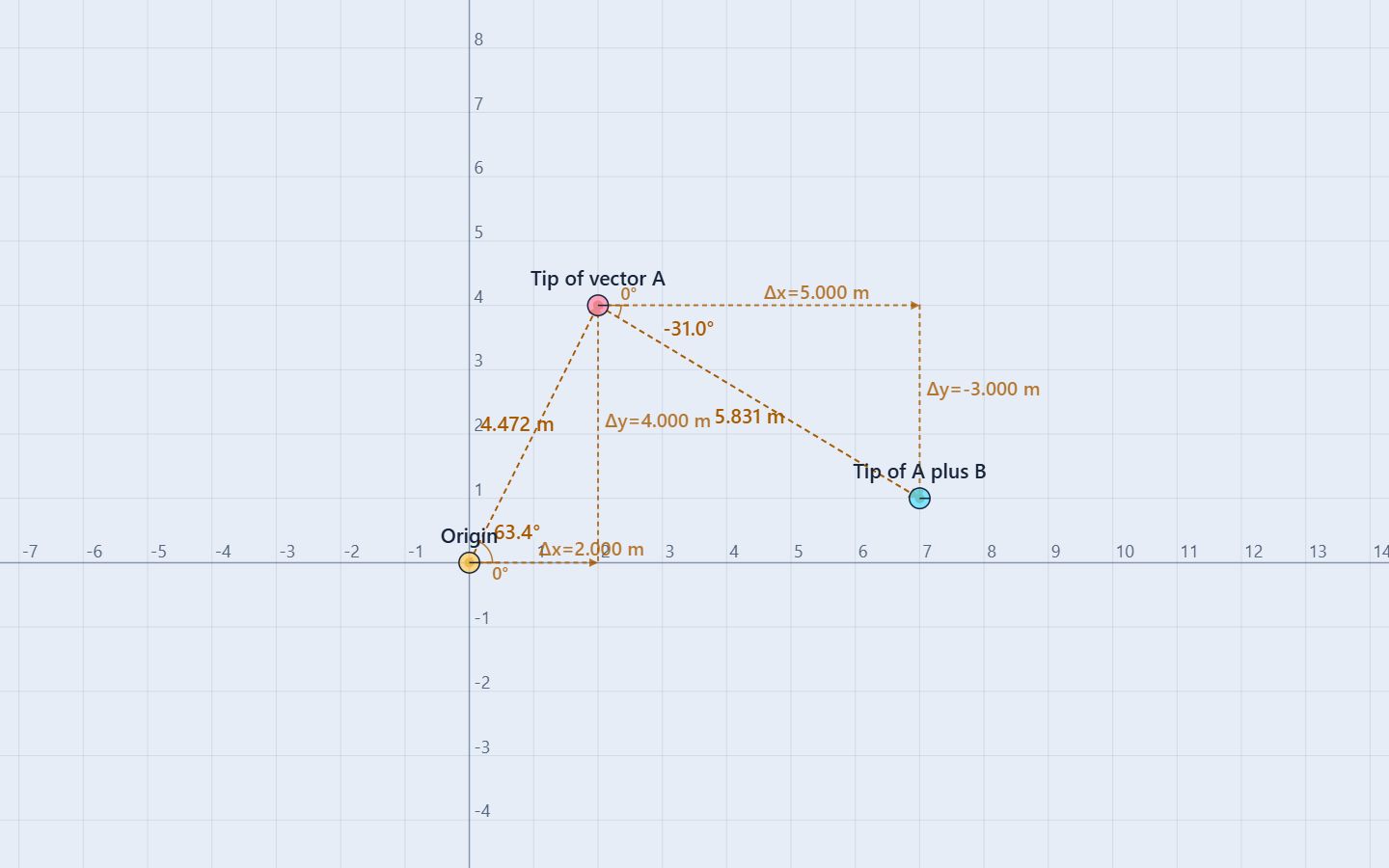
- Add vectors component by component. For A = (+2, +4) and B = (+5, −3), the resultant is R = (+7, +1), with magnitude 7.07 units and direction 8.1° north of east.
- Change reference frames. A boat’s velocity relative to the ground is its velocity through the water plus the water’s velocity relative to the ground. The subscripts identify which observer measures each arrow.
- Aim to cancel a current. With a 5.0 m/s eastward current, give a 20.0 m/s boat a −5.0 m/s westward component. The ground-relative x component is then zero, so the boat travels directly across.
| Vector | x component | y component | Result |
|---|---|---|---|
| v = (+4, +3) m/s | +4.0 m/s | +3.0 m/s | 5.0 m/s at 36.9° north of east |
| 6.0 m/s, 30° north of west | −5.2 m/s | +3.0 m/s | Northwest direction |
| A + B | +2 + 5 = +7 | +4 − 3 = +1 | 7.07 units at 8.1° north of east |
Worked examples
Resolve, add, and check the quadrant
For v = (+4.0, +3.0) m/s, the magnitude comes from the right triangle:
|v| = √(vx2 + vy2) = √(4.02 + 3.02) = 5.0 m/s
For the northwest vector, measure 30° from west. The west component is negative:
vx = −6.0 cos 30° = −5.20 m/s; vy = 6.0 sin 30° = +3.00 m/s
For A = (+2, +4) and B = (+5, −3), add matching components before finding the resultant direction:
R = (2 + 5, 4 − 3) = (+7, +1); |R| = √50 = 7.07 units
Because both resultant components are positive, the arrow belongs in the northeast quadrant. Use atan2(Ry, Rx) to keep that quadrant information when calculating its angle.
Relative velocity
The same motion can have different measured velocities
Relative velocity names the object and the observer. In the river setup, vboat/ground = vboat/water + vwater/ground. The boat’s through-water arrow and the current arrow are added to predict the path seen from shore.
| Velocity | x component | y component | Magnitude |
|---|---|---|---|
| Boat/water | −20 sin 35° = −11.47 m/s | 20 cos 35° = +16.38 m/s | 20.0 m/s |
| Water/ground | +5.00 m/s | 0 m/s | 5.0 m/s |
| Boat/ground | −6.47 m/s | +16.38 m/s | 17.61 m/s |
To land directly across, choose vboat/water,x = −5.0 m/s. It cancels the current’s +5.0 m/s x component. The remaining north component is √(202 − 52) ≈ 19.36 m/s, so the ground-relative motion has no sideways drift.
Common misconceptions
Check the reasoning
Are components separate pieces of the trip?
No. The x and y components describe simultaneous changes along perpendicular axes. Their combination is the actual displacement or velocity vector.
Can I add vector magnitudes first?
Usually no. Add matching components, then calculate the resultant magnitude. Adding magnitudes ignores direction and can give the wrong answer.
Does a negative component mean the magnitude is negative?
No. A component can be negative to show direction, while a vector magnitude is always nonnegative.
Why do the relative-velocity subscripts matter?
They identify the reference frames. Boat speed through water, water speed relative to shore, and boat speed relative to shore are different measurements that must be related with the correct order.
For teachers
Make the arrows and signs do the explaining
Ask students to draw +x and +y before entering a vector. Have them predict the signs of each component, then use the simulation’s measurements to check the prediction. When the resultant points into a different quadrant, require a sentence explaining what each sign means physically.
Use the river scene as a reference-frame discussion: students should identify the observer before adding any arrows. Continue with Projectile Motion to connect component motion to a shared clock, review vector displacement with the Vector Displacement Scavenger Hunt, and revisit one-dimensional signs in Displacement and Velocity.