
Core idea
A scale measures the normal force
A rider’s gravitational weight is Fg = mg, but a scale reads the upward contact force from the floor, FN. With upward chosen as positive, the rider’s free-body diagram gives:
ΣFy = FN − mg = may
FN = m(g + ay)
Acceleration determines the scale reading. Upward acceleration makes the normal force greater than weight, downward acceleration makes it smaller, and zero acceleration makes the two forces equal. The rider can be moving up or down in any of those cases.
What changes
Change the elevator’s vertical acceleration or the rider’s mass while keeping the force model visible.
What stays fixed
Gravity remains 9.8 m/s2 downward. Weight depends on mass, while apparent weight depends on the normal force needed to produce the rider’s acceleration.
Guided lesson path
Separate velocity from acceleration
- Observe an ordinary scale reading. A 4 kg rider with zero elevator acceleration has weight 39.2 N and normal force 39.2 N. The vertical forces balance.
- Identify apparent weight. The scale reports FN, the normal force exerted by the floor. It does not directly measure gravitational force or an imaginary inertia force.
- Make an upward-moving elevator speed up. Give the floor +1.0 m/s initial velocity and +4.0 m/s2 acceleration. The upward velocity grows and the normal force becomes larger than weight.
- Calculate the upward scale reading. For a 4 kg rider at +4.0 m/s2, use the rider equation to predict FN = 55.2 N.
- Observe upward constant velocity. A rider moving upward at +2.0 m/s with zero acceleration still has FN = mg. Motion direction alone does not set apparent weight.
- Test the common misconception. An elevator can move upward while slowing down. Its velocity is upward, but its acceleration is downward, so the rider feels lighter.
- Calculate the slowing-upward reading. With a 4 kg rider and ay = −4.0 m/s2, the normal force is 23.2 N, below the 39.2 N gravitational weight.
- Choose an acceleration yourself. Set any nonzero vertical acceleration between −4.0 and +4.0 m/s2. Predict whether the normal force is above or below weight, then test the prediction.
- Cut the cable in the model. Set the floor and rider to free-fall acceleration −9.8 m/s2. Weight remains 39.2 N, but the normal force becomes zero, so the scale reads weightless.
- Change the rider’s mass. At +2.2 m/s2, increasing mass scales both weight and normal force. Recalculate with the mass you enter rather than reusing the original 4 kg value.
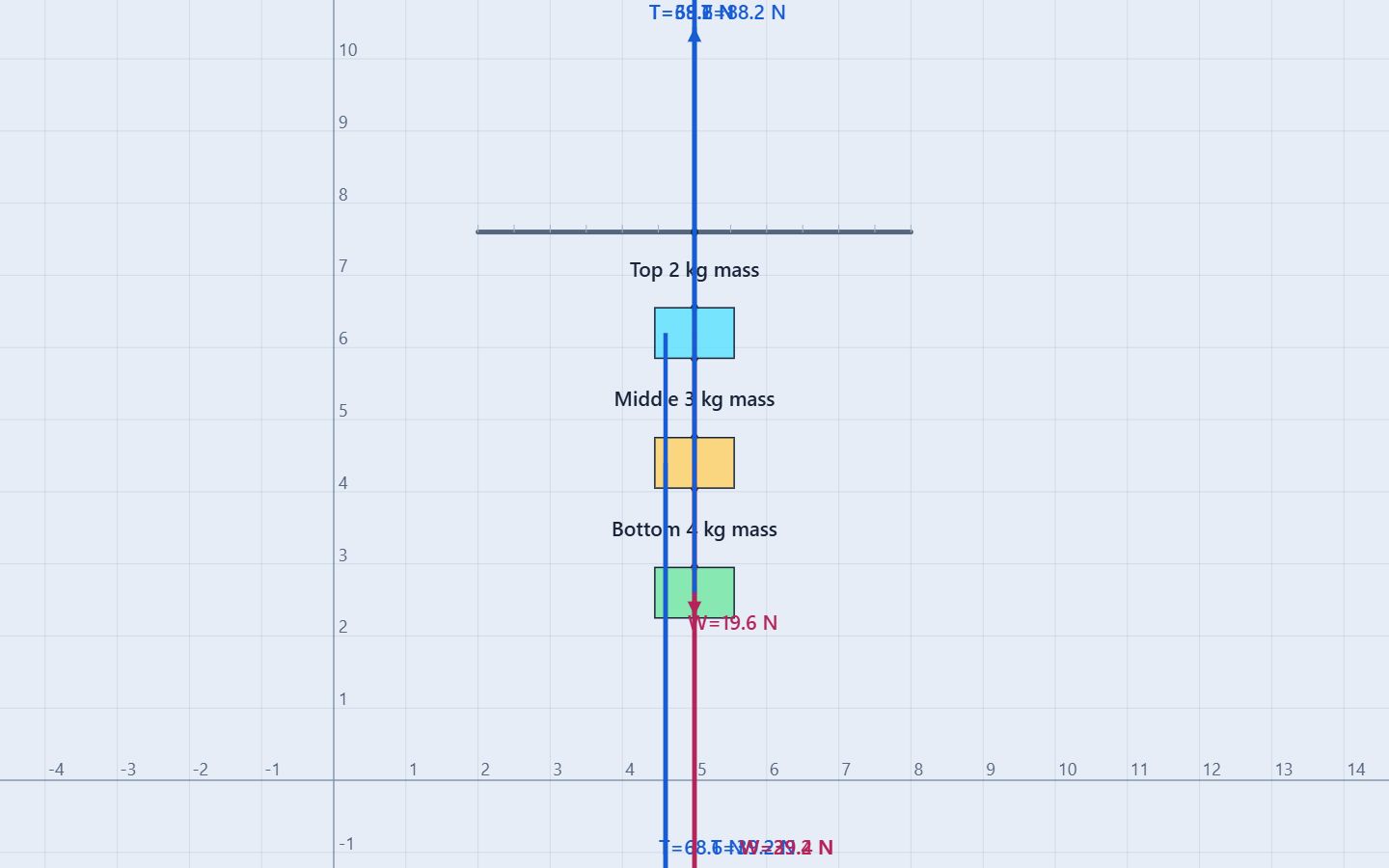
- Choose the system boundary. For three hanging masses of 2 kg, 3 kg, and 4 kg at rest, internal rope forces cancel when all three objects are treated as one system. The ceiling rope is the external support.
- Inspect each object before combining them. The bottom object has T3 = 39.2 N, the middle object follows T2 − T3 − m2g = 0, and the complete 9 kg system has ceiling tension T1 = 88.2 N.
| ay (m/s2) | Weight mg (N) | Normal force FN (N) | Apparent weight |
|---|---|---|---|
| −9.8 | 39.2 | 0.0 | Weightless |
| −4.0 | 39.2 | 23.2 | Lighter |
| 0.0 | 39.2 | 39.2 | Usual |
| +2.2 | 39.2 | 48.0 | Heavier |
| +4.0 | 39.2 | 55.2 | Heavier |
Motion and acceleration
Going down can make a rider feel heavier
| Motion | Acceleration | Scale reading |
|---|---|---|
| Up, speeding up | Up | Greater than mg |
| Up, slowing down | Down | Less than mg |
| Down, speeding up | Down | Less than mg |
| Down, slowing down | Up | Greater than mg |
| Constant velocity | Zero | Equal to mg |
An elevator moving down while slowing has upward acceleration, so its normal force is greater than weight. An elevator moving up while slowing has downward acceleration, so its normal force is smaller. The signs in FN = m(g + ay) make both cases explicit.
Worked examples
Use the rider equation before reading the scale
For the prepared upward-acceleration trial, m = 4.0 kg and ay = +4.0 m/s2:
FN = m(g + ay) = (4.0 kg)(9.8 + 4.0) = 55.2 N
For the same rider moving upward but slowing with ay = −4.0 m/s2:
FN = (4.0 kg)(9.8 − 4.0) = 23.2 N
For free fall:
FN − mg = m(−g); FN = 0 N
For a 60 kg person accelerating downward at 2.0 m/s2, the scale force is 60(9.8 − 2.0) = 468 N. A scale calibrated in kilograms would display about 47.8 kg, even though the person’s mass remains 60 kg.
Objects and systems
Choose the boundary before counting forces
For one rider, the floor’s normal force and Earth’s gravitational force are external. For a three-mass hanging system, the tensions between the masses are internal: when the object equations are added, those equal-and-opposite internal forces cancel. The ceiling rope crosses the system boundary and remains external.
| Chosen system | External vertical forces | Useful equation at rest |
|---|---|---|
| 4 kg rider | FN upward, mg downward | FN − mg = 0 |
| Bottom 4 kg mass | T3 upward, m3g downward | T3 − m3g = 0 |
| Middle 3 kg mass | T2 upward, T3 and m2g downward | T2 − T3 − m2g = 0 |
| All three masses | T1 upward, total weight downward | T1 − (9 kg)g = 0 |
Internal forces do not disappear from the individual object diagrams. They disappear from the complete system equation because they occur in equal-and-opposite pairs inside the chosen boundary.
Common misconceptions
Check the reasoning
Does moving upward automatically make a rider feel heavier?
No. Upward motion can be constant velocity or can be slowing. Apparent weight follows acceleration, not velocity.
Does a scale measure gravitational weight?
No. A scale measures the normal contact force it exerts on the rider. That force equals mg only when the rider’s vertical acceleration is zero.
Does weightlessness mean gravity disappeared?
No. In ideal free fall, gravity remains present while the rider and floor lose contact, making FN = 0.
Are normal force and weight a third-law pair?
No. Both forces act on the rider. The rider’s downward push on the floor is the reaction to the floor’s upward push on the rider.
Can the floor pull the rider downward?
A normal contact force from a floor pushes, rather than pulls. If the required shared acceleration would make FN negative, the rider has lost contact and the rider–floor model no longer applies.
Why combine several masses into one system?
Choosing the complete system removes internal tension pairs from the external-force equation and leaves only the ceiling tension and total weight.
For teachers
Make the sign of acceleration visible
Start with the 4 kg ordinary-reading trial and have students predict the scale before running it. Then compare +4.0, 0, −4.0, and −9.8 m/s2 while keeping the rider mass fixed. Require students to record weight, normal force, acceleration, and velocity separately.
Ask students to explain the two slowing cases in words before using equations. Then change the rider mass at fixed acceleration to show that both mg and FN scale with mass. Finish with the three-mass system so students practice choosing an object boundary and identifying internal forces.
Continue with Newton’s Second Law for the general net-force model, Free-Body Diagrams for force boundaries, and the Elevator Forces experiment for the complete simulation workflow.